
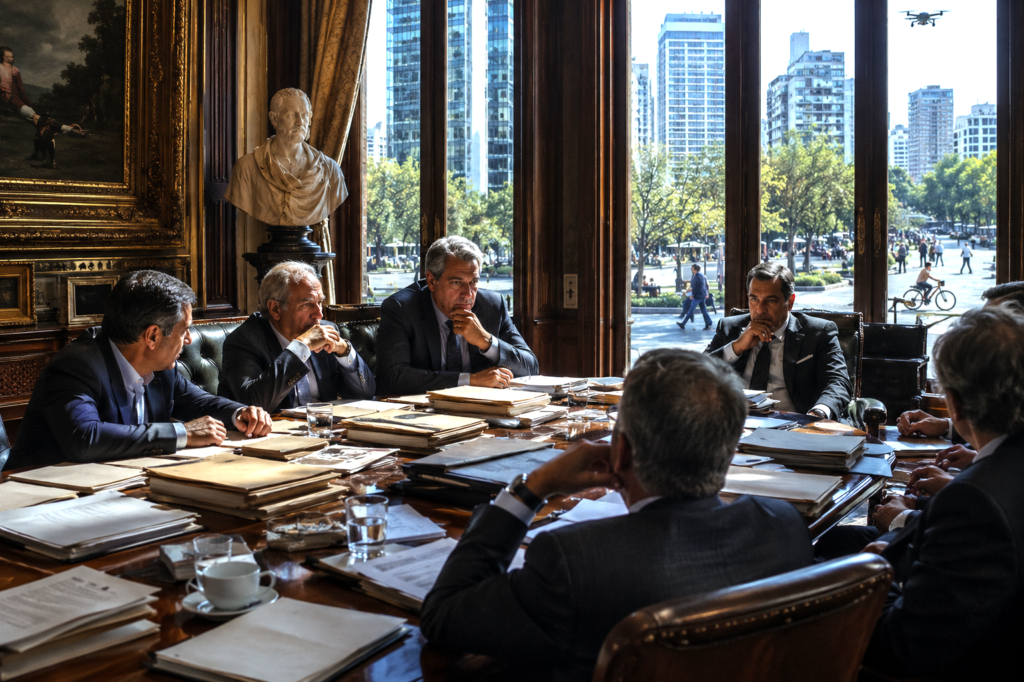
When government and opposition compete to manage a State that no longer understands the age.
The Empty Offer of Power: When the State Suffocates the Alternative
The true drama of a democracy caught between governmental inefficiency and opposition mediocrity does not lie in the lack of “good men,” but in the very nature of today’s political power.
When the State centralizes decisions, absorbs citizens’ wealth and seeks to regulate every aspect of social and economic life, politics ceases to be a service and becomes a prize.
The Degradation of Political Competition
In the market, free competition and consumer sovereignty force companies to improve quality and lower costs in order to survive. In monopolistic politics, the opposite occurs.
If the current government performs disastrously, the opposition does not need to make the effort to present a rigorous, technical or morally superior program; it merely has to sit and wait for the natural erosion of its rival.
A downward leveling then takes place.
The electoral offer becomes cartelized because the threshold of demand has disappeared: competition is no longer for excellence, but for the monopoly of discontent.
The Citizen as Hostage of Bureaucratic Elites
When the analysis of reality shows us that no side offers a reasonable way out, the deep gap between the productive civil society and the political corporation that administers it becomes evident.
Political parties, turned into closed bureaucracies, lose their representative function and begin to defend only their own institutional survival.
For the individual who values freedom, democracy risks becoming a merely formal ritual in which one only chooses which group of bureaucrats will manage the fiscal and regulatory machinery that suffocates him.
The Trap of Messianism and the Erosion of Institutional Order
The most imminent danger of this representational void is social exhaustion.
When inattention to real problems becomes symmetrical, citizens tend toward apathy or, worse still, toward the search for magical solutions outside the institutional order.
Disenchantment with traditional options is often the ideal breeding ground for providential leaders who promise to bypass the rules of the game, threatening individual liberties under the promise of a new order.
The Solution Is Not to Change Men, but to Limit Power
The conclusion before this panorama should not be contempt for democracy as a method of peaceful coexistence, but the urgent need to redefine its limits.
The fundamental mistake consists in believing that the solution will come from renewing the faces in power.
If the State machinery remains omnipotent, it will continue to attract those who seek control and repel free and creative spirits.
The true reform is not to choose rulers better, but to dismantle the privileges of the State apparatus, decentralize decisions and return to the citizen agency, responsibility and control over his own destiny.
Freedom is defended by limiting the power of governments, especially when the alternative visible on the horizon lacks virtues.
To complete this picture, it is imperative to add the most disconcerting nuance of the current reality: the absolute blindness of the political class before the change of age that is already taking place.
While public debate remains bogged down in the old quarrels of the twentieth century —arguing about more or less spending, or measuring success by obsolete ministerial structures— the civil world is moving toward a radical transformation that politics does not even begin to understand.
We are witnessing what could well be defined as an “Agentic Revolution” and one of technological decentralization.
Artificial Intelligence tools, decentralized management systems such as blockchain, and the individual’s ability to audit, produce and connect globally in a direct way are reconfiguring the very notion of sovereignty and social organization.
The distance between party debate and this new frontier is abyssal for three fundamental reasons:
Conceptual anachronism: Politicians —both in government and in opposition— continue to think in terms of centralized control and heavy bureaucracies.
They do not realize that the real challenge is no longer how to administer the elephantine State, but how that State will survive or reconfigure itself when citizens discover that technology allows them to audit public spending in real time, decentralize trust and dispense with inefficient intermediaries.
The defense of the status quo: For the political corporation, accepting that we are facing a paradigm shift means recognizing its own obsolescence.
They prefer to keep the discussion in the mud of reciprocal mediocrity rather than open the door to institutional reforms that would return real agency to individuals through technological transparency and freedom of choice.
The ethical and educational void: Instead of preparing new generations through the Liberal Arts and critical thinking to maintain human control and ethics over technology, politics uses education as ideological spoils.
Slogans from the past are debated while functional illiteracy regarding the future that is already here is ignored.
Ultimately, the mediocrity of today’s electoral offer is the reflection of a system that is dying without knowing it.
The drama is not only that the government is dreadful and the opposition terrible; the true drama is that both are playing cards on the deck of the Titanic, arguing over control of the helm, while the more awakened citizens are already designing the technological lifeboats of tomorrow.
The degradation of political competition.
The citizen facing the overgrown State.
The technological revolution politics does not understand.
Continue reading in Global Order and Geopolitics.
Apoyá la continuidad de Perspectiva Liberal
Perspectiva Liberal es un espacio editorial independiente. Si valorás este trabajo y querés colaborar con su continuidad, podés hacerlo mediante un aporte voluntario a nuestra cuenta Prex.
Cuenta Prex: 13440