
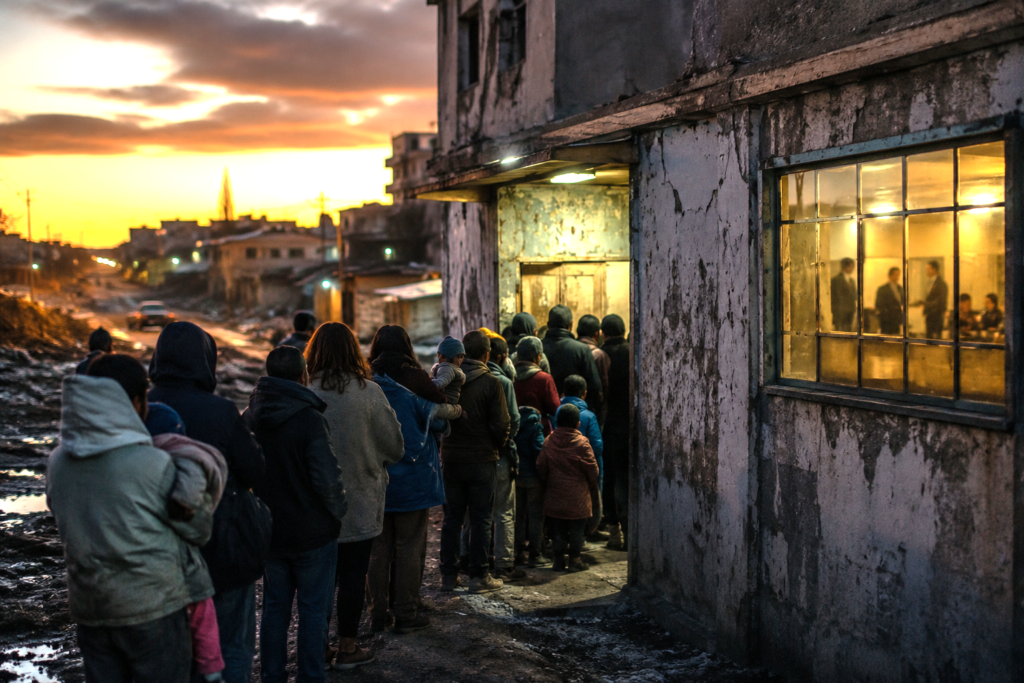
A harsh reflection on poverty, clientelism and the way immediate survival weakens republican judgment.
The Moral Illusion of the Empty Stomach: Corruption as a Survival Strategy
By Dr. Nelson Jorge Mosco Castellano
The contemporary debate on political corruption often suffers from a prim and timid romanticism.
It is fought from podiums with well-intentioned speeches, condemned in editorials with an almost schoolbook republican indignation, and it is assumed, with astonishing naivety, that moral rectitude is a universal absolute, equally accessible to the prosperous citizen and to the individual cornered by poverty.
There is no more severe diagnostic error.
The threshold of sensitivity toward public crime is not governed by civic education manuals; it is calibrated, relentlessly, in the citizen’s stomach.
When basic needs become a daily and unmet urgency, the mental horizon of peoples shrinks until it is reduced to the next twenty-four hours. The long term disappears.
Consequently, that sophisticated abstraction we call “institutional quality” also disappears. What real value can separation of powers or budgetary transparency have for someone who is not certain of being able to feed his children by nightfall? None.
And to pretend otherwise is not only an excess of idealism; it is analytical cruelty.
For the marginalized, the networks of clientelism and state venality do not represent an ethical breakdown, but an informal social insurance system, perhaps the only one that has proven effective.
The already folkloric River Plate saying “He steals, but he gets things done” or, worse, “he steals, but he shares,” is not a sign of ancestral cynicism or moral surrender; it is a calculation of overwhelming economic rationality.
It expresses the resignation of someone who knows that the system is intrinsically predatory, but prefers the wrongdoer who spills a portion of the spoils over the desert of his vulnerability to the honest bureaucrat whose inoperative integrity does not alter his destiny of scarcity in the slightest.
Here lies the true drama of underdevelopment.
Indigence does not only impoverish the body; it confiscates critical judgment.
By depriving citizens of a solid intellectual formation, that classical matrix of logical thought which makes it possible to dismantle the deception of populist rhetoric, demagogic oligarchies build a captive clientele.
The asymmetry of information becomes total: the macro-corruption that destroys the country’s future remains invisible, hidden behind the micro-handout that solves the immediate present.
Political power thus becomes the discretionary administrator of another person’s survival.
One does not escape this bond of dependence through well-meaning sermons or through harsher laws that criminals will always know how to evade, in direct proportion to the level of political power they have reached.
The threshold of tolerance toward corruption will rise only when the individual ceases to depend on political favor in order to exercise his condition as a human being.
As long as subsistence is a concession from the ruler and not the result of clear rules, of truly free markets in terms of basic purchasing power, and of respected property, republican morality will remain an unattainable luxury for those who live exposed to the elements, begging alongside their offspring.
For honesty to become a consecrated civil value, and for its violation to be criminally punished, it must first cease to be an obstacle to life.
This is what tyrants, mafiosi and, lately, the prostitution of republican values have abused since the depths of time.
Corruption and survival.
Clientelism and dependence.
Poverty and moral judgment.
Continue reading in Global Order and Geopolitics
Apoyá la continuidad de Perspectiva Liberal
Perspectiva Liberal es un espacio editorial independiente. Si valorás este trabajo y querés colaborar con su continuidad, podés hacerlo mediante un aporte voluntario a nuestra cuenta Prex.
Cuenta Prex: 13440