From the port to education, a critique of corporate power, state inaction, and their costs for investment, work, and Uruguay’s development
THE ARCHIPELAGO OF EXTORTION
When the State Capitulates and Corporatism Paralyzes the Republic
By Dr. Nelson Jorge Mosco Castellano
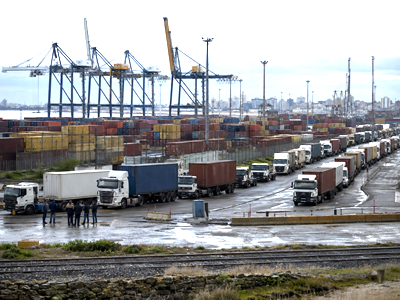
The scene at the Port of Montevideo is neither an isolated anomaly nor an accident of port bureaucracy; it is merely the visible tip of an enormous iceberg.
It constitutes the most conspicuous link in a chain of shutdowns and constraints that cuts across the Uruguayan economy.
Throughout the country, we are witnessing a phenomenon of deliberate inaction: a government that allows conflicts to escalate without intervening, yielding the ideological space necessary for the Communist Party of Uruguay (PCU) and its union branches to halt, directly or indirectly, private activity, investment, and national development.
Twenty-three lone communists paralyze the Port, collude with foreign ports, devastating the image of our main port terminal, and bring ships and cargo to a standstill at will, even determining a war of their own against countries to which we export.
From fuel to stone: Monopolies and strategic paralysis
The map of this strategy of asphyxiation shows how key sectors of infrastructure and production are strangled, and it reflects a clear ideological intent:
The port, multimillion-dollar losses, and the labor aristocracy: In the recent port conflict alone, industrial action and arbitrary shutdowns have so far translated into losses exceeding 15 million dollars.
A monumental loss that is not absorbed by union leaders, but directly strikes exporters and destroys value chains along with the Republic’s image of reliability.
The paradox of this coercion is that its protagonists—far from being vulnerable sectors—constitute a true “labor aristocracy” that, protected by privileges extracted from employers who invest in critical and vulnerable areas, enjoys wages far above the national average, using those same privileged incomes to finance the paralysis that punishes the rest of the country’s workers.
Fuel and the cost of doing business in the country: The production and distribution of fuels, as well as operations linked to ANCAP, have historically been hostage to a union logic that imposes onerous conditions, increasing internal logistics costs and reducing the competitiveness of the entire productive chain.
The latent threat of shortages or operational obstacles functions as an invisible tax on transportation and industry, with the passivity of a State that prefers the peace of corporate graveyards to guaranteeing the freedom to work.
Portland cement and subsidized inefficiency: The conflict surrounding the state-owned cement industry, which has perpetually generated multimillion-dollar losses, and its competition with the profitable private sector is another emblematic example: 800 million dollars thrown away over the past twenty years, 150 employees who bring the entire country to a halt, preventing any restructuring or possibility of securing a private investor.
Instead of restoring public finances and opening the market to efficiency, priority is given to maintaining union fiefdoms that consume budgetary resources while preventing any logical restructuring, punishing taxpayers, regardless of their economic level, in order to sustain unsustainable privileges.
The internal war within SUNCA: Tensions and confrontations between SUNCA’s central leadership and its local branches in the interior—such as the case of Maldonado—starkly expose the internal workings of a hegemonic apparatus.
When the union struggle spills over, the debate is no longer about wage platforms, but about privileges that add to costs, who controls the territorial monopoly of coercion, and compulsory membership, leaving the construction industry and private investment caught in a crossfire in which legal authority is conspicuous by its absence.
Education as an ideological trench: In the realm of education and culture, the picture is identical.
Corporate resistance to any attempt at profound educational transformation perpetuates a model that condemns entire generations of young people to exclusion.
By abandoning its leadership of education in the face of union pressure, the State renounces its essential duty, turning classrooms into ideological trenches where indoctrination is privileged over academic excellence and freedom of choice. And technological progress is ignored because it is “imperialist.”
Inaction as complicity
What is truly alarming about this archipelago of conflicts is not the arrogance of the unions—which act according to their political nature—but the systematic abdication of political power.
Barely 18% of the economically active population defines the national destiny in areas that are crucial to collective growth and the eradication of poverty.
When a government chooses to look the other way, tolerating direct action and operational sabotage until they become commonplace, it is indirectly acting as an enabler of PCU hegemony.
The dangerous fallacy takes hold that governing means negotiating the law with those who own the monopoly of corporate force.
Control of the real economy is surrendered in exchange for a precarious truce, transferring the astronomical cost of stagnation onto the shoulders of the ordinary citizen, the small business owner, the worker who does not belong to the apparatus, the unemployed, and, obviously, the non-unionized informal worker.
Rescuing the future
Uruguay is heading down a dangerous slope if it persists in complacency toward this system of institutionalized extortion.
Private activity—the only force capable of generating genuine wealth, sustainable employment opportunities, and foreign currency—cannot continue competing with one hand tied behind its back by the dead weight of union privileges and state complicity.
Breaking this cycle requires republican courage: enforcing the Constitution and the law, dismantling monopolies of coercion, guaranteeing freedom to work for those who want to produce, and remembering that a government that abdicates its authority in order to hand the helm to corporations does nothing more than administer the decline of the homeland.
Union corporatism
State inaction
Freedom to work
Continue reading in Global Order and Geopolitics
Apoyá la continuidad de Perspectiva Liberal
Perspectiva Liberal es un espacio editorial independiente. Si valorás este trabajo y querés colaborar con su continuidad, podés hacerlo mediante un aporte voluntario a nuestra cuenta Prex.
Cuenta Prex: 13440