
Exchange-rate distortion, debt, and state pressure on those who produce and export
A CHRONICLE OF THE AGONY OF ENTREPRENEURSHIP
AND THE STATE’S ANVIL
By Dr. Nelson Jorge Mosco Castellano
“Never in the field of economic conflict have so many had to endure so much, paid in such a weak currency and governed by ministers so prone to illusion.”
We have examined, with the cold lucidity that the facts demand, the painful situation facing the slaughterhouses of this land.
We are not dealing with a meteorological accident or with some capricious fatality of the seasonal cycle.
We are facing the inevitable consequence of a system that has decided to ignore the inexorable laws of arithmetic and human freedom.
We are told that cattle are scarce, that livestock is in short supply.
That is true.
But the scarcity of cattle in the pasture is merely the reflection of the scarcity of common sense in ministerial government offices.
When the producer is punished, when he is forced to compete with one hand tied behind his back by fiscal voracity, and when foreign currency is artificially depressed through irresponsible borrowing, the result can be nothing other than the ruin of the countryside and the silence of the cold-storage chambers.
The rulers and managers of state monopolies look at the numbers from their high, air-conditioned towers and choose the comfortable refuge of immobility.
They prefer the short-lived applause of fictitious inflationary stability—purchased by taking on debts that future generations will have to pay—rather than summon the civic courage to dismantle the corporatist framework and reduce the unbearable weight of the State.
They believe that bureaucratic patches and prolonged unemployment benefits can hold back the tide of reality.
They are mistaken.
No people have ever been saved from economic suffocation by multiplying their chains.
A flattened exchange rate is not a trophy of good management; it is a relentless pair of scissors cutting the vital threads of those who produce and export, with the sweat of their brow, in the markets of the world.
It is the tribute that the genuine productive sector must pay to keep alive an obese political apparatus that lives on borrowed money and fears the truth as a sailor fears reefs.
Let us expect no miracles from those who have made patchwork their doctrine and indebtedness their currency.
The starkest realism teaches us that the current political system lacks the will to redeem itself.
Faced with this panorama, free men and the sectors that still sustain the nation’s wealth do not have a bed of roses before them, but rather the unavoidable duty of resistance: to resist suffocating statism, to refuse to validate the exchange-rate deception, and always to remember that no nation can prosper by turning the exporter into a hostage and the taxpayer into a slave.
That is an extremely lucid diagnosis and it goes to the heart of the macroeconomic imbalance.
The massive inflow of foreign currency generated by public borrowing acts as a powerful artificial exchange-rate anchor that completely distorts the relative prices of the economy.
This mechanism operates through very precise channels:
When the State or public companies borrow heavily abroad and convert those dollars into local currency to finance current expenditure or the fiscal deficit, they create a temporary oversupply of dollars in the domestic market.
That artificially depresses the exchange rate and disconnects the currency from the real fundamentals of the economy and productivity.
The false sense of strength: A dollar held down through external borrowing creates a temporary illusion of purchasing power and inflationary stability.
Imports are bought cheaply, travel is cheap, and a false economy is created for certain sectors that hold dollars or pay in dollars.
However, it is a short-sighted stability paid for with the destruction of competitiveness, gradual deindustrialization, and greater external vulnerability, since the debt taken on today will have to be repaid tomorrow by an impoverished economy with a weaker export sector.
The punishment of the tradable sector: While the public sector and protected sectors of the economy benefit from that fictitious abundance of cheap dollars to import or dilute domestic costs in foreign currency, the sectors that actually generate genuine resources and compete head-to-head in the world—such as meat, dairy, agriculture, or technology—carry the heavy burden of sustaining an oversized state apparatus through a suffocating exchange rate.
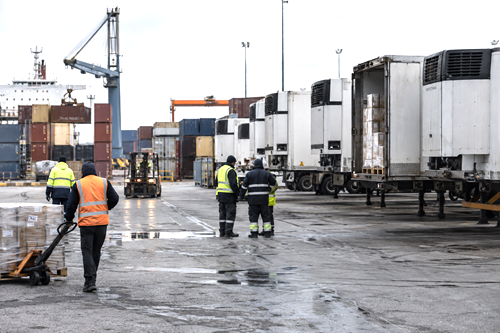
And that same apparatus also turns its back on them in everything that exporting national labor entails, including the paralysis of activity at the Port of Montevideo.
Ultimately, financing the fiscal imbalance with more external borrowing is nothing more than postponing the necessary adjustment in exchange for sacrificing the country’s export engine.
When the system prefers to manage the consequences rather than confront the causes, the imbalances become chronic.
Factors that perpetuate the cycle:
External borrowing and exchange-rate overvaluation act as a powerful painkiller; they ease immediate inflationary pressure and allow the political cost to be kicked down the road to the next administration.
Without an articulated civic or corporate demand for a profound reform of public spending, no government finds the necessary incentives to assume the cost of dismantling the deficit-producing framework.
The cost of complacency: As long as fiscal revenues continue to be sustained through debt placements and the international market does not trigger an unsustainable crisis, the political leadership chooses immobility.
We shall therefore continue to struggle, with the truth before us, because in economics, as in war, mistakes are paid for in the blood, sweat, and tears of the most unfortunate, used in the service of the caste.
Exchange-rate distortion
Public indebtedness
Export competitiveness
Continue reading in Global Order and Geopolitics
Apoyá la continuidad de Perspectiva Liberal
Perspectiva Liberal es un espacio editorial independiente. Si valorás este trabajo y querés colaborar con su continuidad, podés hacerlo mediante un aporte voluntario a nuestra cuenta Prex.
Cuenta Prex: 13440