
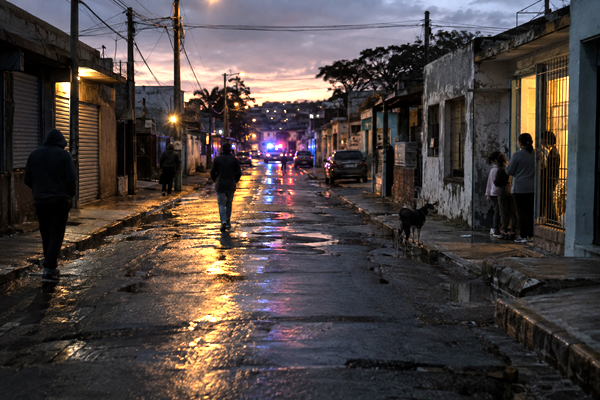
Orsi, Negro, and a critique of the political response to violence and drug trafficking in Uruguay
Find those responsible: Orsi and Negro
By Dr. Nelson Jorge Mosco Castellano
Talking about security in today’s Uruguay is like trying to find logical meaning in a decree of state intervention: an absolute waste of time. Or worse, analyzing budget priorities while expecting rational answers.
We find ourselves on the verge of a social disintegration so subtle and profound that the term “coexistence” is beginning to sound like a cynical euphemism; what we have before us is, quite simply, a new Internal State of War.
The entrails of this institutional tragedy are laid bare when one examines the cases that overflow the judicial trench: a gangrenous social fabric where human life is settled for 500 pesos, two “doses” of pasta base, or an insignificant balance of drug debt.
Aberrant cases in which a hitman executes a stranger for coins, or in which weapons of war are seized —such as raids involving dozens of shell casings or even grenades in the hands of ordinary citizens— reveal that classical rationality has evaporated.
Violence has become a ritual of belonging, a “prison culture” transferred without stops from behind prison walls to neighborhood street corners, where children grow up normalizing prison visits as an everyday family milestone and young people display homicide as a macabre badge of pride.
But what is truly scandalous is not only the operational collapse, but the cynical hypocrisy of a political class that has enshrined the most perverse concept of the “liberated zone,” or, “we lost to the narcos.”
There, in neighborhoods punished by poverty, the rhetoric of “social justice” vanishes in the face of everyday gunfire.
The poor, those very people whom official speeches claim to defend with barricade-like fervor, are the only ones who endure the real risk of death, systematic extortion aimed at forcing them from their homes, and the law of the gangs: join us or I kill you.
While working-class neighborhoods are turned into narco concentration camps where families are left at the mercy of terror, the most abject form of indifference is cultivated from government offices.
In the midst of this debacle, where social fragmentation gives us the worst image of insecurity, President Yamandú Orsi and Minister Carlos Negro seem to have entered a regime of disappearance with full pay, absent from any trace or sign of management.
The warning from Homicide Prosecutor Mirta Morales lays bare that unfathomable chasm where institutions no longer reach, trapped between bureaucratic neglect and operational impotence.
But the Dantesque picture is completed by the most outrageous component of all: the absolute absence of those politically responsible for steering the ship.
While social deterioration produces these aberrant crimes and the prosecutorial system warns about the edges of collapse, President Yamandú Orsi and Minister Carlos Negro seem to inhabit another dimension.
The Republic is crumbling beneath us, gangrened by moral misery and street-level drug trafficking, while the Executive’s senior leadership opts for invisibility and the silence of the office.
How far do they intend to stretch the rope of this institutional impunity?
To delve deeper into the analysis of the impact of extreme violence and the institutional testimony of the prosecutor’s office in the face of this reality, the interview in Yunta with Mirta Morales can be reviewed.
Complicit through omission in the suffering of others, the President of the Republic and his Minister of the Interior enjoy the comfort of their offices and their security details, while the real country bleeds out block by block.
The Republic is dying between empty offices and speeches for the occasion, while the authorities are conspicuous by their absence.
An urgent search party is urgently needed for those who govern with their backs turned to the people’s pain. If anyone runs into them, tell them that the country is collapsing around them: find Orsi and Negro, and tell them that we are living through an unbearable reality of homicides and civic decay.
The final abyss: What is truly dramatic, what condemns the Republic to a perpetual sentence with no return, is the darkest prophecy from the prosecutor’s office: the children who today normalize horror, who grow up visiting relatives behind bars as an everyday errand and who inherit prison culture, are the parents of tomorrow’s Uruguayans.
If the State abandons the present and allows this accumulation of degradation to reproduce itself indefinitely, intact from generation to generation, the future will not simply be worse: it will be the definitive consummation of our moral and physical extinction as a society.
Violence and drug trafficking
Political responsibility
Social fragmentation
Continue reading in Global Order and Geopolitics
Apoyá la continuidad de Perspectiva Liberal
Perspectiva Liberal es un espacio editorial independiente. Si valorás este trabajo y querés colaborar con su continuidad, podés hacerlo mediante un aporte voluntario a nuestra cuenta Prex.
Cuenta Prex: 13440