
From Open Ruin to Borrowed Guilt
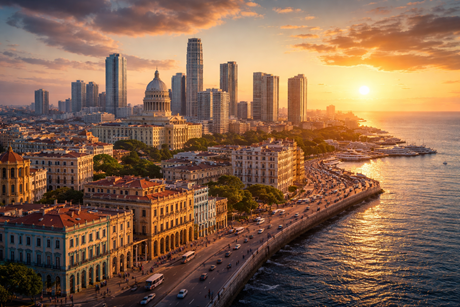
El Impacto en Cuba: “La Singapur del Caribe”
EnWhat would have happened to Cuba and Latin America if Fidel Castro, instead of aligning with the Soviet Union, had purged corruption and joined the free nations of the world?
How different would the destiny of the Americas have been without the violent ideological fracture Castro helped spread across the continent?
To truly grasp the cost of Castro’s Cuba to the American hemisphere, one must engage in counterfactual history. To imagine an alternative path of regional development and integration into the free world. To consider how many lives might have been spared, and how many people trapped in opposing military processes could have lived ordinary lives.
This remains one of the great unanswered questions of modern Latin American history.
Had Castro honored his initial promise to restore the 1940 Constitution, cleanse institutions, and maintain a pragmatic alliance with the United States, today’s geopolitical landscape would be unrecognizable.
This essay invites a disciplined act of imagination. To observe the past as correspondents from a history that never occurred. To envision what Cuba and the continent might have become after Batista’s fall, without resorting to fabricated epics that replaced hopes of freedom and prosperity with tyranny, scarcity, and exile.
Worse still, that ideological pandemic endures. It continues to distort the rhythm of Latin America, a weary continent unable to transform extraordinary wealth into dignified living conditions. Under the same narrative that once distorted Marxism, corrupt and incompetent governments persist, using ideology as a pretext for plunder.
Cuba’s Impact. The Singapore of the Caribbean
In 1959, Cuba was already among the region’s most advanced societies in social indicators, despite severe inequality and political corruption. With legal certainty and a constructive relationship with the United States, the island could have become the Caribbean’s financial and logistical hub.
Capital flight after the revolution would not have occurred. Investment would have modernized infrastructure and industry. Rather than freezing in time, Cuba would have competed directly with Miami and Las Vegas, likely surpassing them in cultural influence and commercial flow.
A liberal reformist Castro could have established a multiparty system similar to Uruguay or Costa Rica, avoiding decades of one-party rule.
Relations with the United States. A Strategic Alliance
A genuine alignment with Washington would have reshaped the Cold War. The Cuban Missile Crisis would never have occurred. Soviet military presence in the Western Hemisphere would have been null.
A prosperous allied Cuba would have built a political lobby in the U.S. Congress comparable to Israel’s, shaping American policy toward Latin America.
The Domino Effect in Latin America
The Cuban Revolution served as the ideological catalyst for armed violence across the continent. Without it, history would have followed a different course.
Groups such as the FARC, FMLN, Tupamaros, and Montoneros would have lacked training, refuge, and inspiration. Likewise, many right-wing dictatorships justified their coups as defenses against “another Cuba.” Without that threat, the excuse for military takeovers would have vanished.
Regional integration would have focused on trade, institutions, and democracy, accelerating the creation of strong economic blocs.
Comparative Summary
Cuba’s economy would not have depended on artificial Soviet subsidies. A service, tourism, and finance hub would have emerged.
Latin America would have avoided extreme polarization and guerrilla warfare. Institutional stability could have driven sustained growth, eliminating extreme poverty without militarization.
Geopolitically, Cuba could have stood as a beacon of economic freedom, shielding the continent from authoritarian socialist illusions.
This counterfactual exercise suggests Latin America might have avoided its bloodiest decade. Yet one question remains unresolved. Whether the United States would have tolerated a truly sovereign Cuba or maintained it as a functional client state.
Apoyá la continuidad de Perspectiva Liberal
Perspectiva Liberal es un espacio editorial independiente. Si valorás este trabajo y querés colaborar con su continuidad, podés hacerlo mediante un aporte voluntario a nuestra cuenta Prex.
Cuenta Prex: 13440