
From the Welfare State to the Revolt of Discontent
From the Welfare State to the Revolt of Discontent
By Dr. Nelson Jorge Mosco Castellano
Contemporary Europe is moving through a dead end from which it is impossible to escape with the old recipes.
What was designed in the postwar period as a solid social pact based on shared prosperity and the “Welfare State” has, over the years, mutated into an unsustainable model.
Once again, Europe stumbles over the same stone that led to the worst conflagrations and holocausts of the last century: predatory politicians who put their interest in perpetuating themselves in power above orderly spending and the promotion of economic growth for the general welfare.
Europe once again lives off an idyllic past in which monarchies lived very well at the expense of the people and ended at the guillotine. Now they intend to live off tourism; off the glories of the past that resulted from fleecing those generations.
With the spirit of sacrifice required to overcome a war through productivity and effort now dead, the generations enjoying the fruits of that enormous sacrifice have become weak, useless and vain.
Trapped between an ageing population demanding the right to live well as if by grace received, stagnant productivity, suffocating bureaucracy and a serious migration crisis, European governments have historically opted for the easiest way out: buying social peace on credit.
The result today is evident: short-term populism has failed, and its inevitable consequences — announced and concealed through lies — are knocking at the doors of a fractured society.
Reality has caught up with them; postponing sacrifice only makes the landing much worse.
The mutation: the mirage of “Social Democratic Populism”
During decades, the European political system lived under the premise of creating wealth and then redistributing it.
However, as the global economy changed and organic growth slowed, the political class across the ideological spectrum adopted a short-term drift.
It compromised with the worst of orthodox ideology, which mutated into variants such as environmentalism and uncontrolled immigration, so that immigrants would do the work Europeans increasingly refused to do, under the argument of solidarity with devastated peoples — peoples whom Europeans themselves had, incidentally, once dominated through imperialism.
A high-intensity clientelist system became institutionalized. Lies were layered upon one another as if they were natural facts.
It became normal to finance structural rights through perpetual debt and increasingly punitive taxation on the middle classes and on work.
Massive subsidies and artificial protections — such as those intended to calm tempers in the agricultural sector — became the norm to avoid immediate unrest, while ignoring the fact that the underlying economic model was collapsing.
Bureaucrats associated with politicians were led to believe that a subsidized standard of living was an immutable right, while the final bill was hidden under layers of public spending that sooner or later would have to be paid.
The migration factor: artificial labor and social fracture
To this cocktail of economic imbalances was added one of the most short-term policies of recent decades: the use of massive and unregulated immigration as a demographic patch and a source of cheap labor to artificially sustain low-productivity sectors.
Far from integrating into the productive and civic fabric, this population has ended up confined in broad urban peripheries transformed into ghettos.
With neither the capacity for assimilation nor real economic plans, this sector has become detached from the fundamental values of the host society, while experiencing high demographic reproduction rates compared with the native decline.
The result is the creation of parallel societies in which economic marginality combines with a profound cultural rupture, frequently leading to conflictive territorial occupation, challenges to state authority and episodes of violence that irreversibly erode security, production and national identity.
From the comfort of “well-being for some” to the “Revolt of Discontent for many”
When the seams of the system give way and the tunnel narrows, the social pact breaks.
It is the definitive passage from comfort to visceral exasperation.
Today, in nations suffocated by fiscal pressure such as France, Spain, Italy or Romania, citizens perceive the social contract as a fraud. The same happens at the top of the EU, which ideologically administers a bureaucracy of privileges.
And also in the United Kingdom, which carried out an anomalous Brexit from which it never managed to recover, and which internalized immigrants into power while trying to conceal the upper caste that continues to enjoy privileges.
A formal worker pays Scandinavian-level taxes but receives deteriorated public services, struggles to gain access to housing, watches purchasing power evaporate in the face of inflation and experiences growing insecurity in his own streets.
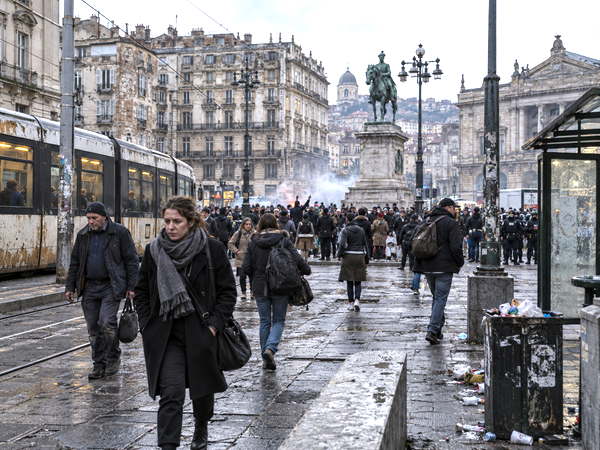
Recurring protests, blockades and generalized discontent are not isolated incidents; they are the natural response of a trapped society that senses that the system demands more sacrifices while resources evaporate in an inefficient state machinery and in the management of an unsustainable migration collapse.
A closed tunnel with no short-term exit
Europe now faces sealed doors that prevent any painless solution:
The door of fiscal reform and spending cuts is blocked by the immediate prospect of furious social upheaval. No sector accepts losing, and the majority demands a way of life that the system will not provide. That confrontation paralyzes the country.
The door of brutal debt and monetary issuance has been squeezed by hard macroeconomic reality, interest rates and community rules, which hypocritically do not allow an open bar without severe punishment from the markets.
The door of miraculous growth and civic cohesion is blocked by an excess of impertinent regulations that hinder local productive development; the loss of competitiveness against hyper-technological powers forces Europe to compete with one hand tied behind its back, while a demographic-cultural fracture threatens internal coexistence.
The inevitable consequences
Short-term populism does not eliminate economic or social problems; it simply postpones them, accumulating pressure in a pot whose lid is definitively sealed.
When politicians prioritize immediate electoral survival over structural reforms of spending, adapting regulations to reality, and adjusting social security benefits to a suffocatingly tight belt, they condemn their nations to a decline rejected by disparate sectors that unite to strike back.
Until a crisis of greater magnitude escalates, or harsh reality forces an absolute breaking point, Europe will continue wrestling with its own contradiction: the agonizing attempt to maintain an exhausted model, degenerated from the twentieth century, with the tools, demographics and geopolitical and internal tensions of the twenty-first century.
Fiscal and demographic exhaustion
Migration and social fracture
Political short-termism
Continue reading in Global Order and Geopolitics
Apoyá la continuidad de Perspectiva Liberal
Perspectiva Liberal es un espacio editorial independiente. Si valorás este trabajo y querés colaborar con su continuidad, podés hacerlo mediante un aporte voluntario a nuestra cuenta Prex.
Cuenta Prex: 13440