
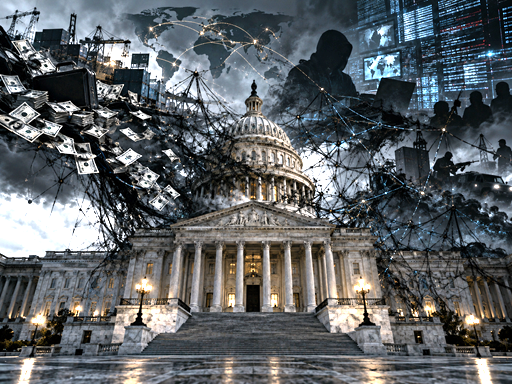
From Republican Collapse to Hybrid Warfare Against the West
THE ANTHROPOPHAGY OF ABSOLUTE TELOS
From Republican Collapse to Hybrid Warfare Against the West
By Dr. Nelson Jorge Mosco Castellano
Liberal democracy and the rule of law are not merely administrative procedures; they are civilizational bulwarks designed to limit the exercise of power and protect individual freedom against the authoritarian impulse.
Yet the most perceptive political theory of the last century has warned of a recurring pathology: when a political project is built upon the claim of an absolute telos — a non-negotiable historical, redemptive, or ideological mission — the institutional limits of the republic are perceived not as safeguards, but as intolerable obstacles.
Under this logic, government ceases to be a temporary mandate subject to law and becomes a pedestal from which uncontestable power is sought, freed from moral restraint and open to the deepest forms of instrumental decay.
The demolition of republican restraints: power without counterweights
To understand how projects with hegemonic ambitions dissolve institutional limits, it is essential to turn to the intellectual diagnosis offered by major thinkers of the twentieth century.
Friedrich Hayek, in The Road to Serfdom, showed that any attempt to centrally plan society and the economy under a single ideological design necessarily requires the concentration of absolute discretionary power.
The checks, balances, and guarantees of the rule of law become obstacles to implementing the plan, making their gradual dismantling an unavoidable operational requirement.
Karl Popper, in The Open Society and Its Enemies, warned that historicist philosophies promising secular salvation or a perfect social order end up justifying any means.
For those who hold an absolute telos, the rules of representative democracy are regarded as “bourgeois fetishes” to be overcome in the name of the supreme end.
Guillermo O’Donnell, in developing the concept of “delegative democracy,” described how the populist or hegemonic ruler assumes that the ballot box has granted him a blank check.
Institutions of oversight — prosecutors, legislatures, and independent judiciaries — come to be viewed as conspiracies by displaced elites, consolidating a vertical form of power in which accountability disappears.
The engineering of clientelism: the state as an electoral cash register
When power is conceived as a moral absolute, the dividing line between public assets and partisan or personal resources evaporates entirely.
The state ceases to be a neutral structure serving citizens and becomes a corporate machinery for purchasing loyalties and distorting sovereignty.
Under this logic, the public treasury is treated as private property. National budgets, social subsidies, public procurement, and state employment are no longer allocated according to merit or distributive justice, but as electoral currency.
Poverty and social vulnerability are not fought in order to eradicate them; they are managed and perpetuated as electoral raw material. Keeping citizens economically dependent becomes the regime’s life insurance.
Elections cease to be an exercise in free deliberation among autonomous citizens and become plebiscitary rituals of economic coercion.
The voter is reduced to the condition of a captive client, threatened with the loss of his only means of support if the verdict at the polls does not favor the sole “savior” of the nation.
In this way, absolute power comes to see itself as perversely legitimized: it uses the resources of the state itself to purchase the complicity of the ballots that supposedly validate it, hollowing democracy out of its republican substance.
Every action, no matter how much it tramples rights, is legitimized, protected, and sheltered, even when it is plainly unlawful.
The gray zone: the shameless alliance with the underworld
When politics is reduced to an existential struggle between absolute good and an absolute enemy, the traditional codes of public morality collapse.
It is here that institutional immorality ceases to be an accidental defect and becomes a method of survival.
Hannah Arendt, in The Origins of Totalitarianism, analyzed the disturbing phenomenon of the alliance between political elites and the underworld.
When a movement seeks to refound the established order outside the law, it finds natural partners in criminal and marginal sectors.
Both share a radical contempt for republican legality. For absolute power, the criminal inspires no shame; he is a highly functional resource, willing to carry out the “dirty work” that democratic forms prohibit.
Charles Tilly, in Coercion, Capital, and European States, by arguing that state formation and organized crime operate according to the same coercive matrix — the collection of protection in exchange for a monopoly on violence — helps explain how a state stripped of republican controls can come to behave structurally like a transnational criminal enterprise.
Edgardo Buscaglia, in his studies on “governance vacuums,” argues that rulers who weaken institutional checks naturally strike bargains with organized crime: the criminal group provides illegal financing and territorial coercion; political power grants systemic impunity.
Cynicism completely displaces shame and gradually numbs citizens, until state corruption becomes normalized.
The geopolitical dimension: crime as a weapon of destabilization against the West
The phenomenon described does not end at the domestic level; today it represents a direct threat of global scope.
The internal decomposition of regimes dominated by an absolute telos — frequently aligned with anti-Western ideological axes and extractive autocracies — is projected outward in the form of hybrid and asymmetric warfare against Western democracies.
When a political elite loses all moral inhibition and colludes internally with drug cartels, illegal-mining mafias, illicit data networks, money-laundering structures, and terrorist organizations, those same illicit structures become instruments of foreign policy.
Large-scale drug trafficking, human trafficking, arms smuggling, and cybercrime are no longer merely sources of illicit enrichment for ruling elites; they are deliberately used as geopolitical weapons to erode the social fabric, corrupt institutions, finance destabilization operations, and undermine the economic and political stability of Western nations. The result is the commercialization of chaos.
A front is thus consolidated in which states failed by authoritarian vocation and transnational criminal networks operate as a single bloc.
For these regimes, striking at the West by weakening its democratic values, poisoning its markets, and degrading its internal security is the logical culmination of their ideological crusade.
0
The prophecy of collapse through civilizational negligence
The warning left by the great thinkers of the twentieth century and contemporary analysts is extremely grave. Western democracies run the mortal risk of underestimating the nature of this phenomenon.
These practices are tolerated through condescension, omission, or the complicity of those who seek to remain in power by concealing their actions.
To believe that the loss of republican limits, the systematic purchase of elections with public funds, and the normalization of criminal collusion in the Global South are mere “political accidents” or internal management problems is an unforgivable historical error.
The absolute telos that scorns the law at home and commodifies popular sovereignty is the same one that fuels hostility and subversion against freedoms throughout the world.
If the West fails to understand that defending its institutional frontiers and relentlessly confronting this machinery of corruption and limitless power are one and the same battle, the advance of this institutionalized barbarism will end up eating away at the foundations of democratic-republican civilization from within and from without.
Unchecked political power
Clientelism and crime
Hybrid warfare against West
Continue reading in Global Order and Geopolitics
Apoyá la continuidad de Perspectiva Liberal
Perspectiva Liberal es un espacio editorial independiente que no cobra por las notas.
Si valorás este trabajo y querés colaborar con su continuidad, podés hacerlo mediante un aporte voluntario a nuestra cuenta Prex 13440.
o por Mercado Pagolink.mercadopago.com.uy/perspectivaliberal