
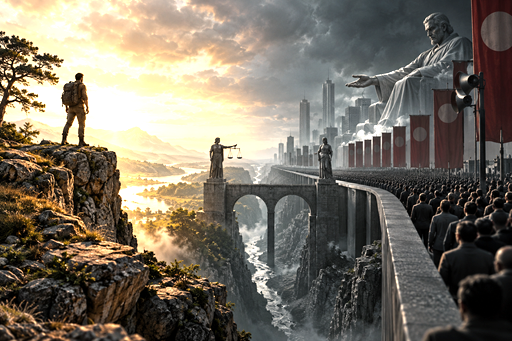
From Montaigne’s innocence to the delirium of the “good revolutionary”
THE GREAT CAROUSEL OF VIOLATED INNOCENCE
From Montaigne’s innocence to the delirium of the “good revolutionary”
By Dr. Nelson Jorge Mosco Castellano
If there is one thing that characterizes our dear and long-suffering species, it is our boundless fondness for complicating our own existence and then, immediately afterward, blaming someone else for the mess.
Over the centuries, intellectuals have refined the art of manufacturing metaphysical alibis to explain why we are such a disaster, their favorite pastime being to invent a lost Eden where everything was peace, harmony and plant life before laws, taxes, Hernandarias and the market ruined it for us.
To understand this monumental act of self-deception — which in Latin America has acquired the overtones of tragic operetta — it is useful to climb aboard a conceptual DeLorean and travel through time: from the sensible skepticism of a gentleman in his tower to the messianic fury of the savior of nations.
Montaigne and the prudence of not promising paradise
Let us imagine, for a moment, the good Michel de Montaigne in the sixteenth century.
While half of Europe was methodically slaughtering itself in the wars of religion over who best interpreted the wrath of God, Montaigne withdrew to his tower to read, reflect and scratch his head skeptically.
When he wrote his famous essay on the cannibals of the New World, good Michel was not founding a guerrilla movement or drafting an insurrectionary manifesto.
He was simply acting as a spoilsport to European pride: observing that the Indigenous peoples of the Americas lived more simply, without the twisted hypocrisies or refined cruelties of the civilization of his day.
But it never occurred to Montaigne, a man of exasperating lucidity, that we should burn the cities, abolish the laws or destroy the institutional order in order to go back to hunting tapirs in a state of nature.
On the contrary, he was profoundly conservative in political matters because he knew that human nature is fragile and crooked.
He held that existing laws, however imperfect, should be respected, because the remedy of trying to rebuild society from scratch was often infinitely bloodier than the disease.
In short, Montaigne looked at the “savage” with anthropological curiosity and a touch of irony, but prudently remained on the shore of common sense.
Rousseau and the original sin of social engineering: the cornerstone of statism
This is where history goes off the rails.
Two centuries later, Jean-Jacques Rousseau takes the poetic intuition of natural man and decides to turn it into a political dogma of titanic proportions.
Rousseau abandons Montaigne’s skeptical prudence and issues the definitive diagnosis: the human being was born pure, free and good, but civilization, private property and society corrupted him from top to bottom.
And since the damage has been done, there is no point in timid reforms. Man must be redeemed by force.
Here lies the cornerstone of modern statism.
Rousseau invents the mystical abstraction of the “General Will” — a kind of secular divinity that is never wrong — and consecrates the most totalitarian postulate of modernity: “the State becomes the father, tutor and every-man-for-himself of the individual citizen.”
It is no longer a matter of protecting individual freedom in the liberal sense — allowing people to make their own agreements and be left in peace — but of subjecting the individual from above to collective communion.
If someone resists being happy according to the parameters of the “General Will,” the State has the sacred duty to “force him to be free,” according to its own particular concept.
Paternalistic and redemptive despotism had thus been baptized with philosophical holy water. All power to the State.
Carlos Rangel and the great Latin American alibi: from the “noble savage” to the “good revolutionary”
A two-hundred-year leap through time and a crash landing in Latin America.
This is where the brilliant Cuban Carlos Rangel enters the scene to explain why our region seems trapped in an endless loop of underdevelopment, populism and victimhood.
Rangel detects that the Latin American mindset eagerly chewed on the Rousseauian poison.
If America had originally been a pure Eden — the American “noble savage” — then successive institutional failures, poverty, inflation and local tyrants could under no circumstances be our own fault.
An external villain had to be found.
Thus the myth metamorphoses: the pure and uncontaminated Indigenous figure gives way to the “good revolutionary,” the romantic and self-sacrificing avenger who comes to redeem us from oppression.
And the culprit for all our woes ceases to be our own inability to build stable institutions and becomes the official scapegoat instead: U.S. imperialism, voracious capitalism and sellout oligarchies.
Under this comforting perspective, Latin Americans absolve themselves of all civic responsibility for building their own destiny.
Why respect the rules of the economic game, accumulate capital, reward merit or demand legal certainty if everything is the fault of the “blockade” and the multinationals?
Revolution becomes a substitute religion, a messianic promise in which violence and radical statism for ideological ends are fully justified because the goal is to purify the land.
The great divide: the “new man,” state corruption and the right to think for oneself
That confrontation — separated by two centuries of ideological distance at each link in this chain — has deposited us squarely in an irreconcilable reality, split into two sides that cannot meet because they begin from entirely opposite anthropological premises.
On one side stand the statists and their machinery of social engineering, direct heirs to Rousseauian messianism and the victimhood denounced by Rangel, who occupy power in order to mold, from the upper reaches of state corruption, the famous “new man.”
If those who wield public power are corrupt or corruptible, that bureaucratic creation which promised to be the moral vanguard of history is today nothing more than an old, weary and unrepentant revolutionary who, clinging to perks, corporate privileges and failed dogmas, feeds on the public purse while impoverishing society in the name of social justice.
On the other side are those of us who simply want to be left alone: individuals who, embracing skeptical prudence and respect for individual human dignity, demand that the State retract its tentacles to their legitimate size, cease the coercive delirium of trying to save our lives, and allow us to think with complete freedom about the voluntary, spontaneous and plural construction of our own lawful life plans, both individually and collectively.
At the end of the day, the historical choice remains exactly the same one Montaigne glimpsed in the face of the fanaticism of his time and that Rangel diagnosed with a scalpel for our Latin American misfortune.
Either we choose the humility of responsible freedom and the rule of law, or we condemn ourselves forever to the pastoral despotism of the saviors of the nation who, promising a paradise of noble savages, end up governing over the ruins of a plundered society.
Human nature and power
Statism and social engineering
Latin American victimhood
Continue reading in \Global Orden and Geopolitics
Apoyá la continuidad de Perspectiva Liberal
Perspectiva Liberal es un espacio editorial independiente. Si valorás este trabajo y querés colaborar con su continuidad, podés hacerlo mediante un aporte voluntario a nuestra cuenta Prex.
Cuenta Prex: 13440