
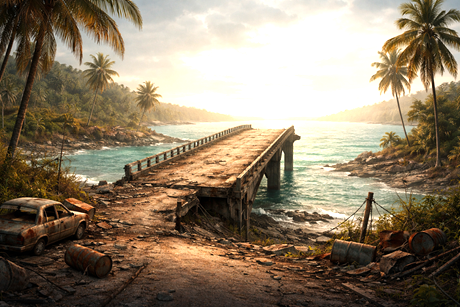
From Open Ruin and Displaced Guilt
There is no better way to assess the real effects of Castro’s Cuba than to project what could have been and never was.
Only through this exercise can the full scale of the Cuban people’s tragedy be measured, along with the continental projection of the Soviet holocaust transplanted onto the island and its devastating effects across the Americas.
The viciousness with which fractures were deliberately created, criminals protected, and corruption nurtured served a single purpose: sustaining Fidel Castro’s ego, even as the fall of the Wall of Shame exposed uniform misery, the horror of extermination camps for dissidents, and the systematic violation of freedom in every form inherent to the human condition.
Let us examine the deep causes of the economic and social stagnation we endure through a uchrony, comparing what is and what remains with what could have been.
Close it and let’s move on.
January 2026: Díaz-Canel Between Confession and Confrontation
As January 2026 unfolds, Miguel Díaz-Canel’s statements have been marked by an outward posture of confrontation and an inward admission of the gravity of the crisis, though without any immediate structural alternatives to the humanitarian calamity.
His most recent remarks can be grouped into three main axes.
The “Mea Culpa” and the Party’s Responsibility
In early January, Díaz-Canel delivered what several analysts described as a “mea culpa.”
He stated that change in Cuba must begin “within the Party” and that its militants must feel responsible for “everything that functions poorly” on the island.
The key phrase of this verbal outburst was: “We must feel responsible for everything that functions poorly in Cuba.”
Context matters.
These words emerged amid the collapse of basic services, with blackouts leaving millions without electricity and fuel shortages paralyzing water distribution.
Tension with the United States and the “State of War” of a Disarmed Figure
After the start of 2026 and in the face of renewed pressure from the Donald Trump administration, including warnings about cutting Venezuelan oil supplies, Díaz-Canel’s discourse became paradoxically more belligerent, as if standing before a firing squad and stepping forward.
In response to Trump’s demand to “reach an agreement,” Díaz-Canel declared on social media that “no one dictates what we do” and that Cuba is prepared to defend itself “to the last drop of blood.”
This should be read as: there is nothing left to eat, and the regime will extract the last drop of blood from the Cuban people.
Declaration of a State of War
Following a military incident in Venezuela that resulted in the death of 32 Cuban combatants, Díaz-Canel’s government formally declared a State of War on January 18, hardening its anti-imperialist rhetoric and calling for the “unity and invincibility” of the people.
In reality, this was a complaint about the failure of its own Cuban custodians, a desperate appeal to a collapsing state, and a hypocritical narrative claiming that a country occupied by its own enforcers somehow achieved independence from the island’s parasitic drain.
The repeated call for “unity” merely confirms that the regime remains trapped in exhausted Castroist rhetoric, incapable of accepting that, if freed, the people would crush their tyrants.
Messages of “Creative Resistance” for 2026
In welcoming the new year, officially labeled the “Year of Fidel’s Centenary,” Díaz-Canel employed terms that provoked indignation among many Cubans given the current precarity.
He spoke of “impossibilities overcome” in 2025 and urged the population to enter 2026 “fighting and more united than ever.”
This should be read as: even though we are defeated, receive 2026 with the hope that the united ruling caste will survive.
He insisted that the people must continue resisting, warning that “no one should expect easy or immediate solutions” due to resource shortages and the blockade.
In other words, he poured fuel, scarce as it is, onto an open wound, issuing the final violated mandate: remain hungry, without electricity or water, but do not allow us to be hunted down like Maduro.
Situation Summary
While official discourse focuses on sovereignty and military mobilization, the reality faced by Cubans, according to reports from this same month, is one of unprecedented shortages of food and medicine, inflation that obliterates wages, and an energy system in ruins.
In the next chapters of this Book II, we will analyze what Cuba and the continent might have become if the so-called revolution had been, instead of an involution, a call for reconciliation, freedom, and the return of exiled Cubans with full rights to their homeland.
Apoyá la continuidad de Perspectiva Liberal
Perspectiva Liberal es un espacio editorial independiente. Si valorás este trabajo y querés colaborar con su continuidad, podés hacerlo mediante un aporte voluntario a nuestra cuenta Prex.
Cuenta Prex: 13440