
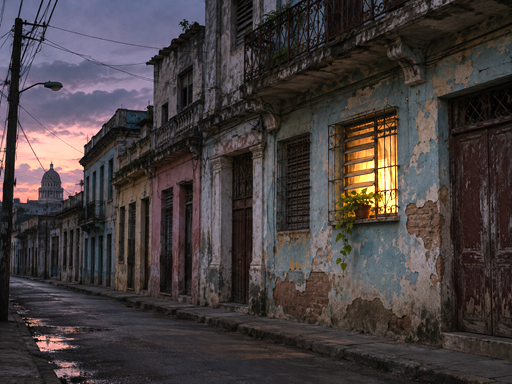
Cuba: legal repression, extreme poverty, and Carlos Liscano’s denunciation of the regime.
The history of totalitarian regimes is often told through the thunder of sweeping emergency decrees and the architecture of their repressive apparatuses.
Yet the true face of an autocracy that perpetuates itself is measured not only by the provisions of its penal codes, but also by the long, silent, deliberate destruction of everyday life.
In Cuba, the Kafkaesque convergence of a legal apparatus designed to annihilate every vestige of individual autonomy—which retains and expands the death penalty—and a humanitarian crisis that, according to the Cuban Observatory for Human Rights, has left 94% of the population in extreme poverty, reveals the contours of a dictatorship that has turned mere survival into a form of martyrdom.
The architecture of coercion: a Penal Code for eternity
While many democracies move toward definitively abolishing capital punishment as incompatible with human dignity, Cuba’s legal system has consolidated and expanded its punitive arsenal.
Raising the number of offenses punishable by death to twenty-four, as the 2022 Penal Code did, is not an act of institutional self-defense but an admission of systemic weakness. When political power must rely for its stability on the threat of execution by firing squad and on ambiguously worded offenses concerning so-called “state security,” it shows that its survival no longer rests on legitimacy or ideological promise, but on sheer coercion.
Independent legal studies have warned of the danger posed by this elasticity of the law. By persecuting dissent, activism, and protest under the euphemism of subversion, the state turns criminal law into a weapon against its own citizens.
Even in periods when executions are not carried out, the death penalty hangs like an institutionalized sword of Damocles: a permanent warning that the price of demanding freedom may be physical or civil annihilation.
Hardship as a method of government
Yet the most perverse aspect of this contemporary dictatorship is that the legal scaffold is merely the visible tip of a pyramid of suffocation.
The real tragedy of daily life unfolds in people’s homes. The Ninth Study on Social Rights in Cuba, released in August 2026 by the Cuban Observatory for Human Rights, estimated that 94% of Cubans live in extreme poverty.
The current crisis has erased the boundary between economic hardship and systematic humiliation.
With wages devastated by inflation and persistent shortages, the population faces food insecurity that forces countless families to skip meals as a matter of routine.
The collapse of food provision is compounded by the collapse of the electricity supply: prolonged blackouts are not merely technical failures of obsolete infrastructure, but the erratic pulse of a system incapable of guaranteeing the most basic necessities.
Recurring darkness, shortages of medicines, deteriorating hospitals, and a crumbling housing stock form a mechanism for wearing down human dignity as relentless as any tribunal of tyranny.
The anonymous martyrdom
In official rhetoric, martyrs are those whom the authorities elevate into founding myths to legitimize their continued hold on power.
But the true martyrs of this seemingly endless dictatorship are not commemorated in the bronze monuments of the official narrative.
They are the elderly who watch the value of their meager allowances evaporate after decades of work; the young, torn between the hopelessness of a future closed off to them and the uprooting of mass exodus; and ordinary citizens who spend hours every day performing impossible arithmetic to obtain bread, fuel, or water.
This martyrdom lacks the fleeting epic grandeur of barricades. Instead, it bears the gray harshness of an ordeal with no expiration date.
Maintaining a system in which the law threatens capital punishment and economic reality condemns people to widespread destitution shows that the regime’s purpose is neither prosperity nor social justice, but the preservation of a ruling caste amid the ruins of a nation.
Understanding this reality requires abandoning ideological euphemisms and confronting the most painful truth: a people held hostage by a machine that confuses sovereignty with captivity and absolute control with eternity.
The ideological past: from revolutionary fervor to disillusionment
Carlos Liscano followed a path familiar to many intellectuals and young people on the Latin American left during the second half of the twentieth century. In his youth, he was an ardent supporter of the Cuban Revolution and an admirer of Che Guevara. He belonged to Uruguay’s National Liberation Movement–Tupamaros and spent more than a decade in prison during Uruguay’s military dictatorship.
His break with dogmatism was not abrupt, but the outcome of a long process of reflection on how the original ideals of emancipation had eventually degenerated into totalitarian structures.
In his 2022 essay Cuba, de eso mejor ni hablar (“Cuba, Better Not Talk About It”) and in subsequent interviews, Liscano challenged the myths surrounding the island’s regime from several angles.
He argued that Cuba’s poverty was not primarily the result of the U.S. embargo, but of a hypercentralized, inefficient model. His assessment was categorical: “Cuba is a very poor country, not because of the blockade, but because it produces nothing.”
Rejecting the official narrative of participatory democracy, he unequivocally denounced the system’s autocratic nature: “In Cuba there are no freedoms of any kind. It is the dictatorship of the Communist Party.” He also pointed to the closed grip of the ruling elite.
He sharply criticized the submissive role that the revolutionary apparatus imposed on culture. What the regime demanded, he maintained, was not a committed intellectual but a revolutionary intellectual obliged to applaud and uncritically justify the political leadership’s directives.
One of his sharpest criticisms was directed at the intelligentsia and the region’s democratic left, whom he accused of maintaining a “shameful silence” out of ideological convenience or fear of breaking with Cold War dogmas, thereby abandoning the Cuban people to their fate.
Someday, the victims of that dictatorship—not their victimizers—will receive the just and deserved tribute they are owed.
Repression and capital punishment
poverty and daily life
Carlos Liscano’s disillusionment
Continue reading in Global Order and Geopolitics

Apoyá la continuidad de Perspectiva Liberal
Perspectiva Liberal es un espacio editorial independiente que no cobra por las notas.
Si valorás este trabajo y querés colaborar con su continuidad, podés hacerlo mediante un aporte voluntario a nuestra cuenta Prex 13440.
o por Mercado Pagolink.mercadopago.com.uy/perspectivaliberal