
An illustrated guide to governing without getting your shoes dirty
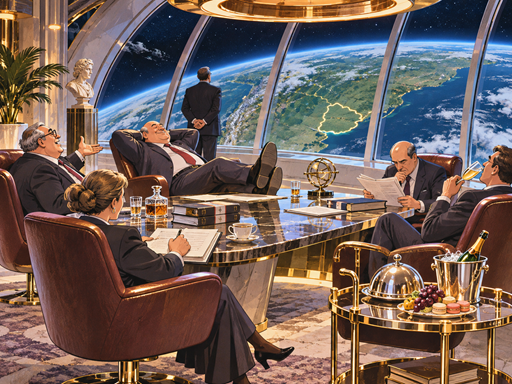
There is a special breed of homegrown astronauts who need no NASA rockets to leave the atmosphere.
All they need is a party membership card, an ergonomic chair upholstered in synthetic leatherette and an air conditioner permanently set to twenty-one degrees Celsius.
From there, perched on a geostationary satellite invisible to ordinary mortals, they observe Earth with the tender condescension of an entomologist watching ants at work. There is one difference: the ants, at least, carry their own food.
For these selfless servants of the nation—who traded “earning their bread by the sweat of their brow” for “living off someone else’s sweat”—economics is an abstract science in which money springs spontaneously from the office walls.
They spend as if tomorrow were an illusion and the national budget were an unlimited credit card issued by an imaginary bank called Inexhaustible Inc.
They alter the lives of those they regard as their “subjects,” while bargaining over their own interests to fleece or subjugate them.
It is a spectacle worthy of anthropological study. Many come from a musty old trade-union culture and buried all memory of hard work the moment they first set foot on the red carpet.
They suffer from amnesia about where they came from and that now apparently dreadful connection to work. Worse still, they seem blissfully unaware that some of their fellow citizens remain trapped in the same deprivation, financing through their taxes the whims of a monarchy with no noble titles but generous allowances for travel and expenses.
Up there, in their private orbit, they imagine themselves members of a superior race, armed to the teeth with desks fit for dukes, from which they issue decrees they never read and few people understand. After all, the consequences never reach them.
They enjoy the services of a retinue of secretaries whose primary duty is to nod with heartfelt devotion at the boss’s bad jokes. There are official cars with chauffeurs, too—ideal for dodging the potholes in the country they themselves mismanage.
For them, the entire universe begins and ends at the frame of their office window. Outside that climate-controlled perimeter, reality is merely an irritating statistical murmur that can be silenced by shutting the double-glazed windows.
Since many are all-knowing—or perceive themselves to be—they regulate other people’s lives as though moving pieces in a game in which they never lose and are never wrong.
The most touching feature of this galactic fauna is its unshakable faith in its own merit. With the innocence of children, its members are convinced that their deeds deserve an automatic promotion.
Not because any sensible person has praised their performance—apart, of course, from the chorus of flatterers and beneficiaries of nepotism who draw their pay religiously from the public purse—but because they consider it a cosmic insult if “all that effort spent living off others” fails to win them a second season.
The funniest part is that, when it comes to legislating or raising a hand in the chamber, far too many do not know what they are voting for, let alone recognize what they ought not to approve because of its consequences for everyone else’s economic well-being.
They pass interminable laws they have not read, sign off on provisions they do not understand and endorse budgets blindly, guided solely by the muse of party discipline or the raised thumb of their parliamentary leader. In doing so, they validate fiscal disasters whose price is invariably paid by the same people at the bottom.
They change nationality rules to include people not born in the country; they bury the Constitution and its sovereign mandates in the graveyard of scoundrels.
They transfer an agency from one branch of government to another as though playing cards. After all, what matters is controlling almost everything from the same side.
Not even in their worst sleepless nights—perhaps brought on by an excess of prawns at an official reception—does the most terrifying idea of all cross their minds: that they are entirely dispensable.
If they vanished tomorrow, the sun would rise just the same, traffic lights would continue changing colour, and the country, relieved of its heavy and costly bureaucratic burden, might even experience an unusual sense of economic and moral relief.
For the real tragedy of this space-age performance is not merely the arrogance, but the setting in which it unfolds.
Uruguay is a country chronically stagnant in its growth, trapped in a cycle of low productivity, crushing costs and an economy pedalling furiously on an exercise bike.
And a stagnant country, by the sheer law of political gravity, lacks the resources to address problems compounded by that very stagnation: structural poverty, educational decline, creaking infrastructure, public insecurity and overstretched health services.
Meanwhile, at the summit of the state, the circus carries on with drums, cymbals and spending blissfully detached from the world below.
We would all like that circus to cost us a little less, at least.
But no: it costs a fortune to maintain the trapeze artists of inefficiency, who collect premium pay for their performances while the audience below juggles to make ends meet, with a bus ticket and a kilo of bread costing more than two dollars.
The ideal world: Operation “Shrink the Clowns” and à la carte austerity
As people grow tired of financing this gilded orbit, they become deeply disinterested in the political pantomime, and common sense calls for measures of scientific rigour.
In that ideal world where the muses of efficiency steer the spaceship of governance, the solutions are as simple as they are revolutionary:
Personal austerity (the real sacrifice): members of this dramatic cast who already possess resources of their own have no need to earn more than a minimum wage.
If they truly are public servants rather than parasites on the public, let them live on the average income of an ordinary Uruguayan.
With this simple measure, professional politicians would automatically become extinct: that endearing species incapable of surviving in the real labour market without a taxpayer footing the bill for its ideological sightseeing trips.
A diet for government structures: every unnecessary bureaucratic expense must be reduced to the bare minimum.
Shrink them: cut their egos, fleets of cars and secretariats down to a size consistent with the modest national reality reflected in the census figures.
Free up those resources for what is genuinely urgent instead of using them to finance international summits about absolutely nothing.
ISO standards for the state’s navel-gazing: demand uncompromising management audits of every government spending unit.
Apply international quality and process-analysis standards, requiring those units to account for their work against minimum benchmarks of public usefulness.
If a bureaucratic procedure does nothing to improve a citizen’s life, abolish it. If a bureaucrat cannot justify their existence beyond cutting ribbons at opening ceremonies, send them back to looking for work, like so many others.
Until that happens, we shall keep watching them from below: tiny bright dots crossing the stratosphere, convinced that they hold up the heavens, when in fact they are merely obsolete satellites consuming far too much energy, preventing others from growing and sending back precious few signs of intelligent life.
Privileges of political elites
Public spending and inefficiency
Accountability in government
Continue reading in Global Order and Geopolitics

Apoyá la continuidad de Perspectiva Liberal
Perspectiva Liberal es un espacio editorial independiente que no cobra por las notas.
Si valorás este trabajo y querés colaborar con su continuidad, podés hacerlo mediante un aporte voluntario a nuestra cuenta Prex 13440.
o por Mercado Pagolink.mercadopago.com.uy/perspectivaliberal