
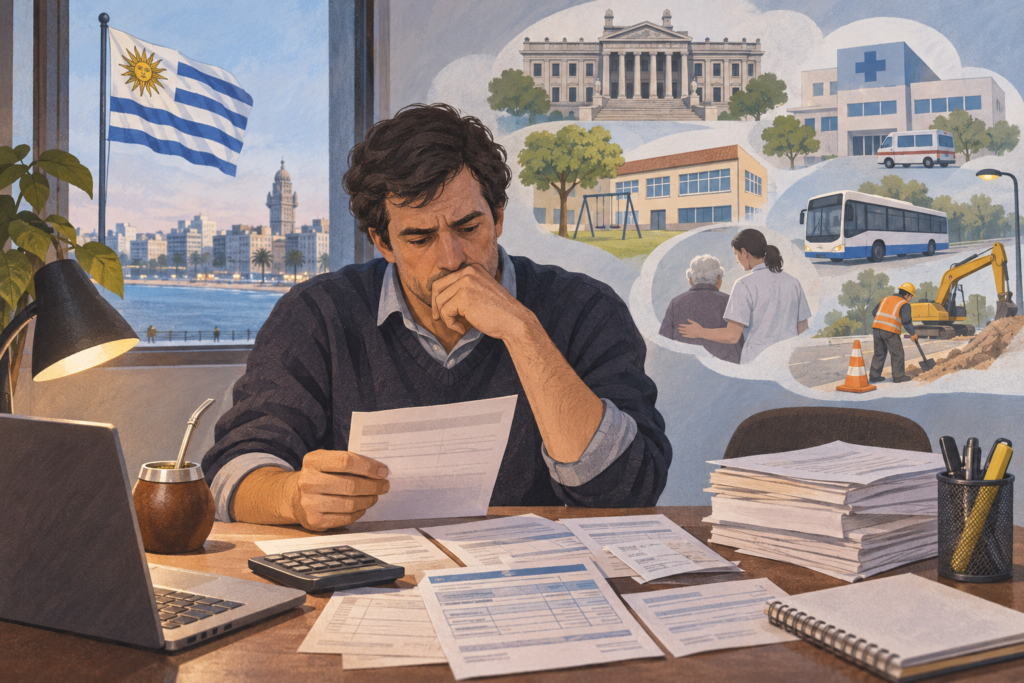
When the State Is the Exploiter
The Tale of “Those Who Have More Should Pay More”: Chronicle of a Fiscal Feast at the Middle Class’s Expense
Few phrases in modern politics have been as poetic, catchy and —in retrospect— cynical as that founding premise of the Broad Front governments: “Those who have more should pay more.”
It sounds like poetic justice, like a modern Robin Hood, like an equitable distribution of wealth.
The only small detail is the other side of reality: for the Broad Front state, those “who have more” invariably turned out to be salaried workers in formal employment, middle-class professionals and retirees.
While large fortunes, free-trade-zone regimes and corporations navigated the system with financial agility or sector-specific benefits, the tax-collecting machinery found its most compliant and exploited source of fuel in the pockets of workers who get up every day to clock in.
The Great Illusion: The Middle Class’s Tax Feast
A review of the structure of this fiscal plunder reveals devastating figures that belie the “solidarity narrative.”
Uruguay’s overall tax burden —which historically hovered between 21% and 22% of GDP before 2005— climbed and remained relentlessly between 27% and almost 30% of GDP.
Who paid for that jump of several percentage points of national output? Not the invisible “millionaires” of international high finance, but the bloc of workers and retirees.
Between 70% and 75% of the total tax take —including the DGI’s major sources of revenue, such as VAT, which accounts for almost half of public revenue, personal income tax (IRPF) and the pensioners’ tax (IASS), as well as all departmental revenue from property and vehicle taxes— falls directly on the WORKER: everyday consumption, household expenses, cars and middle-class homes.
VAT —the most unjust and regressive tax, which punishes someone earning a million just as it punishes someone earning thirty thousand— remains the undisputed king of tax revenue, at around 48% to 50% of the total.
There was a promise to lower it once the IRPF was introduced, and IT WAS NOT LOWERED.
The Stranglehold on Wages: Social Security and Income Tax Working Together
Before a formal-sector worker even sees a peso of take-home pay, a fierce battery of compulsory deductions eats away at the working person’s income:
The worker’s 15% personal pension contribution to the BPS.
FONASA, which, disguised as “health insurance,” operates as a compulsory income tax of between 3% and 8%, depending on family circumstances.
The Labor Retraining Fund (0.10%).
The suffocating IRPF brackets on earned income, introduced to “tax capital” but ending up confiscating the salaries of office employees, teachers and professionals.
On the other side of the counter, labor costs are punished by an additional, suffocating employer contribution of around 12.6% (7.5% in employer pension contributions, 5% in employer FONASA contributions, among other items).
Of course, all these costs paid by employers are passed on to prices, which,
in the end, are paid by… the worker.
The Masterstroke of Continuity: Oddone’s Ingenuity and the Cut to FONASA Refunds
As though the historical squeeze devised by Danilo Astori in 2007 were not enough to sustain the state’s voracity, the model’s ideological heirs found a way to go one step further and extract a little more from formal-sector workers.
With Gabriel Oddone at the helm of economic policy in the current administration, the Broad Front decided to double down on wage income with a surgically precise move: tampering with refunds of excess FONASA contributions.
Under the technical euphemism of a “methodological correction” or an “adjustment for design errors,” the economic team implemented a change in the calculation that, in practice, means nothing less than eliminating or drastically reducing contribution refunds for thousands of workers.
In other words, money that the state had overcharged higher-income contributors relative to the actual cost of their health coverage —and that by law was supposed to be returned— magically ended up swelling the public coffers.
While the official narrative insists that “there is no tax change” because it affects only a particular income bracket, the pockets of the formal-sector middle class feel the harsh reality: another blow disguised as a technical adjustment, punishing those who work, are formally employed and faithfully pay their contributions.
The model’s unchanging logic remains intact: instead of easing the unbearable burden on labor, it demands still more from the same tax slave as always, creating a perfect stranglehold on saving, consumption and social mobility.
How to Destroy Jobs and Multiply Informality (While Wearing the Progressive Label)
Punishing labor so mercilessly carries an inevitable economic cost, even if ideological dogmas refuse to see it: formal employment is destroyed and people are pushed into the underground economy.
By artificially raising hiring costs through so many layers of taxes and levies on income, the state has acted as a criminal obstacle to economic growth and social mobility.
The result? A vast number of our fellow citizens —around 30% of the active population— have been submerged in informal employment, excluded from those supposed “rights” so loudly celebrated by the official narrative. They have been turned into second-class citizens, driven out by a system that made formalization unviable.
This is how new forms of work emerge that evade the full burden of this plunder simply to make getting a job possible.
The celebrated “expansion of rights” ended up becoming a privilege for a few people captive to the union apparatus (to which they also contribute), while driving a third of the workforce into the underworld of odd jobs without contributions or coverage, without paid leave or unemployment insurance, and without a pension —which itself becomes a privilege.
Where Did the Loot Go?
Despite this enslaving increase in tax collection and the state’s control over an enormous share of national wealth, one great question remains: where did the proceeds of such an extraordinary effort by citizens go?
The promise of a robust welfare state crashed into a wall of incompetence and waste:
There are no resources for education —the one true ladder of social mobility and a path out of poverty— which continues to show dramatic signs of neglect and declining quality.
There are no resources for public security, while crime strikes the poorest and hardest-hit neighborhoods with particular cruelty, leaving them defenseless.
There are no resources for public health care, whose users face chronic collapse, endless waiting lists and increasingly deteriorated services.
Ultimately, the great achievement of the Broad Front’s tax model was not to make the rich pay, but to perfect a machine that squeezes formal-sector workers, suffocates the middle class, freezes social advancement and finances an inefficient state apparatus that collects revenue like a Scandinavian country but delivers Cuban-style services.
How much longer can workers and retirees sustain this kind of government?
Let there be no “democratic” complaints about having put them in office, or about the completely inevitable adjustment to the bloated state.
Tax burden on earnings
Middle class and FONASA
Formal work and informality
Continue reading in Global Order and Geopolitics

Apoyá la continuidad de Perspectiva Liberal
Perspectiva Liberal es un espacio editorial independiente que no cobra por las notas.
Si valorás este trabajo y querés colaborar con su continuidad, podés hacerlo mediante un aporte voluntario a nuestra cuenta Prex 13440.
o por Mercado Pagolink.mercadopago.com.uy/perspectivaliberal