
Uchronia. A continental freedom that was stifled, yet possible.
Structural transformation could have been glorious
This fourth chapter explores the structural transformation of the island, examining how the pragmatism Castro never embraced, despite his supposed strategic intelligence, could have turned Cuba into the economic axis of the hemisphere, surpassing even the most optimistic projections of the era.
The Silicon Valley of the Caribbean. Chronicle of the Cuban economic miracle (1960–1995)
If history is, as some argue, a sequence of critical decisions, the signing of a hypothetical 1961 Comprehensive Cooperation Treaty between Havana and Washington could have been the Big Bang of Caribbean modernity.
While revolutionary movements elsewhere chose nationalization and isolation, Fidel Castro executed a radical pivot. He turned sovereignty into a premium brand and political stability into the most coveted asset for international markets.
The great opening. From casinos to microchips
The first step of the “miracle” was not a conventional agrarian reform, but the creation of the Mariel Special Free Zone in 1963.
Using his absolute control over the internal structure, Castro eliminated bureaucracy overnight. By purging the corrupt elements of the Batista era, he not only neutralized political opponents but established an unprecedented technical meritocracy in Latin America.
By 1970, Cuba no longer exported only sugar and tobacco. The island had become the main assembler of electronic components for the expanding U.S. industry. The strategy was brutally simple: offer highly educated labor, the result of pre-revolutionary training and massive technical literacy campaigns, at a fraction of California’s cost, under the legal certainty of a country where strikes and social disorder were eliminated by decree and surveillance.
The Havana effect. The financial capital of the south
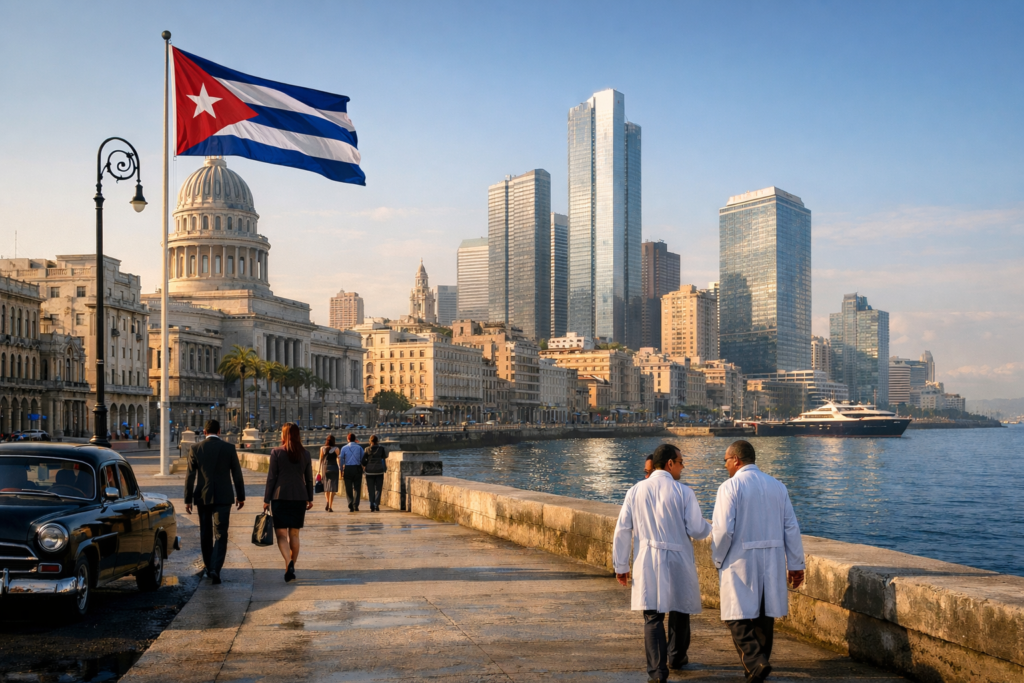
By 1980, Havana’s skyline began to change. The construction of the International Financial Center in El Vedado attracted Swiss and New York banking, seeking an efficient safe haven between the two continental blocs. Cuba became the free port of the Americas.
The Cuban peso, pegged to the dollar and supported by sustained annual growth of eight percent, became the de facto reserve currency for Central America and the Caribbean.
Old Havana was restored with private capital under strict heritage laws, becoming the most beautiful and expensive city in the Spanish-speaking world, surpassing Madrid in high-end tourism flows.
This growth was no accident. It was the result of a masterful economic deception. Fidel convinced capitalists that he was the guardian of order, while persuading the masses that each new skyscraper was a monument to national dignity. Material well-being acted as a social sedative, preserving unquestioned political control over a still-poor population.
The biotech revolution and the leap into the future
The true turning point came in the 1990s. While real history saw Cuba collapse into the Special Period, this uchronia witnessed the inauguration of the Havana Scientific Hub, financed by pharmaceutical consortia from New Jersey and Basel.
Through massive state investment in science, funded by tourism and banking surpluses, Cuba patented a large share of late-century synthetic vaccines and cancer treatments. The island stopped manufacturing foreign technology and began inventing its own.
Castro’s slogan, “the future of our homeland must necessarily be a future of men of science,” materialized as multimillion-dollar patents flowing into a state corporation controlled by his inner circle.
Conclusion. The cost of success
By 1995, Cuba displayed the highest human development index in Latin America and a GDP per capita comparable to Italy or Spain. There were no rafts heading to Florida. Instead, Florida suffered a brain drain toward Havana’s laboratories and software centers.
Yet the miracle rested on the pathology of absolute control and an irreducible statist impulse. The Cuban state functioned as a private corporation with a single lifelong CEO. Castro proved that aggressive capitalism could be domesticated by an intelligent dictatorship, foreshadowing a model China would later refine. Cuba became, in essence, the first forcibly efficient state in history.
Apoyá la continuidad de Perspectiva Liberal
Perspectiva Liberal es un espacio editorial independiente. Si valorás este trabajo y querés colaborar con su continuidad, podés hacerlo mediante un aporte voluntario a nuestra cuenta Prex.
Cuenta Prex: 13440