How legislatures surrender their role, enabling fiscal abuse and the erosion of the productive citizen
Abuse Against the Taxpayer
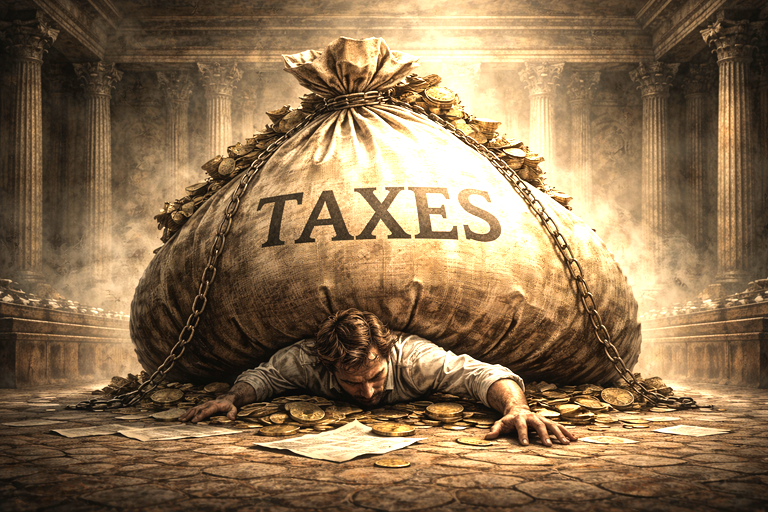
Parliament should act as the citizen’s shield against the fiscal appetite of the State. Instead, a phenomenon of technical or political blindness has taken hold.
New taxes and regulatory burdens are enacted for revenue purposes without measuring real contributive capacity, ignoring economic thresholds, the erosion of savings, and the disincentive to investment.
By deliberately refusing to assess the damage inflicted on the productive citizen, legislatures drain the country’s economic capacity to sustain an oversized, inefficient and self-serving bureaucratic structure.
The Inversion of the Budgetary Role
Historically, Parliament existed to say no to the King’s spending.
Today, that incentive is reversed through electoral opportunism or institutional corruption. Legislators add spending for their own political territories or act under an ingrained logic of extracting resources from those who still possess them.
Budgets become wish lists detached from real funding, approved in haste, without evaluating social return or opportunity costs. This political choice systematically undermines savings, consumption, and social mobility, producing enforced economic stagnation.
Ideology replaces reason.
What once resembled absolute monarchy returns in modern form, now justified by demagogy. Political needs are manufactured to grant unsustainable rights.
The outcome is chronic deficit expansion, opaque financing mechanisms, and widespread economic harm. Private capital is drained, employment contracts, productivity declines, and the State itself becomes incapable of delivering quality services.
The Destruction of Growth
When Parliament abdicates oversight of spending efficiency, it becomes complicit in a permanent extraction model imposed on taxpayers.
The State adopts a monarchical mindset, treating private resources as its own, erasing any meaningful defense of individual rights. Capital that should flow into innovation and production is absorbed to sustain inflated current spending, multiplying frustration and poverty.
Technical warnings about declining competitiveness are ignored. Institutions prioritize their own survival over the health of the real economy. Democracy remains in form, but substance is gone.
Control bodies exist only as decorative structures. Their warnings are systematically disregarded when they conflict with executive power or legislative spending pacts.
This constitutes a crisis of technical rationality.
Political convenience overrides factual truth, legal limits, and constitutional constraints, inflicting direct harm on the taxpayer.
Legislators incur responsibility through deliberate omission, privileging bureaucratic preservation over national economic health.
In this system, the taxpayer stands defenseless. Noncompliance is treated as moral failure, punished without representation.
Spending becomes irreversible, failures are never audited, and inefficiency compounds over time.
The Consumption of Productive Capital
Without effective restraint on executive power, the State behaves as a parasitic organism consuming the very system that sustains it.
Production is suffocated. The private sector is stripped of the capacity to generate collective prosperity. Growth is promised while knowingly made impossible.
Public spending is calculated against total private output, not against what can be responsibly taxed to fund genuine public goods.
To be continued.
Apoyá la continuidad de Perspectiva Liberal
Perspectiva Liberal es un espacio editorial independiente. Si valorás este trabajo y querés colaborar con su continuidad, podés hacerlo mediante un aporte voluntario a nuestra cuenta Prex.
Cuenta Prex: 13440