
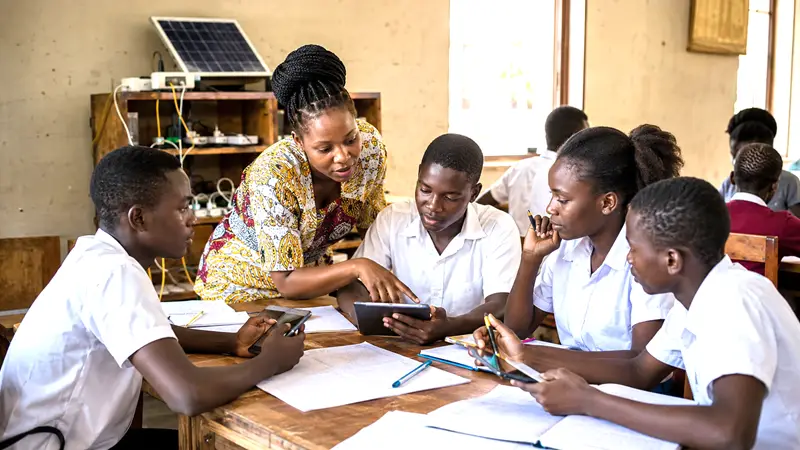
Artificial intelligence could allow African communities to bypass institutional stages and move directly toward personalized learning and cognitive sovereignty.
What If Africa Were the Greatest Beneficiary of Artificial Intelligence?
For decades, we took it for granted that major technological revolutions would benefit the most developed countries first.
It seemed inevitable.
More universities, more researchers, more resources and better educational systems appeared to guarantee that advantage.
However, artificial intelligence could break that pattern.
A few years before 2000, I had the opportunity to travel to China.
I remember an image that surprised me deeply: thousands of people riding bicycles while talking on mobile phones.
In Uruguay, at the time, mobile phones were still a rarity.
I asked why that was happening.
The answer was as simple as it was revealing.
Many of those people had never had a landline telephone.
They were not replacing one technology with another.
They had simply skipped an entire stage.
That experience made me understand that when a society is not burdened by major investments, structures or deeply established habits, it can adopt a disruptive technology more quickly.
Today I wonder whether something similar could happen with education.
Much of the West spent more than a century building enormous educational systems.
Universities, ministries, unions, teacher-training institutes, official curricula, regulations and bureaucracies.
Those institutions played a decisive role.
But their very solidity can become rigidity when transformation requires changing established methods, functions and interests.
Changing a curriculum can take years.
Introducing a different methodology often requires endless negotiations.
Meanwhile, artificial intelligence evolves practically every month.
Africa is not a uniform reality.
However, across vast regions of the continent, educational systems never reached the level of development found in Europe or North America.
Traditionally, this has been regarded as an enormous disadvantage.
But perhaps artificial intelligence could turn part of that weakness into a historic opportunity.
A student with a smartphone and an Internet connection can have access to a personalized tutor twenty-four hours a day.
The student can learn at their own pace, ask unlimited questions, receive explanations adapted to their level and study in their own language.
This will not happen automatically.
Energy, connectivity, devices and people capable of guiding the process will be necessary.
But once those minimum conditions are available, a community could move directly from inadequate education to individualized learning, without passing through every institutional stage followed by developed countries.
This is not about replacing the teacher.
It is about radically changing the teacher’s role.
Until now, one of the teacher’s main tasks has been to transmit information and explain content.
That made sense.
Information was scarce, and the teacher was one of its principal mediators.
Today, that scarcity is beginning to disappear.
For the first time in history, practically any student can immediately access an explanation of almost any subject.
That forces us to ask a much deeper question.
If artificial intelligence can transmit information, what will the teacher’s true mission be?
I believe the answer is not to compete with it, but to use it to accomplish what education has never managed to do systematically.
Teach people to think.
The teacher of the future will not merely prepare lessons.
The teacher will also design the pedagogical behavior of intelligent assistants.
They will be able to configure them so that they do not immediately provide the answer, but instead ask questions, request justification, propose alternatives, point out contradictions and require students to reconsider their conclusions.
Artificial intelligence will then cease to be a machine that answers and become a tool that helps people reason.
And the teacher will cease to be primarily a transmitter of information and become an educator of intelligences.
The teacher’s mission will be to develop each student’s attention, observation, comparison, judgment, reflection and intellectual autonomy.
The teacher will also have to help students recognize the thoughts involved in their reasoning, distinguish those that lead them astray and learn to consciously direct their own mental activity.
In other words, to teach the conscious use of the faculties through which all knowledge is constructed.
Perhaps that is the true educational revolution.
For centuries, we mainly assessed how much a student knew.
Tomorrow, we may be able to accompany and assess how a student thinks.
What they observe.
What they compare.
What grounds they require.
How they discover an error.
How they correct themselves and construct an independent judgment.
That change has a name.
Cognitive sovereignty.
The ability to consciously govern one’s own intelligence, use artificial intelligence without delegating judgment to it and preserve the autonomy to understand, judge and decide.
If this hypothesis is correct, Africa could be one of the first places where that transformation becomes visible.
But the true revolution will not occur on any particular continent.
It will occur in the human mind.
And perhaps, for the first time in history, the primary mission of education will cease to be the transmission of knowledge and become the formation of people capable of thinking with freedom, judgment and responsibility, accompanied by artificial intelligence but still in command of their own intelligence.
Cognitive sovereignty
Personalized learning
African technological leap
Continue reading in Global Order and Geopolitics
Apoyá la continuidad de Perspectiva Liberal
Perspectiva Liberal es un espacio editorial independiente. Si valorás este trabajo y querés colaborar con su continuidad, podés hacerlo mediante un aporte voluntario a nuestra cuenta Prex.
Cuenta Prex: 13440