
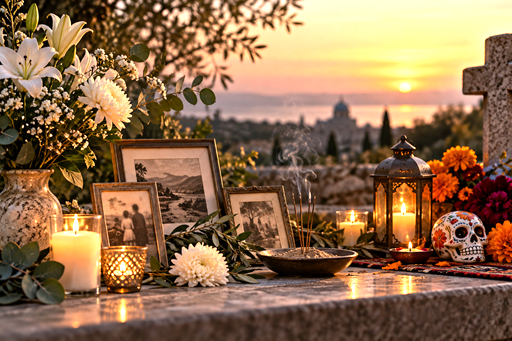
From Mexico’s Day of the Dead to digital remembrance, different cultures show that remembering those who came before us is also a way of building community.
SPONSORED SPACE
Modern life often treats death as something strictly private.
Someone dies.
The family holds a ceremony.
Friends and relatives offer their support.
And shortly afterwards, public life moves on.
Yet many cultures have developed a very different relationship with the memory of their dead.
Mexico offers perhaps the best-known example.
During the Day of the Dead, photographs, flowers, food and personal objects symbolically restore the presence of those who have died.
The centre of the celebration is not death alone.
It is the life that existed before it.
Jewish tradition developed another equally meaningful practice.
Remembrance is not confined to the moment of death.
It returns every year.
The anniversary of a person’s death offers an opportunity to renew their memory and, often, to associate it with a good deed carried out in their name.
East Asian cultures offer different expressions of a similar idea.
In Japan, Obon keeps the family bond with ancestors alive.
In China, Qingming brings generations together around the memory of those who came before them.
In Korea, different family ceremonies express gratitude towards ancestors.
The forms change.
The human need remains.
To remember.
That memory also fulfils a social role that often goes unnoticed.
A family builds part of its identity by remembering those who came before it.
So does a community.
The same is true of institutions.
Companies, universities, clubs, professional associations and social organisations all have histories made primarily of people.
Without them, institutional history can easily become a succession of dates, buildings, balance sheets and anniversaries.
Memory adds another dimension.
Who made possible what exists today.
The digital revolution has profoundly changed the way we record those memories.
For decades, much of the public memory of deaths was preserved in the pages of newspapers.
Death notices served as a kind of informal social record.
Social media has partly replaced that mechanism.
But it has an obvious limitation.
It is designed for the present.
A post receives attention for a few hours or a few days and then disappears into an endless flow of information.
That raises an interesting question.
Where, then, does memory remain?
Technology can also help provide an answer.
A digital platform dedicated to recording deaths can initially serve a very practical purpose.
To confirm that someone has died.
To report when it happened.
To provide funeral service details.
But it can become something more.
It can preserve remembrance.
In Uruguay, Obituarios.uy is seeking to move precisely in that direction.
The project began by addressing a simple, concrete need.
To know who had died.
Its natural evolution is now to add another question.
How do we want to remember them?
An obituary can cease to be merely a notice.
It can become a small fragment of family, social or institutional memory.
A photograph.
A story.
A word of gratitude.
An anecdote.
A description of what someone left behind.
The coming 2 November, All Souls’ Day, offers a good opportunity to return to that reflection.
We do not need to adopt the traditions of other cultures.
We can learn from them.
In different ways, they all seem to remind us that a community is not made up only of those who are present.
It is also built upon those who came before.
Death ends a life.
Memory can extend its meaning.
Obituarios.uy has published a special reflection for All Souls’ Day on these different cultural forms of remembrance and on the value that digital memory can have today.
It can be read at obituarios.uy.
Logosophy also formulated a distinctive conception of remembrance as a continuation of life in others:
This means, then—as has already happened throughout the world—that many of those who have passed through it continue to live in the minds and hearts of their fellow human beings, even after many generations have gone by. They remain alive in the thoughts of those who remember them and who may even feel their presence when they evoke them in moments when they turn to their memory. This is how life can be preserved through many people and many things: by leaving behind a work of goodness, constructive and generous, which, received by the soul with gratitude and emotion, is perpetuated in the spirit of all. Conf. MVD 6-01-39
Memory and community
Cultures of remembrance
Digital memory
Apoyá la continuidad de Perspectiva Liberal
Perspectiva Liberal es un espacio editorial independiente que no cobra por las notas.
Si valorás este trabajo y querés colaborar con su continuidad, podés hacerlo mediante un aporte voluntario a nuestra cuenta Prex 13440.
o por Mercado Pagolink.mercadopago.com.uy/perspectivaliberal