
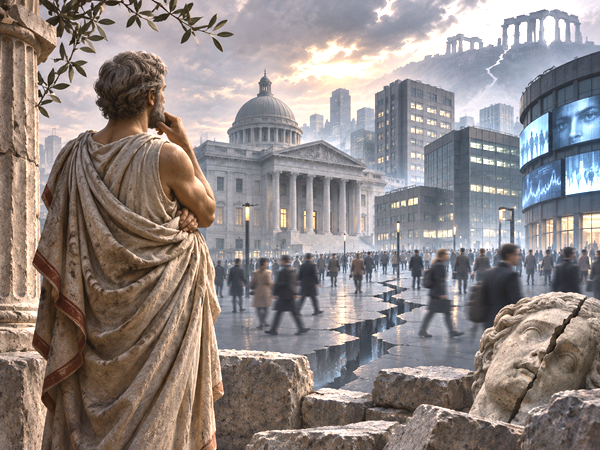
Aristotle’s Return to the Modern Polis
The Journey of the Stagirite: Chronicle of a Foretold Collapse
When Aristotle opened his eyes in the twenty-first century, he was not dazzled by glowing screens, horseless carriages or satellites crossing the heavens.
What stopped his heart—or whatever passed for it in this new awakening—was a catastrophe of words and souls: the realization that civilization had christened the most perfect and sophisticated of invisible tyrannies “democracy.”
Armed only with the mental mantle of a rigorous observer, he set out on a journey across the West to examine the state of the great global polis. This is the record of his diagnosis.
Europe: The Mausoleum of Committees (Bureaucratic Oligarchy)
His first stop was the Old Continent, cradle of reason and classical forms. Aristotle walked through capitals of polished stone and glass corridors where an unsettling silence prevailed: the silence of ministerial offices and supranational courts.
What he found in Europe was not a living political community but a technocratic oligarchy. Real power had been seized by councils of experts, faceless agencies and committees devoted to perpetual regulation, governing through indecipherable directives.
“There are no citizens left here; only people to be administered,” he noted to himself. Laws no longer sprang from deliberation about justice, but from the arithmetic of economic calculation and suffocating regulation. The European middle class, once a bastion of moderation (mesotēs), was crumbling under the weight of voracious taxation and a paternalistic state that treated its members like children. Europe had become a beautiful mausoleum where elections were a harmless ritual for deciding which bureaucrat would administer the decline.
United States: The Digital Colosseum of Factions (Algorithmic Demagoguery)
Crossing the ocean, the Stagirite landed in the great northern power, hoping to find echoes of the noble institutional balance he admired in mixed republics. Instead, he discovered a Roman circus spectacle amplified by silicon and fiber optics.
The United States was suffering from radical, pathological polarization. Society had split into two irreconcilable tribes—a grotesque caricature of the struggle between rich and poor that he had diagnosed in antiquity.
But the most terrifying thing was not the division itself; it was the instrument of domination: the digital demagogues.
Watching millions of people compulsively stare at glowing rectangles, he exclaimed: “Tyrants no longer need the Pnyx (where the people assembled) or the sword; an algorithm that rewards anger is enough.”
Political leaders no longer sought to persuade through logos (reasoned argument), but to inflame the basest passions through instant insults.
The great constitutional republic had mutated into a polarized plutocracy where money bought laws and digital shouting supplanted civil debate.
Mexico and Southern America: Perpetual Stasis and the Populist Mirage
As he traveled down the American subcontinent, passing through Mexico and moving deep into the southern reaches of Spanish-speaking America, the landscape changed dramatically.
The air smelled of urgency, historical misfortune and political turmoil that seemed to offer no respite.
Here Aristotle recognized with clinical clarity the phenomenon of chronic stasis (latent civil war between factions) and the definitive triumph of demagogic populism.
Governments followed one another, promising to redeem the poor at the expense of the rich, but the invariable result was the destruction of institutions, the capture of the state and the division of public spoils among partisan clienteles.
He saw charismatic strongmen constantly invoke the word “people” to justify dismantling judicial checks and balances and the law itself.
“They call it popular sovereignty when a tyrant indulges his whims by telling a hungry crowd what it wants to hear,” he reflected, watching entire economies suffocated by corporatism and demagoguery.
In southern America, the law was not a shield for the free citizen, but a piece of chewing gum that those in power stretched or shrank to suit their factional interests.
The middle class, fragile and battered by inflation and extractive upheavals, lived in a state of permanent struggle for survival.
The Stagirite’s Epilogue
Back at his starting point, surveying the map of a globalized West that proclaimed itself advanced, free and democratic, Aristotle concluded his account with a somber warning:
“You have built a civilization that dominates nature but is incapable of governing itself. You have emptied words of their meaning: you call the consumption of trinkets ‘freedom,’ unbridled appetite a ‘right,’ and the struggle between financial oligarchies and demagogues in the digital public square ‘democracy.’
A society that abandons the rule of law, destroys its middle class and reduces politics to hatred between factions is not evolving; it is signing its own death warrant. Tyranny never comes from outside; it is always the rotten fruit of your own moral degradation.”
European bureaucratic oligarchy
American algorithmic demagoguery
Latin American populism
Continue reading in Global Order and Geopolitics

Apoyá la continuidad de Perspectiva Liberal
Perspectiva Liberal es un espacio editorial independiente que no cobra por las notas.
Si valorás este trabajo y querés colaborar con su continuidad, podés hacerlo mediante un aporte voluntario a nuestra cuenta Prex 13440.
o por Mercado Pagolink.mercadopago.com.uy/perspectivaliberal