
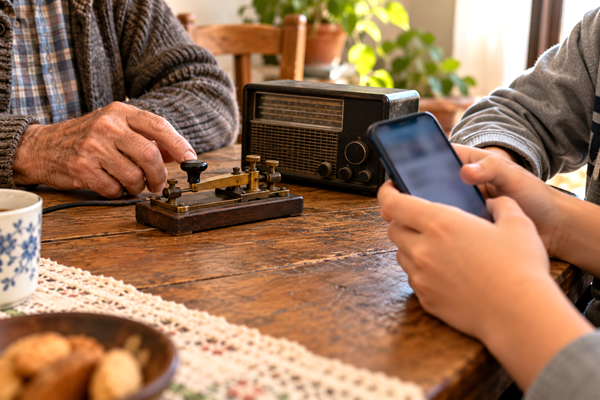
From Morse and radio codes to six-seven: a story of abbreviations, generations and little secret languages.
In my teens, I was drawn to Morse code. I learned a little.
Enough to discover that behind those dots and dashes lay another language.
Then came the Q codes.
QTH meant location. QSL, confirmation. QRM, interference. QRZ, “Who’s calling me?” QSY, changing frequency.
Three letters could replace an entire sentence.
And there were the numbers. 73 meant best regards. 88, something rather more affectionate.
What’s interesting is that telegraph operators were already using 73 in the nineteenth century. A Victorian emoji, minus the little picture.
Many years later, ICQ appeared.
To one generation, it was simply the name of a messaging program.
For those of us who had once played around with radio, codes and abbreviations, the joke was immediately apparent.
ICQ. I seek you. I’m looking for you. They hadn’t invented anything.
They’d reinvented the telegraph operator.
Americans, of course, took this habit rather further.
“What’s your 20?” isn’t asking your age. It’s asking where you are. It comes from 10-20 in police radio codes.
“Give me the 411” means give me the information, because 411 was the directory assistance number for decades.
And 86 emerged in restaurants to indicate that something had run out.
Later it came to mean removing, getting rid of, or simply throwing someone out.
There’s also the famous 101. At American universities, it traditionally identifies introductory courses.
That’s why “Economics 101” came to mean simply “basic economics.”
So far, it all made a certain amount of sense.
The codes saved time. They reduced errors. They shortened transmissions.
They helped people understand one another.
Then came six-seven. Not “sixty-seven.” “Six-seven.”
It spread through a song, TikTok, basketball and teenagers.
And the remarkable thing is that nobody can explain exactly what it means.
It can be an answer. It can be a joke. It can mean so-so. It can mean absolutely nothing.
And that seems to be precisely where its success lies.
The journey is admirable.
First, we invented codes because transmitting cost money.
Then because radio airtime was valuable.
Later because typing messages was awkward.
Then because belonging to a community means knowing its passwords.
And finally, we arrived at codes whose main virtue is not meaning very much.
Perhaps every generation needs its own little secret language.
Telegraph operators had 73. Radio amateurs, QSL. Truckers, 10-4. Our early Internet had ICQ.
And now teenagers have six-seven.
After a century and a half of trying to say a lot with very little, we have finally achieved perfection.
Saying very little with even less.
Codes and Abbreviations
Generational Identity
Humor and Language
Continue reading in Humor and Satire
Apoyá la continuidad de Perspectiva Liberal
Perspectiva Liberal es un espacio editorial independiente. Si valorás este trabajo y querés colaborar con su continuidad, podés hacerlo mediante un aporte voluntario a nuestra cuenta Prex.
Cuenta Prex: 13440