A strategic reading through Umberto Eco’s critique of bureaucratic simulacra and the liquid society.
Government systems are human creations. And as such, they are fallible, corruptible, deformable, decadent and ultimately collapsible.
History does not call for alarmism, but for lucidity. When examined carefully, it reveals a recurring pattern of institutional exhaustion. The current global architecture appears to be entering one of those phases. Not abruptly, but structurally.
What collapses does not fall because it is attacked. It falls because it no longer serves the majority. It survives only for a caste.
Umberto Eco’s reflections in “From Stupidity to Madness” offer a sharp intellectual lens to understand this process.
His analysis of the transition from a solid society to a liquid one — influenced by Zygmunt Bauman — anticipated many of the dysfunctions we now witness in international governance structures.
The Bureaucracy of the Simulacrum
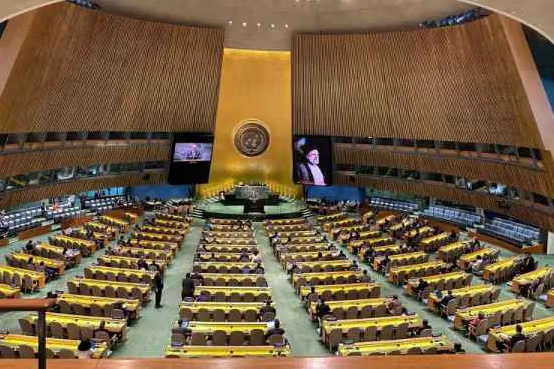
From a semiotic perspective, international organizations increasingly resemble self-referential monuments.
They maintain the appearance of authority — flags, summits, declarations, diplomatic rituals — but lack effective capacity.
Power has been replaced by representation.
What remains is administrative production. Reports. Protocols. Committees. Endless documentation that justifies the existence of the structure itself.
A Loss of Gravitational Center
In a fragmented world without shared ideological foundations, global institutions become rigid structures operating in a liquid environment.
Without a moral or political consensus, they default to day-to-day management. Tactical maintenance without strategic direction.
They become solid shells in a dissolving world.
The Triumph of Spectacular Stupidity
Eco warned that politics was turning into spectacle.
International governance increasingly resembles expensive stage design.
Public inaction. Performative summits. Budgetary continuity without accountability.
Societies maintain twentieth-century structures for twenty-first-century problems those structures were never designed to solve.
Proliferation of Paper
In ironic parallel to the Library of Babel, institutions produce volumes of documentation that alter nothing.
Administrative white noise replaces effective intervention.
From Stupidity to Madness
The ultimate sign of decay is not failure itself, but persistence in maintaining what is known to be ineffective.
Institutions cease to be arbiters and become archivists of chaos.
Following Eco’s logic, democratic decay is not an accident. It is metastasis.
This analysis will continue in the next article.
This analysis is part of the thematic axis Order and Geopolitics, dedicated to the strategic study of transformations in the international system.