
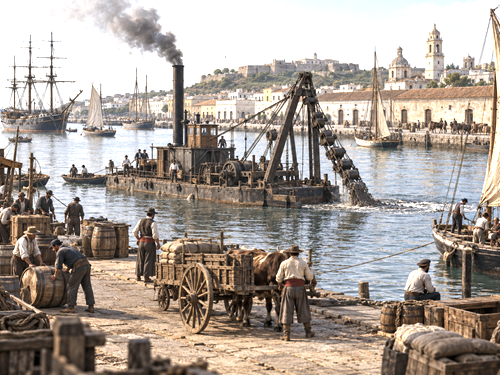
During his first presidency, Rivera promoted studies, dredging, navigation aids and new regulations to strengthen Uruguay’s main port.
Fructuoso Rivera and the Port of Montevideo
by Dr. Edison González Lapeyre
General Fructuoso Rivera is remembered above all for having been a lieutenant of the Father of the Nation, General Artigas, and for his military victories, among which Guayabos, Rincón, Sarandí, Cagancha and his extraordinary Misiones campaign stand out.
His career has been the subject of both praise and criticism, but what is beyond doubt is that he played a leading role in the genesis of the Oriental Republic of Uruguay, not only because of his status as a caudillo and victorious military leader, but also for other reasons that have generally been forgotten.
In a previous article, I referred to the agreement of Ibereambá or Ibereabasubá, concluded on December 25, 1828, by virtue of which General Fructuoso Rivera, by refusing to move with his army as far south as the Arapey River and reaching an understanding with the representative of the Empire of Brazil, General Barreto, to advance only as far as the Cuareim, prevented the entire territory north of the Arapey from falling under Brazilian jurisdiction.
Because of its importance, I have described it as the first boundary treaty concluded by Uruguay as an independent state, which had emerged a few months earlier with the Preliminary Peace Convention.
In today’s article, I will address the role played by General Fructuoso Rivera, as the first president of the Republic, in the development of the Port of Montevideo.
As J. M. Fernández Saldaña points out in Historia del Puerto de Montevideo (Montevideo, 1939, p. 58), Rivera took a particular interest in promoting our main port terminal, and his government signed, on February 8, 1833, an agreement with the French hydraulic engineer Carlos Enrique Pellegrini, who had come from Buenos Aires, for him to prepare “a detailed and formal report on Montevideo Bay and the possibility of building a sheltered port there,” for which a fee of one thousand pesos was agreed.
The report submitted by Pellegrini to the Executive Branch on March 15 was of excellent quality, proposing the construction of a new pier and including a descriptive plan of the works he believed should be carried out.
In accordance with his recommendations, President Rivera’s government agreed to purchase a steam dredger from a British company for 40,000 pesos. It arrived in Montevideo disassembled in November 1835 and began operating one year later.
As Eduardo Acevedo points out (Anales Históricos del Uruguay, Montevideo, 1933, Vol. I, p. 421), that dredger had the capacity to remove 200 tons of mud, sand or gravel per hour of operation and to dig to a depth of 24 feet.
But in addition to Engineer Pellegrini’s report, which we could describe as our country’s first port master plan, President Rivera’s government carried out works to mark navigational hazards in the Río de la Plata and the Uruguay River and regulated matters relating to maritime pilots, “creating an association of eight sea and river pilots who would be appointed after an examination before a special Tribunal” (Acevedo, ibid.).
General Fructuoso Rivera, during the period in which he served as president of the Republic, carried out substantial changes that significantly promoted the development of the Port of Montevideo.
The comparison with what is happening in our own time, despite the enormous technological development that has taken place and the ineptitude that prevails, is truly striking.
Development of Montevideo Port
Fructuoso Rivera’s administration
Infrastructure and navigation
Continue reading in Global Order and Geopolitics
Apoyá la continuidad de Perspectiva Liberal
Perspectiva Liberal es un espacio editorial independiente. Si valorás este trabajo y querés colaborar con su continuidad, podés hacerlo mediante un aporte voluntario a nuestra cuenta Prex.
Cuenta Prex: 13440