
Resolve and Courage at Europe’s Precipice
Europe is going through one of the darkest and most complex crossroads in its recent history.
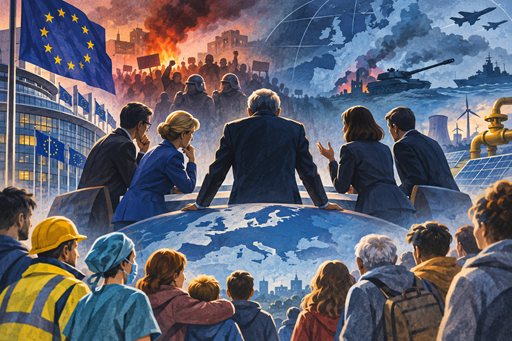
The streets of the continent’s major cities are shaken by uncontrollable unrest, driven by declining purchasing power, a housing crisis, deteriorating public services and profound disaffection with a political class perceived as distant and ineffectual.
At the same time, the shadow of geopolitical instability and the specter of a large-scale conflict have prompted governments such as the United Kingdom’s to issue warnings and launch civil preparedness campaigns, urging citizens to keep minimum emergency supplies—water, food and basic necessities—to survive for at least 72 hours in the event of a critical breakdown.
When the stakes are this high, history teaches us that ordinary institutions, bureaucratic technocracy and short-term electoral calculations collapse like houses of cards.
It is at such moments that the indispensable leader ceases to be a theoretical abstraction and becomes an existential necessity.
To grasp the magnitude of this moment, we must confront our diagnosis of the present with the teachings of the great thinkers of power and political character.
Diagnosing Collapse: Weber and Aron on the Contemporary Crisis
In the face of the social unrest sweeping Europe—marked by tension in the streets, repression and the impasse of the current socioeconomic model—Max Weber’s historical sociology offers our first key to interpretation. Weber warned that when institutional routines fail and standardized structures cannot respond to collective demands, society enters a vacuum of legitimacy.
In this setting, mediocre or fainthearted rulers often retreat into lifeless legality or empty rhetoric, worsening public discontent.
By contrast, Weber calls for the combination of passion, judgment and a sense of responsibility: the qualities that define a true politician.
Along similar lines, Raymond Aron warned of the fragility of European democracies when they lose their clarity of vision in the face of totalitarian danger or domestic disorder.
Aron argued that the principal danger to the West does not always lie in the strength of an external adversary, but in the intellectual and moral paralysis of its elites, who are unable to make tragic yet necessary decisions for fear of immediate unpopularity.
The Ethics of Daring: de Gaulle and the Loneliness of Power
When the British government appeals to citizens’ resilience and asks households to prepare for isolation and temporary shortages, it becomes clear that national security is no longer remote from everyday life but a test of collective resolve.
Here the figure of Charles de Gaulle resonates strongly, both as a statesman and through his work The Edge of the Sword.
De Gaulle held that, in moments of supreme crisis, a leader must stand out by accepting solitude and exercising the authority that comes from strength of character. For the Gaullist leader, politics is not the art of managing the consensus of the moment, but of embodying the nation’s continuity when everything seems to be dissolving.
A fainthearted ruler conceals the truth from the people to avoid conflict; a leader with resolve, by contrast, anticipates risks, addresses citizens with unsparing honesty and mobilizes the national will above petty partisan interests.
The Spirit of Resistance: Churchill, Roberts and Kersaudy Against Appeasement
Twentieth-century history bequeathed us the clearest reflection of this dilemma in Winston Churchill, masterfully portrayed by historians such as Andrew Roberts and François Kersaudy.
In 1940, faced with a British establishment tempted by appeasement, cowardly negotiation and defeatist realism, Churchill emerged not through bureaucratic unanimity but through unbreakable audacity.
Roberts emphasizes in his analyses that Sir Winston’s leadership lay in turning fear into a force for heroic resistance.
Far from concealing the gravity of the crisis, he dramatized it to mobilize the spirit of his people.
Today, with Europe fractured by internal social tensions, its geopolitical flank under threat and also beset by attacks from hostile hackers, Churchill’s example and Kersaudy’s studies of the mettle of great decision-makers take on absolute relevance: weak rulers invite aggression and collapse; firmness and rigorous preparation are the only real deterrents against disaster.
Political Judgment at the Crossroads: Isaiah Berlin
For his part, the historian of ideas Isaiah Berlin offered an indispensable perspective on political judgment.
For Berlin, true statesmen differ from dogmatic ideologues and colorless administrators because they possess a “sense of reality”: an intuitive and accurate capacity to discern what is feasible, what is at stake and which drastic decisions cannot be postponed.
When the streets burn over the cost of living and European governments begin to prescribe civil survival measures in anticipation of technological warfare and supply disruptions, political judgment is put to the test. There is no room for ambiguity or for the petty calculations of those who remain fainthearted in the face of the storm, generating anxiety and unease before a diffuse enemy that the political system itself fails to identify.
The Imperative of Resolve
Europe stands before a historical mirror. Uncontrollable social unrest and the need to adopt civil emergency measures demand a qualitative leap in the caliber of its leadership.
As de Gaulle and Churchill taught us, and as Weber, Aron, Berlin, Roberts and Kersaudy theorized, the greatness of a nation in moments of extreme trial depends not on the absence of crises but on the presence of iron wills capable of weathering them.
If today’s rulers can overcome the temptation of bureaucratic timidity, put patriotism ahead of incapacity and inertia, and adopt courage, truth and audacity as guiding principles, Europe may turn its present distress into another trial overcome in its history; otherwise, the implacable judgment of future generations will condemn to oblivion those who could have acted but chose to look away.
European leadership crisis
Political courage and responsibility
Resistance in adversity
Continue reading in Global Affairs and Geopolitics

Apoyá la continuidad de Perspectiva Liberal
Perspectiva Liberal es un espacio editorial independiente que no cobra por las notas.
Si valorás este trabajo y querés colaborar con su continuidad, podés hacerlo mediante un aporte voluntario a nuestra cuenta Prex 13440.
o por Mercado Pagolink.mercadopago.com.uy/perspectivaliberal