From Argentina to the United Kingdom and Venezuela: how the logic of contraction turns prosperous economies into zero-sum systems
Induced underdevelopment and managed decline: the global pattern of extractive societies
From Argentina to the United Kingdom and Venezuela: how the logic of contraction turns prosperous economies into zero-sum systems
Lilliputian societies are groups of people frozen in time.
They play small ball, barely survive while consuming always the same; they bite off part of their neighbors’ wealth, exhaust productive resources while enduring intransigent rulers who plunder them to fulfill regal obligations; they manufacture poor people who will never escape that miserable condition, and they adapt; they justify themselves by saying “it has always been done this way”; they promote decadent informal subsistence; and they blame large foreign powers, while envying them and seeking to subdue and plunder them, to live off them.
Let us conduct a harsh and biting diagnosis of what many sociologists and economists call “induced underdevelopment.”
It is the vision of a society trapped in a short-term survival cycle, where a long-term state vision is replaced by day-to-day urgency.
The mechanism of contraction
The fiscal trap and informality
By overtaxing the sector that attempts to operate legally, a perverse incentive is created.
Informality ceases to be a choice and becomes the only refuge to avoid being suffocated by bureaucracy.
The poverty factory
When economic policy focuses on redistributing wealth that is no longer being generated, the only thing that ends up being democratized is scarcity.
This is where “justification” enters: precariousness is sold as a form of resistance or identity.
It is the logic of “bread for today, hunger for tomorrow.”
Strategic assets or natural capital are consumed to cover immediate fiscal holes. This ultimately impacts household income that never suffices, as families anxiously wait for the next month.
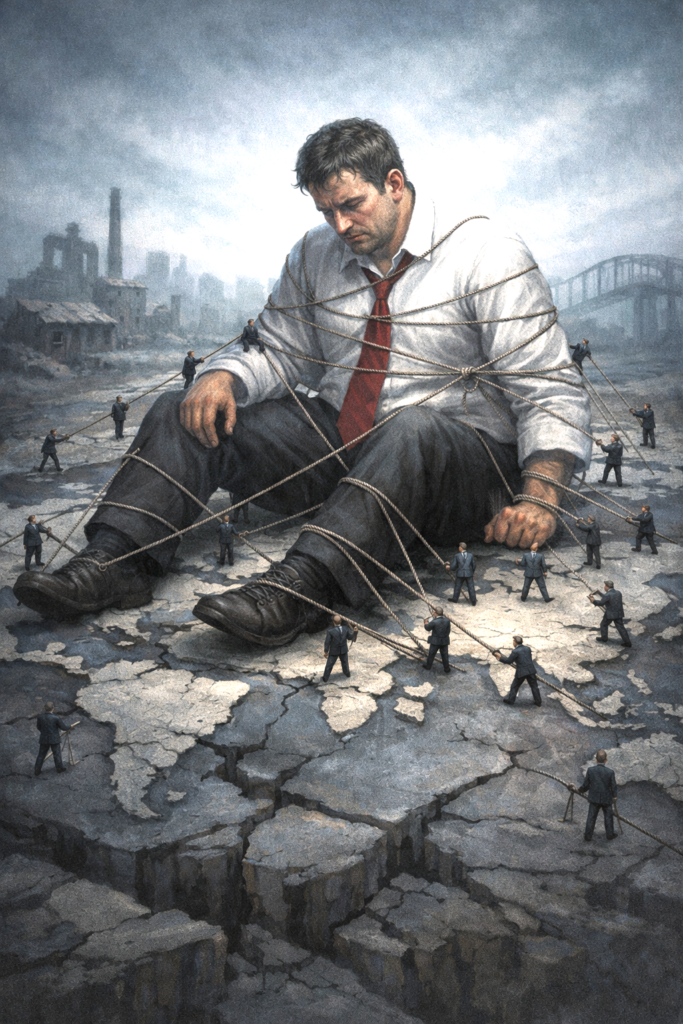
The paradox of the giant domesticated by Lilliputians
They create an environment of legal insecurity.
They desperately seek foreign capital because domestic capital has been suffocated.
Once capital arrives, it is viewed with suspicion or as a “box” from which quick resources can be extracted through changes in the rules of the game.
The result is that only “hot money,” money launderers, or high-risk investors arrive, who in turn demand leonine conditions to exploit local desperation, feeding the cycle of mutual plunder.
It is a pessimistic description, yet very real, of how institutions can end up working against their own people.
Society shifts from being a “society of progress” to a “zero-sum society,” where for one to win, another must lose, promoting corruption from top to bottom.
The State becomes a source of desperate resources, accessed through co-optation by friends of the regime.
This argument challenges the idea that progress is linear.
History shows that prosperity is not a guaranteed inheritance, but a fragile equilibrium.
When Lilliputian governance, short-termist, extractive and driven by small expectations, takes command of a society, what occurs is what may be called “managed decline.”
Let us look at the best in class who paradoxically became the most Lilliputian.
Argentina, the paradigmatic case
At the beginning of the twentieth century, Argentina was among the ten richest economies in the world, measured by GDP per capita.
It possessed cutting-edge railway infrastructure and an enviable educational system.
Lilliputian governance meant shifting from an open economy integrated into the world to a forced import-substitution model and chronic public spending financed by money printing and debt.
The result was decades of consuming accumulated capital. They ate through reserves and infrastructure to sustain subsidies, transforming an agricultural and industrial power into a society that today struggles with structural inflation and informality affecting more than 40 percent of a plundered society.
The United Kingdom and the so-called British disease in the 1960s and 1970s
After being the workshop of the world, the United Kingdom entered a spiral of decline that led it to be called the sick man of Europe.
Lilliputian governance meant that governments of both political signs focused on protecting obsolete and state-owned industries such as mining and steel through massive subsidies, while unions and employers engaged in zero-sum struggles.
The result was a halt in innovation investment. The country became less productive than its European peers, infrastructure deteriorated, and in 1976 the United Kingdom had to be rescued by the International Monetary Fund, a harsh wake-up call for a former imperial power.
Venezuela, from abundance to subsistence
In the 1970s, Venezuela was a destination for European immigrants and the most stable and prosperous country in South America.
Lilliputian governance followed the logic of plundering the investor through nationalization of the oil industry and massive expropriations, along with price controls designed to manufacture social justice, which destroyed the productive apparatus.
The result was that by exhausting resources and suffocating private initiative, society became dependent on government food boxes.
They went from being an energy power to experiencing one of the largest migration crises of the century.
These are only some outstanding examples, yet today the Lilliputian pandemic has advanced into the developed world, which lost momentum, settled into delegating work and living comfortably off financial extraction, or living off being financed.
Common traits of decline
Those who undertake are punished, and those who live off the State are rewarded.
Saved capital is consumed: maintenance of communication infrastructure, railways, roads, bridges, electrical grids and the educational system is neglected in order to finance current or political spending.
Talent exodus: the brightest minds that were costly to educate are the first to flee the society of contraction.
Blame narrative: the regal government justifies misery by blaming external factors, empires, the climate, the rich, or those who promote change for personal benefit.
It is the triumph of small-scale mentality over long-term vision.
A developed society, or one with development patterns, that stops investing in its future in order to survive until the next election is inevitably playing small, becoming Lilliputian.