Pride is the satisfaction and self-indulgence derived from contemplating one’s own virtues while holding others in contempt.
Pre-1959 Cuba was a country of profound contrasts.
It was a nation with macroeconomic indicators and levels of urban modernity that much of the world envied, yet marked by deep social inequality and strong external dependency, which generated constant tension.
During the 1950s, Cuba displayed what could be described as “first-world” economic indicators.
The Cuban peso was on par with the U.S. dollar.
Cuba ranked third in Ibero-America in per capita income and was the world’s 29th largest economy.
Today, Cubans exhibit similar or even better socioeconomic indicators only if they managed to escape the island and settle in capitalist countries.
The “Sugar King” economy depended almost entirely on sugar, which accounted for roughly 80 percent of exports.
This made the country prosperous when prices were high and destitute when they fell.
It generated the so-called “dead season,” during which thousands of rural workers were employed only during harvest time and left unemployed for the rest of the year.
Such fluctuations, in any place and era, foster resentment among workers whose livelihoods depend on external forces beyond their control.
The United States was Cuba’s main trading partner.
U.S. companies controlled large portions of public utilities, mining operations, and the most productive agricultural land.
They were the primary investors, but also widely perceived as privileged beneficiaries.
Technological Modernity
Cuba was a technological pioneer.
It was the second country in the world to introduce color television in 1958 and the first in Latin America to have a railroad system.
Its geographic position and technological infrastructure placed it in a strong position to overcome economic instability by diversifying workforce skills.
What the country needed was greater equality of opportunity and stable employment.
The so-called revolution eliminated the uncertainty of individual income only to replace it with an equalized form of servitude for all, except for a very wealthy ruling elite.
An amoral dictatorship emerged from an immoral one.
The Divide Between City and Countryside
Life in Havana bore little resemblance to life in the Sierra Maestra or the sugarcane fields.
The capital was a cosmopolitan hub, featuring luxury casinos, modern hotels, and a vibrant cultural scene.
It became a favored destination for celebrities and the U.S. mafia.
Prostitution existed by choice; under Castro, it became a necessity.
Health and Education
Cuba had one of the lowest illiteracy rates in the region at 23 percent and one of the highest ratios of physicians per capita.
However, these services were concentrated almost entirely in urban centers.
While the latest Cadillacs were purchased in Havana, 60 percent of rural inhabitants lived in huts with dirt floors, no electricity, and no running water.
Eighty-five percent lacked basic sanitation.
Equality arrived for everyone.
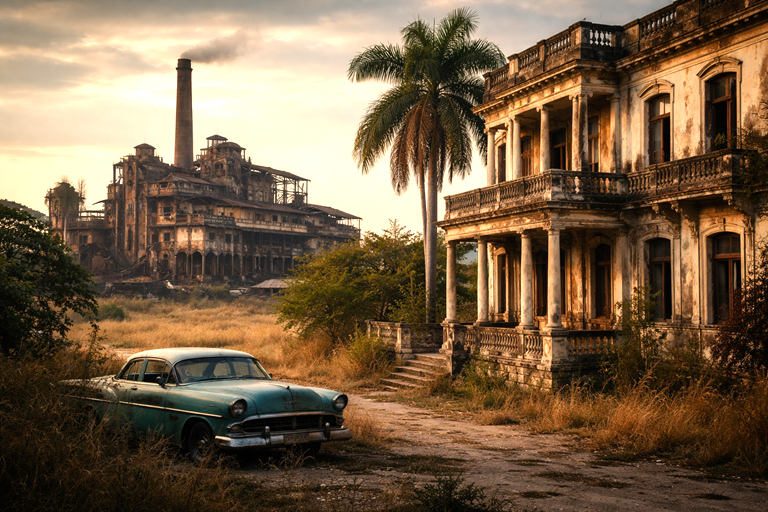
Poverty extended the useful life of those Cadillacs, which now survive solely as props for “poverty tourism.”
Corruption and Repression
The dictatorship of Fulgencio Batista, following his 1952 coup, was marked by rampant administrative corruption and severe political repression.
This alienated not only the poor, but also the middle class and intellectuals.
The world applauded Batista’s flight as the liberation from yet another dictatorship.
Cuba in the 1950s ranked third in Latin America in per capita income and caloric intake, had low illiteracy for the era, and ranked among the lowest in infant mortality worldwide, despite extremely poor rural infrastructure.
This duality explains why, despite favorable aggregate indicators, social discontent fueled support for the so-called revolutionary movement.
A Historic Backfire
The revolution led by Fidel Castro has endured for 67 years as one of the worst examples of human exploitation by humans.
Castro’s privileged upbringing shaped his worldview.
His father, Ángel Castro, a Spanish immigrant, amassed wealth through land acquisition and sugar production while working with the United Fruit Company.
His mother, Lina Ruz, of humble and nearly illiterate origins, worked on the estate.
This dual heritage forged an aristocratic conception of power and entitlement.
Submission of others became his formative school.
As commander, Castro claimed the right to appropriate the fruits of others’ labor and redistribute them arbitrarily.
He condemned millions of Cubans to dependency on Soviet subsidies, aligning himself against humanism and freedom during the Cold War.
Vanity drove him to become a willing instrument of totalitarian power.
After the collapse of real socialism exposed the devastation of his system, he chose persistence over reality.
He replaced Soviet subsidies with drug trafficking, blending it with terrorism and military complicity.
His ambition to dominate the continent set back Latin America for decades at immeasurable human cost.
He fostered ideological obedience, infiltrated democracies, and normalized ethical ambiguity.
After Castro, honesty and governance became incompatible terms.
Exiled Cubans thrived in free societies, proving that true change resides in individuals.
Fidel Castro remains a lasting blight on the economic and social development of the Americas, as long as the poison of communism persists.