Valcorba, or the sentence the Left pronounces
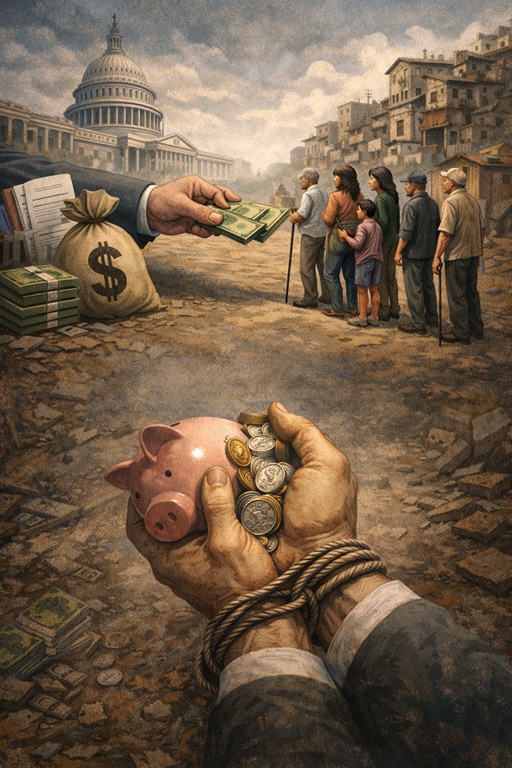
When the State spends what it doesn’t have and pays without restraint, it ends up competing with the private sector for credit (the crowding-out effect), which stalls private investment, jobs, and reproduces the conditions of poverty.
But then, why do voters mostly lean toward these left-wing proposals?
And we’re not alone here.
Just like several Latin American countries, now New York, too, is turning to socialism.
We could say, paraphrasing the popular saying: in the democratic, liberal, capitalist old age, North Americans move straight toward its opposite, driven by popular disillusionment with a patronage system that reduced opportunities for upward economic mobility.
The growth of the State as a political end
There is a phenomenon known in political science as “the expansion of the State” for reasons of control or clientelism.
In this case, it’s directly clientelism.
Or more precisely, because a target audience has been created that feels that welfare, subsidies, and handouts will solve their existential anxieties.
Expanding bureaucracy
To patch up, here and there, a public made poorer by the State’s advance and by the multiplication of public employment and spending, these people believe you have to press the accelerator.
Ministries and agencies are created to address new “social agendas,” inefficient structures that consume more and more resources, making it impossible for socialist “benevolence” to reach the final beneficiary.
Public budget disarray leads to spending more, through more abusive authorizing officers, ignoring budget constraints, the inefficiency of agencies without resources, and a deepening deficit.
Dependence on the State
By expanding the base of people who depend directly on a state transfer (employees, beneficiaries, subsidized groups), the government secures a loyal electoral base, even if this is fiscally unsustainable in the long run.
And it deepens the extraction of resources that could go to the only universally proven solution: saving, investment, capital formation with more entrepreneurship, generating real opportunities for the unemployed, underemployed, and poor or indigent in general who have the will to overcome their precarious condition.
“Fiscal illusion” and the lack of incentives
Interventionist public management ignores the Laffer Curve.
Raising taxes excessively, beyond taxpayers’ capacity, ends up collecting less because it discourages work and destroys savings and investment resources.
Social justification
It’s assumed that any spending is justified if it bears a “noble” name (education, health, poverty), even if execution is terrible, scarce resources are squandered, social indicators worsen, and an obscene debt inflation is imposed on posterity.
The triumph of utopia over the budget
Oscar Wilde said that a map of the world that doesn’t include “utopia” isn’t worth consulting.
But applying the Left’s utopian program in full, which is precisely what is now being tried to dismantle, is like trying to paint an Impressionist mural using triangles.
The paradox is plain to anyone without a bucket for a mind: it bets on such an absolute redistribution of wealth that, in the end, no one will have enough to be considered “rich,” eliminating, among other important things, the only interesting occupation of the upper class: being the target of criticism at charity dinners.
And, of course, it singles out the only ones who dared to restrict personal spending in order to invest in a business and give work to those who don’t, or can’t, go through that process.
The result is that the Ministry of Economy stops being an office of numbers and becomes a department of epic storytelling, where the fiscal deficit is treated not as a problem but as an artistic license.
The dictatorship of collective virtue
For the Left, the authentic revolutionary must not demand that each person live as they wish, but demand that others live the way they want.
It seems that not even taking Maduro to “mature” in the U.S. has made Americans notice that.
Worse still, not even in New York do they hear the Cubanized English that tells the story of crossing on a raft, risking one’s life, to escape what has now been voted for.
The application
If the socialist program (softened at first) were applied 100%, society would become so “perfect,” so compulsorily “solidary,” and so “equitable” in restricting spending that boredom would be the leading cause of death.
The clash is that, without the “necessary” inequality to feed resentment or ambition, the socialized would lose their national sport: complaining.
A country where everything works according to the Left’s “program” is a country where ingenuity dies from lack of use.
Science versus style
Valcorba, our deputy minister of economy, acts here like a literary critic who says the plot is implausible.
A true leftist would reply that “reality is a detail of no importance.”
The irony is that, when trying to finance the infinite with the finite (the original sin of any comprehensive left-wing program worthy of the name), the voter should have understood that money has the bad habit of being deeply conservative.
It tends to go to sleep in other countries when it feels watched and constrained, or when it senses the tax collector’s hand nearby.
The final scene is that the program, if applied in full, would become a masterpiece of fiction literature.
It would be aesthetically impeccable on paper, but unbearable to read in real life.
In sum, a Pyrrhic victory
If everything Valcorba says can’t be done were applied, the Left would achieve what no party has achieved: failure by excessive success of a narrative that killed the factual.
A system would have been created so meticulously designed for “well-being” that the individual would disappear under the weight of state benevolence.
As Oscar Wilde would say: “There are only two tragedies in life: one is not getting what one wants, and the other is getting it and realizing what it’s for.”