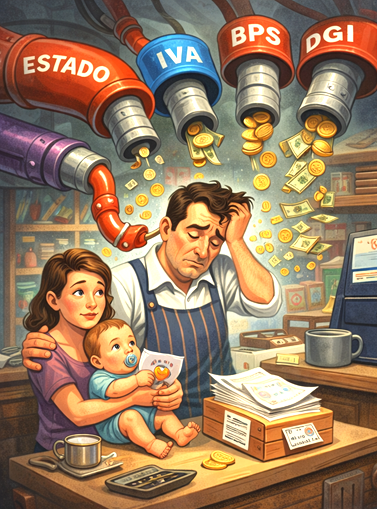
In Latin America we believe that freedom is only economic, and that it is achieved at the expense of everything else.
We are poor in Latin America because we do not believe in ourselves and we completely delegate our power, our authority and our rights to providential leaders, waiting for the State to solve what is exclusively our own responsibility.
The State, or the politicians who decide on its behalf, will not lift anyone out of poverty, except themselves, their lovers, and the nepotistic networks they use to reward relatives.
No leader has all the answers and no state can efficiently manage the complexity of a society’s interactions.
The political system solves its problems through the abusive or corrupt use of the money it is responsible for administering and accounting for.
We do not believe in individual freedom, in the virtues of competition, or in the opportunities offered by trade.
We tend to trust ideologies with voluntarist narratives or populist figures to solve our problems.
A huge number of people distrust economic and social growth based on merit and effort. We distrust progress. We believe that redistributing other people’s wealth until we are all equal is just and necessary to reduce social and economic gaps.
Since we do not believe in free competition, we envy. And above all, we are dishonest, because we claim the wealth of others as a natural right.
In doing so, we not only punish those who strive to create wealth, but we also incentivize them to stop doing so.
In Latin America we suffer from the prisoner’s syndrome: we prefer a mediocre jail to freedom.
There is a growing tendency toward corruption, which is widely tolerated.
There is a willingness to justify theft, violence and the violation of freedom in the name of equality in misery, which we comfortably accept as a generally just solution.
We do not believe in freedom with responsibility, nor in competition within a legal framework that treats us equally.
Our most powerful citizens create and maintain networks of economic and social influence that strangle the middle class and the poor, thus perpetuating inequality.
Those who govern try to emulate viceroys. Instead of seeing power as a temporary circumstance, they consider it a right to extend it until an opposing force manages to remove them.
That is the most painful nightmare of our peoples. We remain stuck in a world of kings and vassals. When someone gains a position, those who supported them aspire to displace whoever previously held it.
Minorities are subjugated and never considered anything more than opposition. They submit to the rules of the game, trying to denounce the abuses of the majority, without contributing meaningfully to improving the collective situation.
Those who take office are satisfied with applying patches to a reality that is becoming critical, without even accepting when the abyss they are approaching is pointed out to them.
Because we are the way we are, there is no equality of opportunity in our societies. Some want unnatural equality for everyone, while others want all opportunities only for themselves.
For all these reasons, there is no real wealth creation in Latin America. What actually exists is a zero-sum economy in which the available wealth is based exclusively on natural resources.
Those resources are expropriated by the State in order to politically dominate the population, or they are appropriated by national or foreign private actors who build and maintain networks of political influence to secure indefinitely the economic and social power they have gained.
Otherwise, when a private investor is persuaded to come, we change the rules of the game as soon as political conditions allow abuse.
We ignore, or refuse to see, that the great human institutions and the rules of individual behavior recognized as virtuous emerged spontaneously and were not created by intellectual constructs, much less by absolutist powers.
We are poor by majority vocation, believing in the magical realism of narratives that have been proven to fail, in the words of someone who feels close to us or invents “nice” words.
We do not believe in the laws that have emerged from the complexity of historical evolution, which have proven superior in overcoming the base poverty that characterizes us.
The worshipers of the vulgar have defeated culture, which they label “popular,” in order to overvalue what is crude, decadent and disintegrating of what should unite us: THE VALUES THAT HAVE BEEN CULTIVATED THROUGH DECANTATION.