
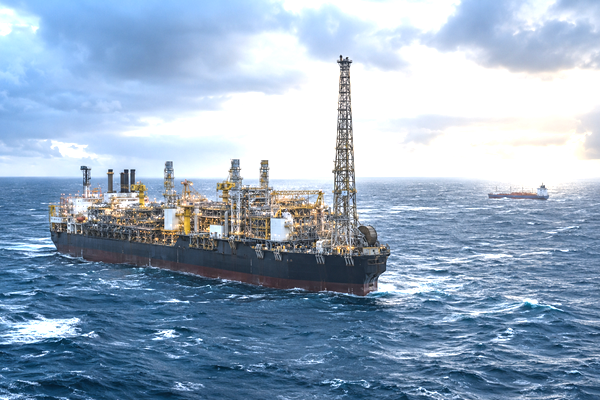
As Argentina steps up legal and political pressure on Sea Lion, the project continues to advance.
De-escalation could turn geopolitical risk into economic value and create a strategic role for Uruguay.
SEA LION: THE COST OF CONFLICT AND THE DIVIDEND OF DE-ESCALATION
The dispute surrounding Sea Lion has entered a new phase.
Argentina has stepped up its opposition to the oil development north of the Falkland Islands/Malvinas.
A federal judge in Río Grande has issued an interim order requiring Navitas Petroleum and Rockhopper Exploration to refrain from initiating, continuing or carrying out activities related to the project.
The Argentine government has gone further, announcing its intention to pursue international arbitration against the United Kingdom.
Sea Lion, meanwhile, continues to move forward.
That apparent contradiction may hold the key to what happens next.
ARGENTINE PRESSURE HAS NOT STOPPED THE PROJECT
Argentina regards unilateral hydrocarbon development in the waters surrounding the islands as an infringement of its sovereign rights and has deployed political, administrative and judicial measures to challenge it.
The dispute has therefore moved beyond diplomacy.
It is now before the Argentine courts and could increasingly spill into international law.
Yet the commercial response has not been to put Sea Lion on hold.
Rockhopper continues to target the first quarter of 2028 for first oil.
Navitas and Rockhopper took the final investment decision on the first phase of the Northern Development Area in December 2025.
Financing for that phase includes US$1 billion in senior debt.
More recently, the partners have moved towards a much larger second stage through the planned acquisition of the OSX-1 FPSO for the Central Development Area.
The aim is to increase Sea Lion’s future production capacity substantially.
This changes the nature of the problem.
Argentina can raise the political, legal and commercial cost of the project.
So far, however, there is no evidence that it has made Sea Lion economically unviable.
THE COST OF CONFLICT
The fact that Sea Lion can proceed despite Argentine opposition does not mean that the dispute comes without a price.
Argentine sanctions may affect suppliers, insurers, contractors, financiers, transport operators and companies with interests both in Argentina and elsewhere in the region.
They may also complicate a supply chain that will need to operate for decades in one of the world’s most remote maritime environments.
In economic terms, this amounts to an Argentine risk premium.
There is no need to overstate it.
It is enough to recognise that it exists.
Any company weighing participation in Sea Lion against other regional interests will have to factor that risk into its decisions.
Any logistics solution designed to avoid jurisdictions, suppliers or infrastructure exposed to Argentine sanctions carries a cost.
And every new political escalation adds uncertainty to a project whose operating life may extend over several decades.
That is also where an opportunity emerges.
THE DIVIDEND OF DE-ESCALATION
A negotiation need not begin by asking who is right about sovereignty.
Decades of experience suggest that starting there is a reliable way of ensuring that nothing else moves.
A more useful opening question might be different.
How much economic value could be created if some of the risk generated by the dispute were removed?
Cooperation does not have to make Sea Lion viable.
Sea Lion is already moving forward.
It has to make cooperation more valuable than confrontation.
Future Argentine economic participation could then become an instrument of de-escalation without altering either side’s legal position on sovereignty.
YPF, Argentine companies or purpose-built structures could participate in later developments, services, logistics or investment.
That would not settle the Falklands/Malvinas dispute.
It would provide a way to stop destroying value while the sovereignty question remains unresolved.
Nor would the idea be entirely without precedent.
Argentina and the United Kingdom demonstrated in the 1990s that arrangements for cooperation on hydrocarbons could be explored without either side abandoning its sovereignty position.
The political circumstances today are very different.
The underlying principle nevertheless remains relevant.
Cooperation does not necessarily require renunciation.
THE PROJECT IS NOW MUCH LARGER
There is another important difference from earlier discussions.
Sea Lion is no longer merely a single oil development.
The acceleration of the Central Development Area creates the prospect of a second major production phase.
Rockhopper has indicated that the planned CDA development would involve 38 wells across its first two phases.
Navitas expects to submit its development plan in 2027 and is targeting a final investment decision during the first half of 2028.
That considerably widens the space for negotiation.
The first phase is already financed and under way.
Later phases still leave room for new capital structures, corporate participation, services and logistics.
A carefully constructed negotiation would not necessarily have to reopen decisions that have already been made.
It could concentrate instead on the value that has yet to be created.
AND WHAT ABOUT URUGUAY?
This is where an opportunity emerges that Uruguay would do well to examine carefully.
Montevideo does not need to become a party to the dispute.
Its potential value lies precisely in remaining outside it.
Uruguay maintains normal relations with Argentina, the United Kingdom, Israel and the United States.
It has ports, an international airport, financial and medical services, maritime suppliers and a geographical position that makes it a credible base for certain support functions in the South Atlantic.
It need not replace Punta Arenas or other established logistics bases.
It can complement them.
More importantly, it can offer something particularly valuable in a politically sensitive environment: a logistics platform located outside the jurisdiction of the parties directly involved in the dispute.
Neutrality in this context does not mean indifference.
It means predictability.
Uruguay could provide services under its own laws without taking a position on sovereignty and without becoming involved in the exploitation of disputed resources.
The greater the risk that the political dispute spills into regional supply chains, the more valuable that position may become.
A NEGOTIATION FROM POSITIONS OF STRENGTH
There is one final condition.
Any negotiated outcome is unlikely to endure if either side tries to portray it as the other’s capitulation.
Navitas and Rockhopper do not currently appear to need a negotiation in order to rescue Sea Lion.
Argentina, for its part, cannot realistically abandon a claim that has endured across governments, political parties and generations.
That may look like an obstacle.
It could also be an advantage.
The most durable negotiations often begin when neither side is required to surrender.
Oil may deepen the conflict in the South Atlantic.
But it can also change its incentives.
For decades, the Falklands/Malvinas question has been overwhelmingly about territory, history and sovereignty.
Sea Lion introduces something different: tangible, growing and measurable economic value.
The relevant question is therefore no longer simply who can prevent whom from doing what.
It is how much value all sides are prepared to lose in order to leave the conflict exactly as it is.
And how much they might gain by finding a way to manage it.
That is the real dividend of de-escalation.
Sea Lion, Falklands/Malvinas, Argentina, United Kingdom, Navitas Petroleum, Rockhopper Exploration, oil, South Atlantic, geopolitical risk, de-escalation, Uruguay, Montevideo, regional logistics, YPF.
Apoyá la continuidad de Perspectiva Liberal
Perspectiva Liberal es un espacio editorial independiente. Si valorás este trabajo y querés colaborar con su continuidad, podés hacerlo mediante un aporte voluntario a nuestra cuenta Prex.
Cuenta Prex: 13440