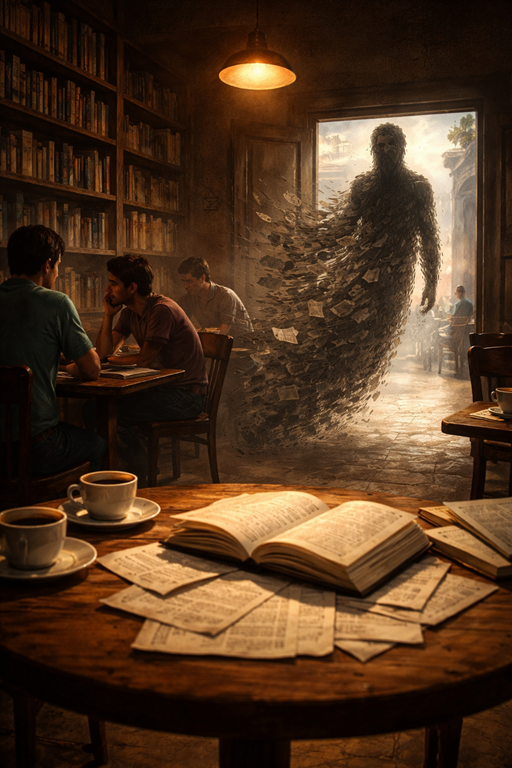
How a Bearded Hidalgo Sold Mirages for Gold and a Thirst for Blood to Prosperous Nations
Let us allow Cervantes to lend fascination to the tale of this story.
In a corner of the Ocean Sea, where the sun seems never to set upon the vanity of men, there emerged a tall-booted knight with torrential speech who decided that his destiny was not to govern an island, but to become the master of all Southern wills.
The discreet are right to say that selfishness is the only vice men forgive in their idols, provided they have the courtesy to call it “sacrifice.”
That hidalgo, whose name history will take great care to forget with scrivener’s precision, understood that the world was weary of the dullness of peace and thirsty for the intoxication of tragedy.
Uruguay, Argentina, and the nations of balance in these lands were, in the 1960s, like well-ordered ancestral homes.
There was bread in the pantries, books on the shelves, and a middle class that, in its blessed monotony, allowed itself the luxury of dreaming of utopias: a small house and a modest car.
Ah, the middle class. That stratum which possesses too little to be free, yet enough to be envied.
It was against this class that the Bearded Knight cast his first enchantment.
For observe well: nothing does a bourgeois intellectual, the landed gentry’s offspring, desire more than the destruction of the system that allows him to exist as nothing more than a bourgeois intellectual.
The strategy was diabolically elegant.
No warships were sent, for war is expensive and stains linen suits.
Words were sent. Agents were dispatched who, like modern squires of falsehood, infiltrated the cafés of Montevideo and the universities of that city and of Buenos Aires.
Their mission was simple: to convince the prosperous that their prosperity was a sin of selfishness, and the worker that his effort was a chain binding him to poverty.
“Social justice is the name tyrants give to theft so that the victim feels guilty for protesting.”
In the minds of the very young was planted the idea that life was a farce of black and white.
Either one stood with the “Revolution” —that capricious lady who always demands blood to preserve the epic of youth— or with the sinful “Past” of exploitation.
There was no room for nuance, nor for the gray of the Constitution, nor for law, nor for the nobility of dialogue.
Uruguay, which had once been a garden of understanding flavored by the informal “chinchulín pact” that distributed offices among compatriots, began to see foreign weeds of suspicion growing between its paving stones.
The archives rescued by the chronicler Yofre from the claws of oblivion show that while freedom was spoken of in public squares, rifles were being counted in the shadows, waiting to persuade the lukewarm when burning outbreaks of violence made it possible.
“Operation Manuel” was not a poet’s dream, but an expense report paid for by distant powers that spoke with the cold accent of the steppes.
The assault on heaven was being prepared, but first it was necessary to turn the earth into an inferno of scarcity and shortages.
Producers of goods were scorned, merchants vilified, and the guerrilla crowned the sole virtuous man of the age.
But what happens when bread disappears because the baker has been imprisoned?
What occurs when the wise man is replaced by the political commissar?
The result was a nation that began to feel a new hunger: not only hunger for bread, but hunger to understand itself again, for formality, solemnity, truth, and future.
The Bearded Knight smiled from his island, knowing that a people who think only of their next ration have no time left to think of their next rebellion against him.
Totalitarianism dressed itself for a celebration, and the guests, intoxicated by rhetoric, failed to notice that the ballroom doors had been locked from the outside with iron bolts.
But ah, reader, this is only the first scene of our comedy.
For while deception was consolidating, a young physician with a restless spirit and adventurous asthma was preparing his bloody entrance onto the stage, determined to carry this madness to its ultimate consequences, unaware that his face would one day adorn more T-shirt displays than his ideas would inspire hearts truly willing to die for a blood-soaked utopia.
What dark pacts were signed in the shadows of Havana for Uruguay to lose its compass?
Who were the “useful fools” who, for flattery or a paid trip, handed over the keys of their own house to the enemy?
Prepare yourselves, then, for the next chapter, where we shall see how gunpowder began to replace ink, and how the “Knight of the Sorrowful Machine Gun” began his macabre dance across the lands of the South.