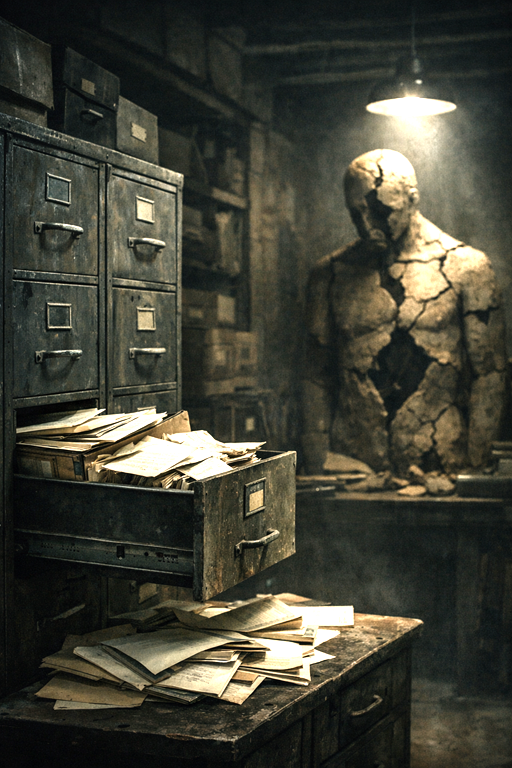
Of the Scribes of the Shadow and the Stripping of the Idols of Clay
It came to pass, reader, that while the peoples of the South danced to the flute of the Bearded Knight, other men, more discreet and far less eloquent, devoted themselves to the monastic task of writing everything down.
They were the scribes of the shadow, agents of the Czechoslovak StB and other intelligence services from beyond the Iron Curtain, men who understood that the best way to possess a man is not to convince him, but to have his weakness documented.
The archives unearthed by Yofre, with the skill of an archaeologist of human misery, reveal that the so-called “revolution” was not an outburst of idealism, but rather a bookkeeping office for organized chaos.
In Montevideo, Buenos Aires, and Santiago, the Cuban frenzy relied on these bureaucrats of espionage to turn men of letters into straw men.
Alas, what a sad spectacle it is to see an intellectual selling his pen for a trip to Havana or a pat on the shoulder from a political commissar.
There is no cheaper vanity than that of one who believes he is making history when he is merely serving as a useful fool for a system that holds him in contempt.
The documents expose, with technical cruelty, how shortages were deliberately planned and how contempt for the middle class was methodically cultivated.
The reports spoke of the need to “sharpen contradictions,” which is nothing more than pouring salt into the wounds of the poor so that pain prevents them from seeing who the real surgeon is.
The objective was to make the producer of goods, the small shop owner, the man who sustained his family and the balance of the nation through savings and effort, feel like a leper in his own land.
For totalitarianism, an independent citizen is an affront, and a hungry citizen is a subject.
“The true tragedy of political falsehood is not that the people believe it, but that the ruler ends up believing the people are as stupid as he needs them to be.”
In this chapter of our history, we witness the stripping bare of the idols.
“Che,” that mystic of the firing squad, appears in the documents not as the saint of T-shirts, but as a failed strategist who regarded the peasants of the South as mere pawns in his bloody chessboard.
And Chávez, heir to the oil-soaked checkbook, emerges as the great purchaser of consciences.
The archives trace the money’s path: bags heavy with dollar bundles crossing borders in silence, funds destined for strikes that sought not the worker’s welfare but the collapse of democracy itself.
Uruguay, in its innocent self-image as the “Switzerland of the Americas,” became the stage for one of the most subtle infiltrations.
We see how factions were created within political parties, how a politics of “black or white” was financed so that brothers would stop speaking to one another.
The goal was for the average citizen, overwhelmed by scarcity and the noise of gunfire, to end up begging for “order,” even if that order meant the cemetery, the prison, or despair over a piece of bread or an egg.
The cruelty inflicted upon the poorest was absolute.
They were promised heaven while being stripped of their last shred of hope.
Yofre’s archives prove that their redemption was never sought, only their dependence on a hired thug.
A people dependent on a ration card to eat is a people that has lost the capacity to say “enough.”
And that, reader, is tyranny’s supreme victory: not the silence of the dead, but the enslaved obedience of the living.
Yet fate has its own twists.
Those archives meant to be burned to erase the trace of infamy survived in Prague’s basements and in forgotten intelligence boxes.
Yofre recovered them and, in doing so, transformed deception into evidence.
The Caribbean retablo of marvels now stands revealed as what it always was: a cardboard stage sustained by the vile ambition of a few and the incentivized blindness of many.
What happened when these infiltration plans collided with the reality of a people that, despite everything, refused to die.
How bitter was the awakening of those who, having given everything for the “cause,” discovered they had merely been instruments of a foreign tyranny.
Do not turn away from this reading, for in the final chapter we shall witness the fall of the clay gods and the lesson the past leaves for the present, before the ink dries and history delivers its definitive sentence.