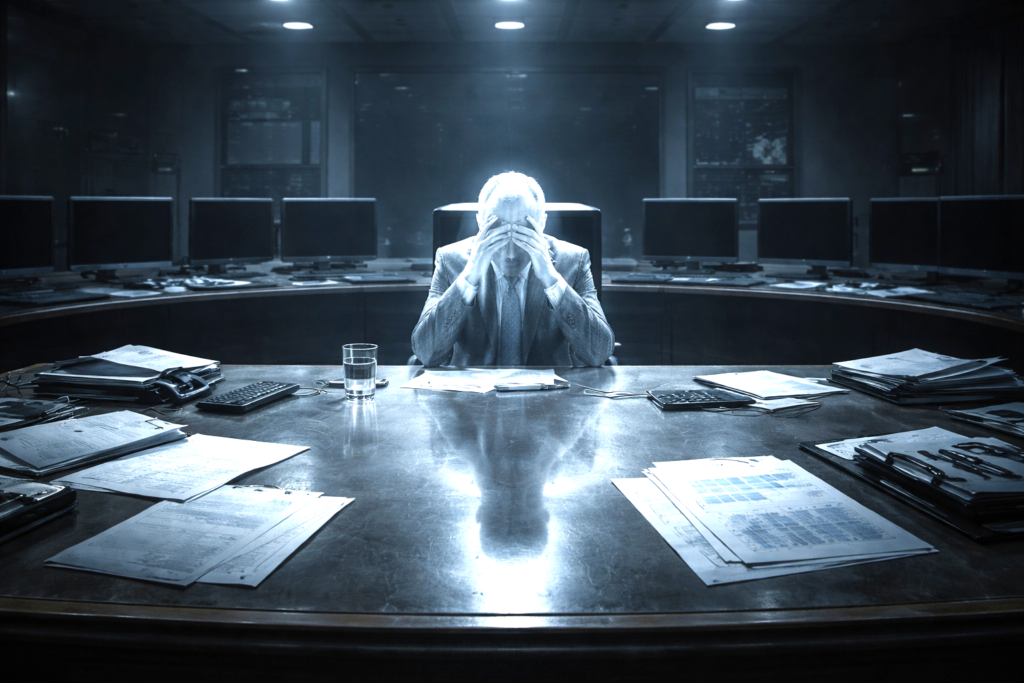
Why weak executives are failing in a world shaped by technology and geopolitical competition
The end of ineffective presidents
In this new global era, societies can no longer afford ineffective leadership.
Review. The anatomy of inaction
Contemporary politics is experiencing a silent crisis. Not through dramatic institutional collapses, but through a persistent aesthetic of failure. Governments continue to function, administrations fulfill formal procedures, yet lack any real transformative capacity.
Within this landscape emerges the figure of the “glass president”. A coalition leader who, by attempting to be transparent to everyone, ultimately becomes invisible. Authority dissolves into endless consensus-building exercises that no one truly believes in, but everyone accepts as an excuse to avoid decision-making.
The obsessive pursuit of consensus becomes a polite form of economic and social paralysis. Nothing breaks, nothing reforms, nothing is restructured. And yet, by refusing to break anything, these governments end up breaking the future.
This dysfunction is amplified by the structural inability of postmodern bureaucracies to absorb the specialized knowledge demanded by the 21st century. Artificial intelligence, cybersecurity, non-kinetic warfare, global logistics and technological finance remain far beyond the comprehension of traditional political elites.
In this context, the rise of disruptive leaders is not an accident nor a populist anomaly. It is a systemic response by societies that prefer the noise of rupture over the silent stagnation of inaction.
Understanding why governments that refuse to break anything ultimately break their citizens’ future is essential to interpreting global politics today.
The paralysis of giants. Geopolitics of immobility in a changing era
Economist Enrique Iglesias has offered one of the clearest diagnoses of this historical transition. We are not living through an era of change, but through a change of era.
The seventy-five years following World War II were the most prosperous in human history. That cycle has ended. The American-led order depended on a single dominant power. That balance collapsed with China’s rise.
In this new stage, national survival depends not on territory or resources, but on the sophistication of technical-political teams and executive clarity. Those unable to grasp artificial intelligence, quantum computing and technocratic power structures are doomed to irrelevance.
This transformation is evident in the leadership structures of the United States and China, where technology, capital and military power operate as integrated systems. Modern competition seeks paralysis, not destruction.
Meanwhile, many countries remain led by presidents unfit for this reality. They cling to empty rituals, mistaking inertia for stability, while the future moves on without them.