Which leaders are we talking about?
The cost of “banality”
The worst effect of these leaders is not the money they appropriate (which is considerable), but the opportunity cost.
While these societies debated political or criminal responsibility for Cristina’s handbags, Maduro’s birds, Fernández’s parties at the Olivos presidential residence, or the legal proceedings against Sánchez’s relatives, and others suffered through endless wars, the rest of the world was advancing in technology, education, and sustainability.
Social backwardness is not just poverty; it is a loss of hope that personal effort can change reality.
When the example set from above is impunity, the torn social fabric requires generations to mend; and sometimes a period of totalitarianism.
The diagnosis is stark: any country lacking the infrastructure to interpret artificial intelligence, quantum warfare, and the dynamics of technocratic power is irrevocably destined for extinction, or worse, a quaint irrelevance that will not appear in history books.
In this era of change, ideology is merely an excuse to halt progress or camouflage corruption. Traditional conflagration is dead; the most feared weapon is not the one that explodes, but the one that emits an imperceptible hum.
High-Power Microwave (HPM) weapons represent the apotheosis of human technological stagnation.
These systems operate on the principle of converting electromagnetic energy into high-power radiation to implement a “soft kill” on enemy information systems, leaving the adversary with a collection of useless hardware that serves only to decorate the landscape.
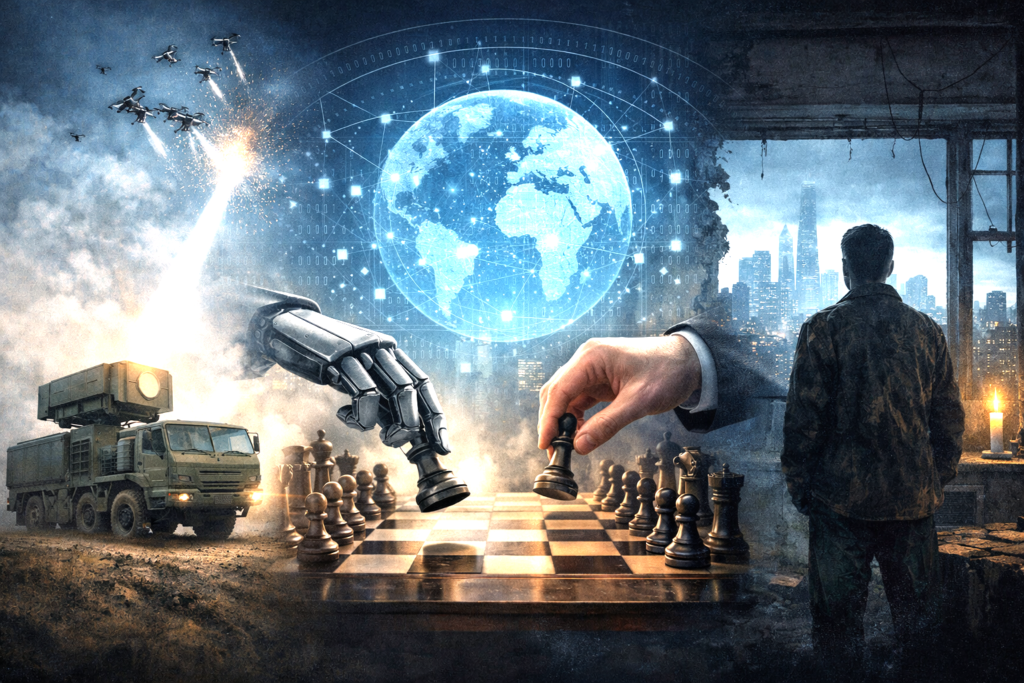
China has taken the lead in the deployment of these “military appliances” with the Hurricane series. Unveiled at the 2024 Zhuhai Air Show, these systems have been designed to counter the drone swarm.
The Hurricane 3000, mounted on a Shaanxi Auto 8×8 truck, features a giant movie screen designed to project a pulse that instantly fries the circuits of hundreds of drones simultaneously.
The scientific irony lies in the economy of firing.
While a conventional missile-based air defense system can drain the national treasury trying to shoot down five-hundred-dollar drones, the Hurricane fires bursts of energy that cost only pennies of electricity.
It is the victory of thermodynamics over logistics: the adversary is rendered immobile because its electronic “eyes” have been blinded by a flash invisible from miles away.
The American answer to electromagnetic immobility is called “Leonidas,” developed by the company Epirus.
What makes Leonidas a piece of “elegant irony” is its software-defined nature. Using gallium nitride (GaN) semiconductors instead of the old, bulky vacuum tubes, the Leonidas can fine-tune its energy beam with surgical precision to disable a single hostile drone or saturate an entire volume of space.
The Trump administration has integrated the Leonidas into its “Golden Dome” architecture, a defensive dome that promises to immobilize any low-altitude threat before it can even detect its target.
Instead of a physical projectile, we have an “energy wall” that causes no collateral damage, leaves no shrapnel, and requires no one to be buried alive; a war where the only casualty is the enemy’s balance sheet.
If machines can be paralyzed by microwaves, humanity has found its own “invisible lock” in the Active Denial System (ADS).
It is one of the most intriguing and refined applications of millimeter-wave physics, designed to stop suspicious individuals or hostile crowds without causing them a scratch.
The ADS operates at a frequency of 95 GHz, emitting an energy beam that travels at the speed of light and penetrates human skin to a depth of only 1/64 of an inch.
Unlike a conventional microwave oven, which operates at 2.45 GHz and cooks tissues from the inside out, the ADS remains on the surface, exciting water and fat molecules to produce an intolerable sensation of heat.
The result is the “repulsion effect”: the subject feels as if their skin is on fire and instinctively moves to escape the beam.
The adversary cannot advance, cannot fire, and cannot think, because their brain is completely occupied processing the false information that they are being turned into a human barbecue.
Once the individual is out of the beam, the sensation disappears without leaving permanent damage; the ideal weapon for this “changing era” where public opinion and international law scrutinize every drop of blood spilled.
Alongside the heat ray, the Long Range Acoustic Device (LRAD) has been elevated to the status of an urban legend.
Although known as a “sound cannon,” its function is to immobilize through auditory disorientation and physical pain induced by sound pressure.
In recent incursions, such as those by Maduro and his Cuban mercenaries, rumors have circulated about secret sonic weapons that cause nosebleeds and vomiting, but such effects are the result of panic and disorientation, not a magical frequency that ruptures organs from a distance.
However, the LRAD’s ability to stop an intruder simply by projecting a warning tone that makes knees buckle and balance is a fundamental tool in the arsenal of immobilization.
It’s war transformed into a poorly tuned disco from which no one can escape, an elegant and comical solution to the problem of overly enthusiastic sentries. In this era of change, power is no longer a matter of infantry battalions, but of swarms of drones coordinating their actions like a single hive mind. Paralysis here is achieved through saturation: the defender has so many targets to attack that their defense system simply “surrenders” due to the mathematical impossibility of intercepting them all.
China has unveiled the Jiu Tian, a 10-ton “mothership” capable of launching swarms of smaller drones from a modular cargo bay.
While traditional drones are slow and easy to detect, the Jiu Tian flies at 900 km/h, allowing the swarm to be deployed in the heart of enemy territory in a matter of minutes.
The true scientific magic lies in “swarm intelligence.”
The drones are not individually controlled by a human (which would be a logistical nightmare), but rather use algorithms inspired by the behavior of bees or birds to adjust their formation, cover search areas, and respond to threats autonomously.
The result is the complete immobilization of the adversary, who finds themselves surrounded by a cloud of machines that block their communications, interfere with their radars, and, if necessary, carry out surgically precise attacks.
The United States’ “Replicator” program seeks to counter the Chinese drone fleet with its own wave of thousands of cheap, disposable autonomous systems, slated for completion in August 2025, under the direction of the War Department’s new “technology vendors.”
Replicator focuses on “Collaborative Autonomy.”
The irony of this approach is that the Pentagon is trying to solve a military problem using a mass-production model that more closely resembles the production of mobile phones than fighter jets.
DARPA Director Stephen Winchell has made it clear that the goal is to build “easily manufacturable” robots in third-tier shipyards and local workshops, ensuring that quantity has its own immobilizing quality.
An enemy facing ten thousand drones is not fighting a war; it is trying to empty the ocean with a spoon.
To complete the picture of this epochal shift, we must delve into the invisible: computer code and biochemistry. Here, immobilization requires neither light, nor sound, nor heat; it requires only the manipulation of information and physiology.
In 2025, cyberwarfare has evolved from simple data theft to the “immobilization of critical infrastructure.”
The technical teams of Trump and Xi have “non-kinetic effects” units that can shut down a power grid, stop the water supply, or paralyze an entire nation’s transportation systems with a single line of code.
The irony of this method, tested on Maduro and Cuban mercenaries, is that the adversary often doesn’t know they are under attack until it’s too late.
Surgical cyber operations disguise themselves as technical glitches, update errors, or maintenance issues, immobilizing a government’s ability to respond while it attempts to “reboot the system.”
It is the paralysis of the modern state, so dependent on connectivity that it becomes vulnerable to a digital lock no one can see. Finally, scientific progress in biochemical incapacitating agents offers the possibility of “switching off” the enemy at the cellular level.
Current research on agents such as BZ or fentanyl derivatives seeks to create conditions of temporary immobility lasting hours or days, allowing an elite force to capture a position without firing a single shot.
These agents act on the central nervous system, inducing states of confusion, sleep, or reversible muscle paralysis.
Xi’s technical-political team, for example, has integrated these studies into its vision of “smart warfare,” recognizing that a sleeping soldier is much easier to manage than a dead one.
It is the ultimate expression of comic elegance: winning a battle because the opposing side decided, collectively and involuntarily, that it was an excellent time for a deep nap.
The Triumph of Intelligence over Brute Force, in a SHIFT OF ERA that is already here, and which is merciless with the unprepared. The ability of Trump and Xi to surround themselves with teams that operate microwaves, swarms of drones, heat rays, and computer viruses is what allows them to dictate the rules of the global game today.
The immobility of the adversary is not just a military tactic; it is a metaphor for technical and political superiority in the 21st century.
The elegant irony of our era is that war has become so sophisticated that, in its purest form, no one has to die; they only have to remain very still, silent, while the future passes them by.
Our backward leaders must quickly decide which side we will take, since they are useless; let us trust in chance so that this time, they get it right.