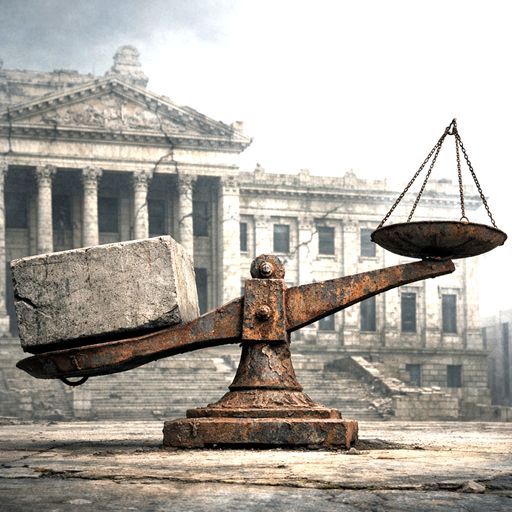
How political incompetence and permanent debt hollow out parliaments and suffocate productive economies
When taxation is no longer sufficient, Parliament authorizes permanent increases in debt or monetary issuance, which function as deferred or hidden taxes, deepening long-term damage without any serious cost-benefit analysis.
What may once have been, millennia ago, a mechanism to overcome critical situations has become in postmodernity an indispensable oxygen tank for an Executive suffering from acute economic sclerosis.
The most serious aspect of endemic indebtedness is not merely its existence, but the fact that it is ignored. This grants executive abuse, with legislative complicity, an appearance of legality.
The Executive can claim that the budget was “debated and approved,” that it passed through “technical controls,” and that it is “funded,” when in practice those controls were silenced or neutralized by party discipline and the complicity of a so-called opposition.
Ultimately, Parliament has renounced its very reason for existence.
It is no longer a limit on power, but the lubricant that allows the Executive to exercise absolute authority under the guise of law.
It has become a structure that chooses to remain ignorant of the economic consequences of its actions in order to avoid the political cost of austerity or deep reform of a disordered public expenditure.
The decadence that weighs upon us is irreversible and ongoing.
The situation worsens when the president and ministers are incompetent and place ideology above the responsibility of governing.
We are facing confirmation of systemic degradation. When institutional structures are defective, the mediocrity of those who execute them acts as a catalyst for collapse.
If Parliament renounces its oversight function and limits itself to echoing the Executive, the quality of those occupying ministerial offices becomes the final nail in the coffin of state efficiency and rational prioritization of scarce resources.
This combination of factors generates a scenario of functional paralysis and active harm.
An incompetent minister does not merely fail to solve problems, but multiplies them through inefficiency and disorder, fostering waste.
Lacking knowledge of effective management, such ministers generate redundant structures.
They create commissions, secretariats and unnecessary positions to compensate for their own inability to govern, increasing public spending without productive return and facilitating corruption.
Lacking technical training, the minister becomes hostage to bureaucracy, corporate pressures seeking self-preservation, or private interests that capture the budget through poorly drafted or harmful resolutions.
In a healthy system, Parliament should question and remove mediocre ministers.
However, within this degenerated “elective autocracy,” political shielding by legislators loyal to the system protects incompetent ministers not for their performance, but to avoid exposing governmental failure.
Parliamentary hearings become media spectacles without legal or technical consequences. Slogans are debated, not numbers or economic impacts.
When political leadership is incompetent, the only response it knows to poor results is extraction of more resources.
Unable to grow the economy or encourage investment, it raises taxes, abuses public pricing, or expands debt to cover the gaps left by disastrous management.
The productive citizen faces a state that demands more while delivering increasingly inferior services administered by individuals detached from real-world complexity.
Irreversibility is evident because it rests on institutional entropy.
The abnormal system has lost the capacity to self-correct.
Incentives favor the rise of mediocrity while technical competence is ignored.
Parliament lacks both the will and the knowledge to restrain abuse, as its members belong to the same caste benefiting from expanding expenditure.
The state enters a phase of autofagia, consuming the capital and energy of its citizens to sustain a façade of governability managed by predatory hands.
Decline is not accidental, but the logical outcome of a division of powers that has become another utopia, used to seize power and apply it tyrannically.
Under this model of “managing decline,” collapse will arrive either through total exhaustion of taxpayers’ capacity or through internal bureaucratic implosion.
It is a perfect storm.
Collapse does not occur through a single pathway, but through a destructive feedback loop of a supposed institutional order that has, in reality, become a dictatorship.
The state ultimately devours itself.
There comes a moment when the productive citizen simply cannot continue.
This is not a matter of will, but of physical and economic impossibility.
Capitalization is the virtuous process through which individuals improve their quality of life. Decapitalization through taxation and regulatory paralysis is the worst condition for those who work.
Citizens stop investing and consuming to pay taxes that only sustain ministerial incompetence.
The economy stagnates or contracts.
As a defensive mechanism, productive sectors move into informality or relocate capital to more rational jurisdictions.
Parliament responds blindly by raising taxes on the few who remain, accelerating decline.
Ironically, by suffocating producers, the state collects less revenue despite higher taxes.
Internally, an incompetent state structure becomes ungovernable.
Administrative entropy fills ministries with useless procedures and absurd “solutions” that generate new problems.
Bureaucracy grows so heavy that it expends all its energy merely attempting to move.
As resources dwindle, internal factions wage war over the remaining spoils, insisting blindly that there is always more to confiscate.
Parliament becomes a battlefield of corporate interests, incapable of coherent decision-making, while seeking external culprits for its own failures.
The state ceases to issue coherent commands and produces only noise.