How low-intensity institutional failure turns modern democracies into hollow states. Uruguay as a regional case study
The final outcome is not always social explosion. Sometimes it is systemic languishing.
The country simply stops functioning. Basic services deteriorate to the point of disappearance, infrastructure decays, and the rule of law becomes optional and selective.
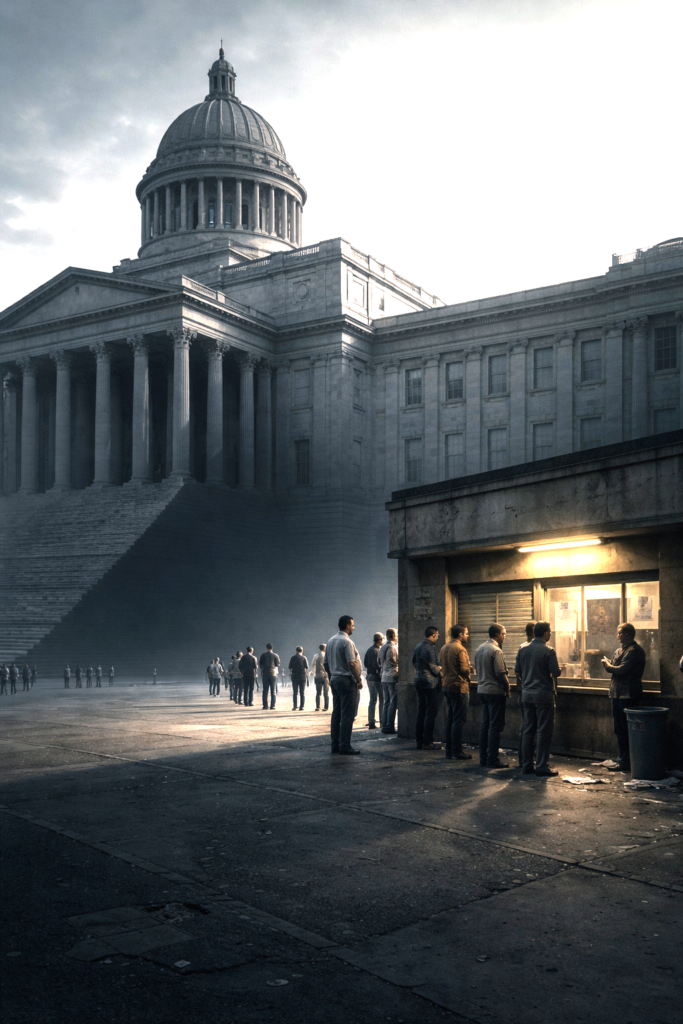
In this scenario of economic and social irreversibility, Parliament and the Executive no longer act as powers. They survive as archaeological remnants of a distorted democracy that may never have truly existed, merely concealed by leaders of greater ethical and intellectual stature.
Buildings remain. Offices, chauffeurs, salaries, and official travel continue. But governance and citizen protection vanish.
The tragedy lies in the intact façade.
Parliament continues to meet. Presidents and ministers continue to travel. Yet they perform in an empty theater while real economic life collapses and citizens are abandoned.
Individuals grow increasingly dependent on a state that concentrates residual resources through its power of taxation.
This dependency becomes nearly impossible to dismantle because it threatens entrenched interests and carries a political cost no one is willing to pay.
What ultimately seals the system’s irreversibility is the creation of a symbiotic relationship between the state and a captive citizenry.
This is structural clientelism.
The state becomes not merely an inefficient administrator but an agent of social domestication.
The sovereign citizen is transformed into a consumer of state favors.
When a majority depends on subsidies, unnecessary public employment, or state contracts, voting ceases to be an evaluation of governance and becomes an act of survival.
Citizens recognize the system’s incompetence but fear that any attempt at reform will harm them first.
Political leaders discover that buying loyalty with other people’s money is cheaper than governing effectively.
Reforming the state carries immediate political costs: protests, electoral losses, social agitation, and pressure from entrenched inefficiency.
As a result, political actors choose low-intensity populism. They preserve a degraded status quo while the country slowly decays.
Responsibility erodes.
Citizens lose the capacity to generate independent solutions, conditioned to demand everything from the state.
Public money is no longer perceived as citizens’ own resources extracted through taxation.
Government incompetence becomes accepted as environmental background noise, tolerable as long as transfers continue.
Parliament avoids confronting abuse because productive taxpayers are a minority funding the political survival pact.
Executive spending sustains power. Parliament legitimizes it. Citizens comply to preserve assistance.
Technical competence becomes irrelevant compared to loyalty and redistribution.
Any attempt at reform is rejected by a social body anesthetized by dependency, fearing the cure more than the disease.
Eventually, economic reality intervenes.
Without credit and with an exhausted tax base, the state loses its ability to distribute. Dependency collapses through scarcity.
What politics refused to reform gradually, crisis dismantles violently.
Inflation or default destroys the very benefits once protected, but chaotically and at far greater social cost.
Masks fall.
Institutions exposed as empty shells.
The price of postponement becomes unavoidable.
Each year of validated decay increases the final social bill.
Uruguay’s 2002 crisis briefly imposed fiscal discipline and technical seriousness. But institutional vices regenerate when power structures remain unreformed.
Only at the edge of collapse does political courage appear, driven by survival rather than conviction.
Order does not emerge from political will but from economic reality colliding with fragile institutions.
In 2026, the sense is déjà vu. The same film, weaker actors, and a more deteriorated stage.
Pessimism is simply the recognition that institutions rarely reform themselves when their beneficiaries control them.