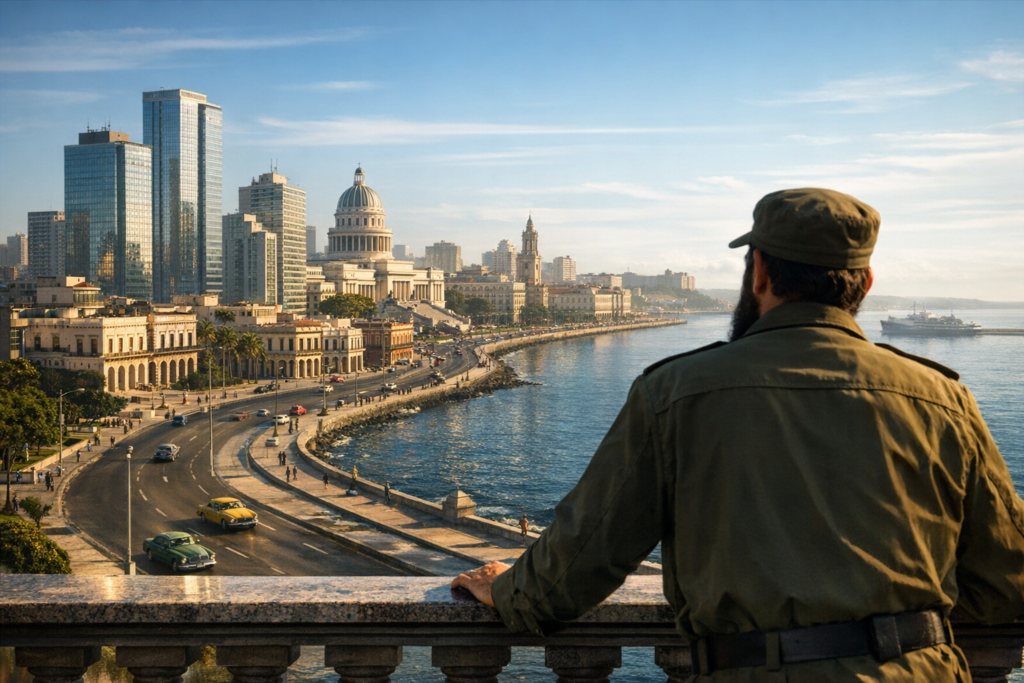
The Washington Speech (1959). The Day Cuba Chose Development Over Ideology.
In April 1959, the world held its breath.
A young Fidel Castro landed in Washington, D.C.
In our historical timeline, that trip marked the beginning of an irreversible rupture.
But in this uchronian reality, Castro took a step no one expected. Instead of defiance, he presented a “Plan for Institutional Reconstruction.”
Speaking to the press at the National Press Club, Castro did not invoke Marx, but Jefferson and Martí.
He declared a “total war against graft and bribery,” promising that Cuba would not become anyone’s satellite, but rather the most transparent partner in the Americas.
By purging the government of corrupt figures and radical communists in the early months, this uchronian Castro secured massive lines of credit from the World Bank.
The 1960 Administrative Transparency Act dismantled the casino mafias, transforming them into legitimate hotel corporations.
Havana did not close itself off. It professionalized.
The result was the emergence of a professional middle class of doctors and engineers who, in our remastered reality, fled to Miami.
Here, they became the engine of a nation that by 1965 already surpassed the per capita GDP of several southern U.S. states.
The Pearl of the Caribbean and the Economic Miracle.
Infrastructure, Industry, and a Tropical Silicon Valley.
Without the embargo that never was, and with legal certainty restored, the 1960s became for Cuba what the 1990s were for the Asian Tigers.
The island transformed into a global logistics hub.
The Port of Mariel, rather than a departure point for refugees, became the most important deep-water port in the Americas, linking the Panama Canal to the U.S. East Coast.
The Green Revolution meant Cuba moved beyond sugar. With U.S. technology, it diversified its agriculture, becoming the Caribbean’s hydroponic pantry.
Education and Technology flourished. Maintaining ties with institutions such as MIT and Harvard, the University of Havana founded the first Antillean Technology Hub in 1972, attracting early computing companies seeking bilingual, highly skilled labor.
A Havana of modern skyscrapers that respected colonial heritage. A city where the subway opened in 1978 and living standards became a benchmark for all of Latin America.
The Architect of the Mirage. Fidel Castro and the Aesthetics of Power.
Two decades after Fidel Castro’s peaceful withdrawal from public life, contemporary historiography faces a question that still unsettles academic circles in Havana and Washington.
Was Castro the savior of Cuba, or the most brilliant executor of a systemic deception?
While in the timeline some theorists call the Soviet branch Castro became an international pariah, in this uchronia he emerged as the most influential statesman of the twentieth century.
Yet behind the façade of prosperity and the glass towers along the Malecón lies the narrative of an ambition that mastered the art of disguising control as order.
The Great Turn of 1959. Cleansing or Purge.
Official history claims that upon entering Havana, Castro did not seek confrontation but purification.
Under the banner of a Cuba free of corruption, he initiated trials that, unlike the summary executions of other revolutionary processes, featured international observers and impeccable procedural staging.
Castro understood early that to retain absolute power, he did not need to destroy institutions, but to inhabit them.
He cleansed the state apparatus of Batista-era figures, replacing them with a technocracy loyal to his person.
His alignment with the United States was not an act of submission, but a masterful political chess move.
By aligning with Washington, Castro eliminated the possibility of invasion and instead received the largest capital inflow in Caribbean history.
The deception lay in convincing the world that his charismatic authoritarianism was in fact a “guided democracy” necessary for development.
Madness Beneath the Velvet Glove.
The concept of vesania, a furious madness or obsession, did not manifest in Castro through bunker paranoia or rationing shortages.
In this utopian version, his vesania was perfection itself.
Fidel sought a Cuba that would serve as a global showcase, and for that reason any dissent was treated not as political opinion but as a social pathology or betrayal of prosperity.
In the 1970s, while much of Latin America bled under obsolete dictatorships born of incomplete decolonization, Castro’s Cuba exported a model of stability that was, at its core, a gilded cage.
Prisons were not filled with peasants, but with selfish speculators afflicted by moral emptiness amid rising GDP.
The Cuban intelligence system, indirectly financed by booming trade with Florida, became the most sophisticated in the world, capable of detecting even minimal deviations from the work ethic.
It was not the military boot of a banana republic, but the precise scalpel of a surgeon operating on the nation’s soul to remove any will other than that of building a free and prosperous country.
Deceit as State Policy.
Castro’s greatest achievement was convincing the United States that he was the indispensable interlocutor.
During the Cold War, Cuba became the key mediator between North and South.
Fidel played the leader of the Third World in UN forums, while privately dining with U.S. presidents at his Cayo Piedra retreat, negotiating investment quotas and biotechnology treaties to outpace North America itself.
This double game was the ultimate expression of deceit.
By 1980, Cuba was a medical and technological powerhouse, but also a society where truth and freedom existed in full rhetorical display.
Media control was not imposed through crude censorship, but through a monopoly on the narrative of success.
Who could complain when the continent’s best healthcare system and full employment were guaranteed.
That mantra silenced any question about the fundamental freedom to change government.
Castro discovered that freedom of expression is a price most people are willing to pay in exchange for comprehensive security and sufficient consumption.
The Twilight of an Earthly God.
When Fidel Castro withdrew in the early twenty-first century, he left behind a nation envied across the Hispanic world.
Yet recently declassified documents suggest his greatest fear was always that the veil of deception would be torn.
His private manuscripts reveal a constant struggle against what he called the mediocrity of real democracy, showing that his alignment with American capitalism was always a means, never an end.
Fidel was not a failed communist. He was a modern monarch who understood that in the twentieth century power is not sustained by obsolete ideologies, but by efficient capital management and the productive labor of the masses.
His legacy is a wealthy Cuba, inhabited by a generation only now beginning to ask who they truly are once stripped of the shadow of the giant who protected and transformed them with equal intensity.
Ultimately, the story of this alternative Cuba is a study of how the genius of a single individual, when combined with a will to serve and manage with brilliance, can alter the fate of an entire hemisphere, creating a paradise that for many still carries the bitter taste of a forbidden truth. Cuba, and the continent, could have drowned in blood.