
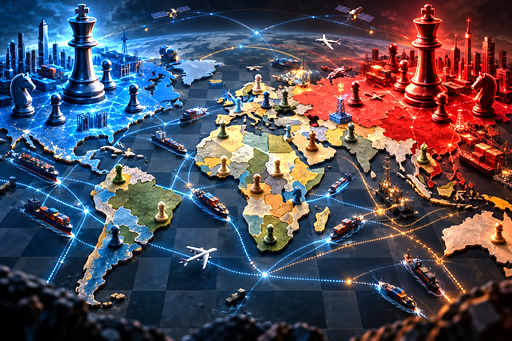
THE BOARD OF THE NEXT BIPOLARITY
The geopolitical transition and the strategic challenge for the West
By Dr. Nelson Jorge Mosco Castellano
The illusion of a unipolar, pacified world governed by the universal canons of liberal democracy — that fleeting “end of history” proclaimed after the fall of the Soviet bloc — is officially over.
The international system is rapidly moving toward a scenario of intense global competition.
Understanding this new geopolitical reality requires abandoning the dogmas of naïve diplomacy and recognizing that the world is moving toward a new axis of confrontation: the next bipolarity.
From unipolarity to the new bipolarity: the United States versus China
The architecture of global power has undergone a radical transformation.
The West’s undisputed predominance over the past decades has given way to the emergence of revisionist powers and, above all, to China’s hegemonic rise.
This new bipolarity is not limited to a tariff dispute or a temporary trade friction; it represents a systemic clash between two models of political, economic and technological organization.
While the United States and its traditional allies seek to uphold the foundations of the Western rules-based international order — or something close to it — the challenging pole operates through a logic of state capitalism, long-term planning and relentless projection of influence across all five continents.
The danger of automatic alignment and regional pragmatism
One of the most critical contributions of strategic analysis — especially relevant for peripheral regions such as Latin America — is its warning against the danger of automatic polarization.
Emerging countries often fall into the temptation of subordinating their foreign policy to a dogmatic ideological alignment, whether with Washington or Beijing.
This approach is a strategic mistake with serious consequences.
In such a contested bipolar world, a country’s international positioning should be guided by rigorous economic and diplomatic pragmatism, maximizing trade opportunities without becoming trapped or losing autonomy vis-à-vis the intelligence and security networks of the superpowers.
All of this, of course, within the limits of each country’s geopolitical and governmental capabilities.
The battle of narratives and soft power
In this new global confrontation, the material struggle is complemented by an intense “battle of narratives.”
The powers are competing not only for control of supply chains, critical minerals or dominance in artificial intelligence, but also for cultural and discursive hegemony — soft power.
While the West wrestles with identity crises, self-inflicted guilt and bureaucratic paralysis, global autocracies deploy coherent and attractive narratives for the Global South, presenting themselves as efficient alternatives to the traditional democratic model and offering financing without institutional or human-rights conditions.
And why not? A few bribes as well.
Asymmetry in the rules of the game: centralized efficiency versus democratic paralysis
The West’s most fragile flank in this new bipolarity lies within its own internal structure.
As seen in urban crises and European institutional debates, liberal democracies suffer from systemic paralysis: they are constrained by political alternation, the immediate demands of societies with low tolerance for frustration, and complex normative and political scruples.
On the opposite side, the competitors in the new bipolar order operate without pressure from public opinion, without internal opposition and with a centralized capacity for execution that allows them to plan strategies twenty or thirty years ahead.
This asymmetry places Western democracies at a clear defensive disadvantage if they fail to recover institutional firmness, social cohesion and strategic realism.
The consolidation of the next bipolarity allows no room for improvisation or naïve readings of international politics.
The world of the coming years will reward nations capable of reading the pulse of real power and severely punish those that retreat into complacency.
The survival and relevance of the West on this new board will depend critically on its ability to overcome internal paralysis, defend its essential values firmly and compete sharply in a global system that no longer tolerates weakness.
State corruption also matters, complicating clear alignments at a time when confrontation is unforgiving toward radically misaligned actors.
U.S.-China bipolarity
Regional geopolitical pragmatism
Global democratic asymmetry
Continue reading in Global Order and Geopolitics
Apoyá la continuidad de Perspectiva Liberal
Perspectiva Liberal es un espacio editorial independiente que no cobra por las notas.
Si valorás este trabajo y querés colaborar con su continuidad, podés hacerlo mediante un aporte voluntario a nuestra cuenta Prex 13440.
o por Mercado Pagolink.mercadopago.com.uy/perspectivaliberal