
The Uruguayan case and declassified intelligence files exposing Cold War operational networks
Spies with Names and Surnames: “RIFLE”
If a civilian operating as a paid spy for international communism seems reprehensible, what would it mean if he were a military officer? The Uruguayan case as a study of ideological and operational infiltration by the Soviet bloc in Latin America.
The Spanish physician and writer Pío Baroja once stated that history is a branch of literature.
In truth, there are two ways of writing it.
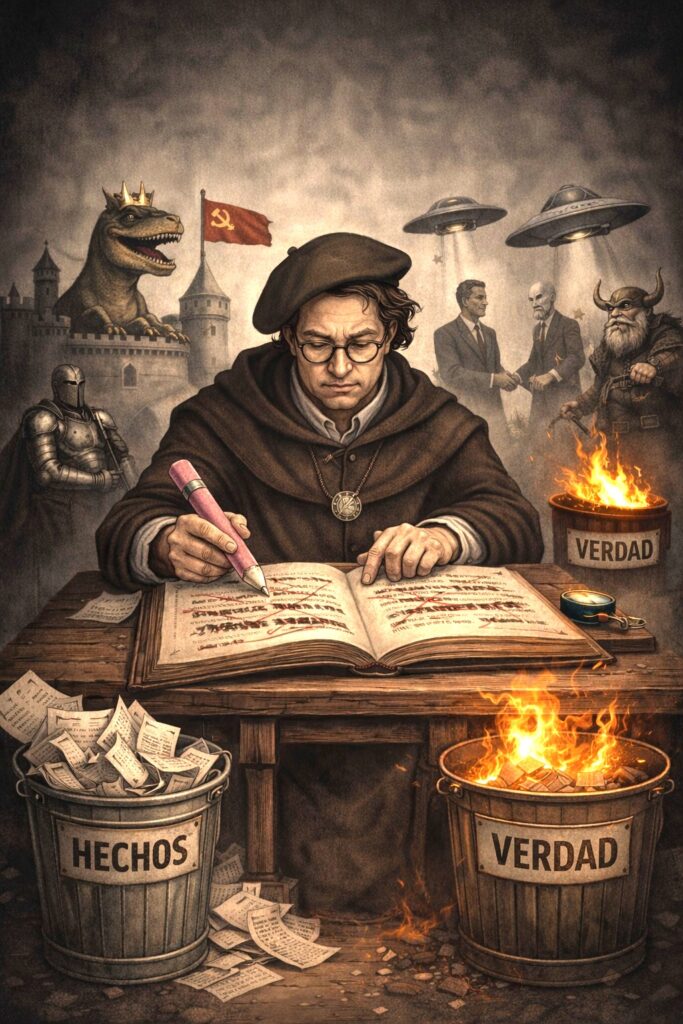
What follows is an example of how false history is written, and how long it can be sustained.
“In 1973, with the coup d’état […] My father, a career military officer […] was left in a difficult situation, not only personally but also politically, since his decision to respect the Constitution was public and his refusal to participate in a military intervention was unequivocal, which, as is known, led to the death of thousands of people.”
“Later he would be arrested, disappeared for two months, then kept in prison, later tried, demoted, and once that dark period in my homeland had ended, and after a long struggle for recognition, he was reinstated in retirement status post mortem and granted the rank of general,” writes playwright Álvaro García de Zúñiga in his autobiography published online.
The author makes a double error.
To claim that the 1973 coup led to the “death of thousands of people” is, to put it mildly, a colossal absurdity.
Not even the official chroniclers of the dominant narrative dared to conceive such a fabrication.
The other error is that his father was not arrested for “respecting the Constitution,” as we shall see.
It is understandable that a son would wish to vindicate his father’s memory.
But even in this era of post-truth in which narrative defeats data, sometimes truth emerges.
This is one of those cases.
The Uruguayan writer residing in Portugal died in 2014.
Four years later, researchers Petrilák and Kraenski — Vladimír Petrilák and Mauro Kraensky, The StB, the Arm of the KGB in Uruguay, Montevideo, Planeta, 2018 — revealed a world that had until then remained hermetically sealed.
In 2018, archives of the Czechoslovak secret service were made public, and among them was a file dedicated to a Uruguayan agent bearing the suggestive codename “Rifle,” assigned number 43849.
The agent was recruited by the head of the rezidentura at the Czechoslovak embassy in Uruguay, StB officer Vlastimil Veselý, who operated under the codename “Vlasák.”
Rifle provided information to the Czech intelligence services, and consequently to the KGB, from 1963 until 1972.
During that period, Uruguay’s Executive Power was exercised by the National Council of Government.
In 1967, the people approved, through free and democratic elections, a new Constitution.
How could it be argued that being on the payroll of a foreign country to reveal information about the Uruguayan army constituted a struggle against dictatorship?
Was that, perhaps, “the fulfillment of his oath of loyalty to democratic institutions,” as stated in the Resolution granting his reparation?
The Oath to the Flag, which every natural or legal citizen must swear, reads:
“Do you swear to honor your Homeland through the constant practice of a dignified life, devoted to the exercise of good for yourselves and your fellow citizens; to defend, with the sacrifice of your life if necessary, the Constitution and the Laws of the Republic, the honor and integrity of the Nation and its democratic institutions, all of which this Flag symbolizes?”
Clearly, that was not the case.
Especially when he was acting precisely in the opposite direction: supporting a communist dictatorship that would last seventy-four years at the cost of millions of deaths.
For his services, Rifle received — the Czechs kept meticulous records — 2,640 dollars, 195,920 pesos, 18,100 cigarettes (American, it should be noted), and 78 bottles of alcoholic beverages.
We leave the spy’s name to the reader’s discernment.
We will only say that in 2006, the left-wing government, by Resolution dated July 26, 2006, promoted him post mortem to the rank of general with retroactive effect to February 1, 1988.
Historical narrative written with honesty is built upon the information available at the time.
If new data emerges, honesty demands that it be corrected accordingly.
Apoyá la continuidad de Perspectiva Liberal
Perspectiva Liberal es un espacio editorial independiente. Si valorás este trabajo y querés colaborar con su continuidad, podés hacerlo mediante un aporte voluntario a nuestra cuenta Prex.
Cuenta Prex: 13440