
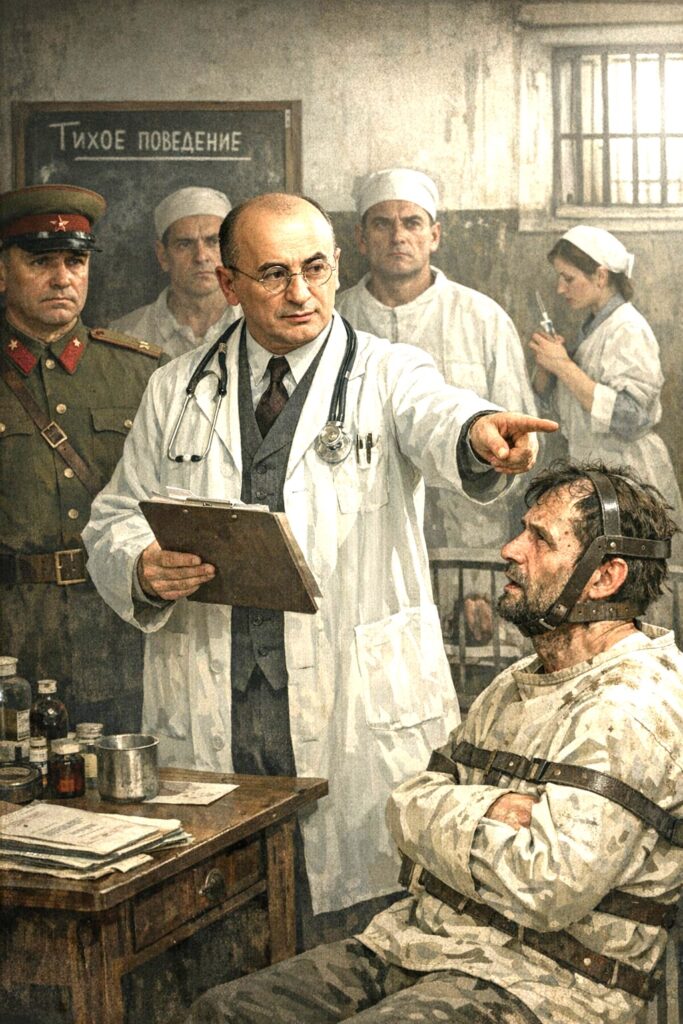
From delegitimizing dissent to cultural engineering: mental health within 20th-century ideological conflict.
– The clinical reframing of political dissent.
– Cultural infiltration as geopolitical strategy.
– The continuity of psychological engineering mechanisms in contemporary Western societies.
Psychopolitics and the Political Abuse of Psychiatry in the 20th Century
Therapeutic practice or weapon of mass destruction?
An attempt at domination through mental control.
A surpassed stage?
WHERE ARE THE COMMUNISTS?
WHERE ARE THEY?
In 1971, the notable Argentine writer Adolfo Bioy Casares (1914–1999), under the pseudonym Javier Miranda, published his Diccionario del argentino exquisito.
It is a text written with a clearly satirical tone, aimed at criticizing the “cult of rich vocabulary” that leads writers to use obscure or incomprehensible words for the reader.
It also includes expressions which, he says, enjoy “an incomprehensible popularity in the country.”
In the prologue to the 1978 edition he states:
“The world attributes its misfortunes to conspiracies and machinations of great villains. I believe it underestimates stupidity.”
Nevertheless, under the letter B he includes the following definition:
“Witch hunt: Any action against communists.”
Later Bioy records:
“Bogeyman. Used in the phrase: ‘The bogeyman of communism.’”
Were these perhaps some of those expressions that have “an incomprehensible popularity”?
What is the origin of this idea?
Because the concept of “witch hunt” is pejorative.
And “bogeyman” refers to someone who lies or exaggerates.
Or, in another sense, someone who disguises himself to frighten others.
It starts from the premise that witches do not exist and that those who pursue them are fanatical madmen.
Applied to “any action against communists,” it suggests that those who undertake such actions are fanatics.
Or mere agitators chasing imaginary threats.
Therefore, their actions should not be taken seriously.
And those who promote them should perhaps be subjected to psychiatric therapy.
This line of reasoning led me to a small book that in 1955 Charles Stickley first, and later Kenneth Goff, made public in the United States.
It was presented as a compendium of lectures allegedly delivered “to American students at Lenin University” by the powerful Lavrenti Beria on Psychopolitics.
The cycle was directed at “highly specialized personnel” in the field of mental health.
It started from the premise that, in order to achieve the objectives of communism, it was necessary “to produce the greatest possible chaos in the enemy’s culture.”
To accomplish this, students were to enter the field of Psychopolitics.
That is:
“The art and science of obtaining and maintaining dominion over the thoughts and loyalties of individuals, officials, and the masses, and of conquering enemy nations through ‘mental healing.’”
Also known as “brainwashing,” though more individual in scope, psychopolitics sought to act upon entire populations.
The idea of the “new Soviet man” implied a reconstruction of human beings from a communist perspective.
But in order to build, one first had to destroy the values upon which human life was founded.
In short, to reset the minds of millions of people.
For this, Beria recommends:
“It is of the utmost importance that psychopolitical agents infiltrate the medical profession.”
If discovered, he says, the best defense of the agent would be to “attack the sanity of the accuser.”
Thus, by employing scientific authority, the agent would defend the effectiveness of treatments documented with plausible records.
In that way it would be “proven” that healing therapy was used, not malicious mental conditioning procedures.
At the same time, the Soviet Minister of Internal Affairs boasts of having introduced into the United States “the principles of Marx and the data of dialectical materialism into psychology textbooks” in order to turn students into “serious candidates for militant communism.”
He adds that in that country “all chairs of psychology are occupied by persons sympathetic to our ideas.”
Along similar lines, Canadian psychiatrist and military officer Brock Chisholm (1896–1971), Director-General of the World Health Organization (1948–1953), stated:
“To achieve world government it is necessary to remove from the minds of men individualism, loyalty to family traditions, national patriotism, and religious dogmas.”
Concepts that sound aligned with Beria’s discourse.
It is doubtful that Chisholm would fall into the category of “useful idiot,” described by Beria as someone functional to psychopolitical objectives even without knowing it.
The useful idiot, who would also require therapeutic assistance, through “hypnosis by pain and drugs,” to become unconditional.
Beria places particular emphasis on religion as a preferred target, until “religion becomes synonymous with insanity.”
Was Bioy so mistaken when he denounced the use of the concept of witch hunt as an attempt to neutralize any action against communists?
Was it merely a bogeyman to frighten people?
The fall of communism did not mean its end.
The effects predicted by Beria are visible in contemporary Western society.
Some will argue that this is another era.
And it is true.
But does that mean the end of psychopolitics?
Or is communism simply one form of materialism?
This analysis is part of the Global Order and Geopolitics cluster, dedicated to the strategic study of transformations in the international system.
Apoyá la continuidad de Perspectiva Liberal
Perspectiva Liberal es un espacio editorial independiente. Si valorás este trabajo y querés colaborar con su continuidad, podés hacerlo mediante un aporte voluntario a nuestra cuenta Prex.
Cuenta Prex: 13440