
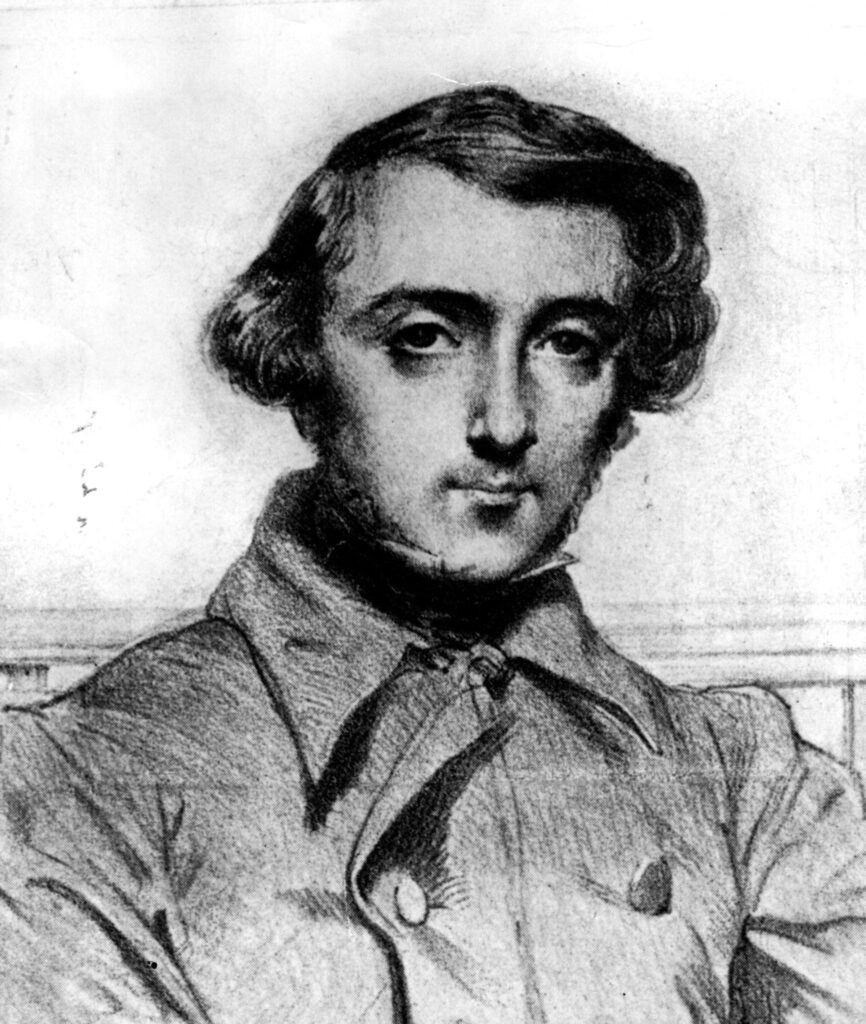
From soft despotism to modern corporatism: how democracy can erode freedom from within.
– The Rise of Soft Despotism and the Tutelary State
– Democratic Individualism and the Emergence of Corporatism
– Equality Versus Liberty: The Structural Roots of Corruption
The Democratic Collapse: Tocqueville’s Structural Warning
From soft despotism to modern corporatism: how democracy can erode freedom from within.
If Umberto Eco warned us about “Ur-Fascism” and the recurring patterns of modern authoritarianism, Alexis de Tocqueville performed something even more unsettling nearly two centuries earlier: a structural autopsy of democracy itself, before it had fully matured in Europe.
Tocqueville’s Prophecy: The Breakdown from Within
When Alexis de Tocqueville returned from the United States in the 1830s, he did not merely describe a political system. He issued a warning. Democracy, he argued, carries within its own logic the seeds of degradation.
The threat does not necessarily come from an external enemy. It emerges from internal tendencies left unmanaged.
To understand today’s inefficient governance, suffocating corporatism and systemic corruption, we must revisit the mirror Tocqueville held up to democratic society.
Soft Despotism and the Crisis of Governance
Tocqueville did not fear tyrants with chains and whips. He feared something far subtler: soft despotism.
He envisioned a tutelary state that ensures citizens’ comfort and security while gradually rendering them passive.
The symptom is a citizenry willing to exchange real political participation for public tranquility guaranteed by administration.
The structural flaw appears when power is increasingly centralized to avoid friction and inconvenience. Governance becomes heavy, technocratic and disconnected from local realities. Democracy ceases to be an active exercise of freedom and becomes instead the management of social docility.
Individualism and the Rise of Corporatism
Tocqueville observed that democratic equality fosters individualism: a reflective withdrawal into private life.
Individualism, he wrote, disposes each citizen to isolate himself from the mass of his fellows and abandon society to itself.
When citizens retreat into private concerns, a vacuum of civic power emerges.
That vacuum does not remain empty. It is filled by organized interest groups, extractive elites and corporatist structures that negotiate with the state behind the façade of the common good.
Modern lobbying systems and corporatism are not anomalies. They are structural consequences of civic disengagement.
Equality versus Liberty: The Soil of Corruption
For Tocqueville, the passion for equality burns hotter than the love of liberty.
Citizens are often willing to sacrifice political freedom in exchange for material parity.
When equality becomes the primary metric of legitimacy, and economic systems fail to generate merit-based prosperity, clientelism and patronage networks arise.
Corruption ceases to be an accident. It becomes a lubricant that allows a structurally inefficient system to survive.
The Gradual Withering
Democratic collapse rarely takes the form of violent rupture. It manifests as institutional withering.
Democracy degenerates when administration becomes immense and paternal.
When intermediary bodies weaken and individuals stand alone before the state.
When material comfort becomes the sole measure of success, and the demanding discipline of liberty is forgotten.
Much of today’s technocratic governance resembles the immense tutelary power Tocqueville feared. The system may not be broken. It may simply be operating according to structural flaws we failed to correct.
The Carnival of Decay
Umberto Eco described medieval carnival as a moment when hierarchies were inverted and norms suspended.
Our era risks becoming a permanent carnival.
Governments perform theatrically. Criminal structures consolidate power. Public discourse devolves into spectacle, outrage and symbolic warfare.
The true madness is not that institutions weaken. It is that societies normalize aesthetic and moral degradation.
For Eco, resistance required intellectual pessimism and moral resolve: pessimism of the intelligence, optimism of the will.
The question is whether democratic societies are still capable of that effort.
Apoyá la continuidad de Perspectiva Liberal
Perspectiva Liberal es un espacio editorial independiente. Si valorás este trabajo y querés colaborar con su continuidad, podés hacerlo mediante un aporte voluntario a nuestra cuenta Prex.
Cuenta Prex: 13440