
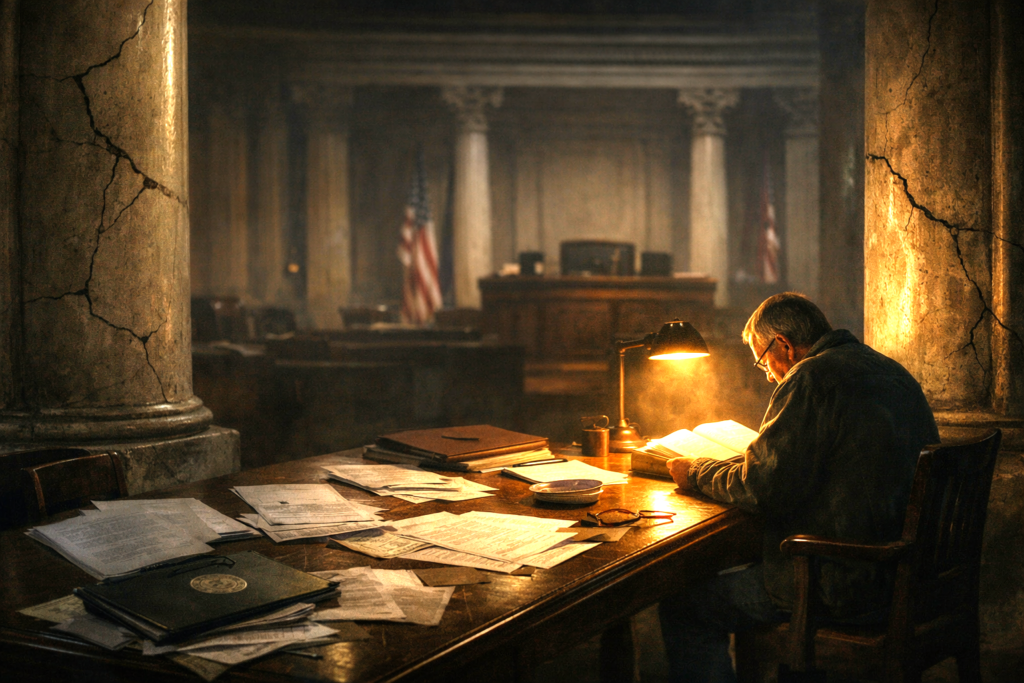
When institutional capture and political spectacle erode democracy, memory and culture become deliberate acts of resistance.
The symptoms of systemic corporate capture are visible everywhere.
According to recent official data, the United States has already collected at least US$130 billion after President Trump invoked the International Emergency Economic Powers Act to increase tariffs as a mechanism to protect national corporate interests.
The Supreme Court intervened against the president’s unilateral decisions to impose extraordinary tariffs as a geopolitical instrument in competition with external corporate powers.
Over the past year, a majority of justices had shown willingness to allow the administration to advance its broader agenda — particularly in immigration and federal restructuring — while legal challenges continued through the judicial system.
This ruling, however, closed the door to one of the most expansive uses of presidential authority.
Chief Justice John Roberts warned that allowing the tariff policy to proceed without clear legislative backing would replace the historical collaboration between the executive and legislative branches in trade policy with unchecked presidential policymaking.
According to the Court’s reasoning, the president must demonstrate clear congressional authorization to justify such an extraordinary assertion of power. That standard was not met.
Trump described the ruling as “deeply disappointing,” publicly criticizing the majority and praising dissenting justices while accusing others of lacking courage and betraying national interests.
He subsequently signed a new executive order raising the global tariff to 15 percent under Section 122 authority, which allows temporary supplemental tariffs for 150 days before congressional intervention becomes mandatory.
Meanwhile in Brazil, investigative reporting revealed the collapse of Banco Master, led by businessman Daniel Vorcaro, whose rise from evangelical-linked family businesses to elite financial circles reflected the permeability between political influence and financial power.
He was accused of orchestrating what has been described as the largest financial fraud in Brazilian history, allegedly including insolvent securities as regulatory capital.
His strategy reportedly involved transferring the failing institution to a state-controlled bank through political connections, effectively relocating financial risk.
The case escalated to Brazil’s Supreme Federal Court. Justice José Antonio Dias Toffoli initially oversaw aspects of the broader legal environment surrounding related investigations, including decisions that impacted prior corruption cases involving former president Lula.
Subsequent revelations indicated financial proximity between the magistrate and the banker, prompting his removal from the case.
Additional controversy emerged when it was disclosed that the spouse of another Supreme Court justice, Alexandre de Moraes, had signed a substantial contract with the banker shortly before the collapse.
Brazil now faces the political reverberations of this institutional crisis at the outset of an electoral cycle.
Institutional Crisis and the Concentration of Power
These episodes illustrate a structural pattern rather than isolated scandals.
State corruption is not merely illegal enrichment. It is the gradual erosion of institutional balance, where executive authority expands, judicial legitimacy weakens, and financial power intertwines with political influence.
When this occurs repeatedly, abnormality becomes normalized.
Memory and Culture as Strategic Antidotes
Umberto Eco argued that contemporary power survives by erasing memory.
If societies forget yesterday’s promises and scandals, today’s corruption appears ordinary.
Resistance therefore begins with remembering.
Archiving the present — mentally or in writing — becomes a civic duty.
A society with memory is far harder to manipulate through choreographed narratives of governmental “impotence.”
Eco also proposed a cultural defense.
Culture is not decorative. It is structural.
Historical literacy reveals that declining empires often display privilege and spectacle precisely before institutional collapse.
The Critical Filter in the Age of Noise
In an environment saturated with information, resistance requires decantation.
The problem is not insufficient information, but excess noise.
Less consumption and more discernment.
Refusing to participate in the media spectacle of influencer-governance is itself a political act.
Returning to demanding texts and complex thought becomes an act of civil disobedience against a system that rewards distraction and superficiality.
Individual Resistance within Collective Decline
Eco did not trust grand revolutionary promises that frequently generate new bureaucracies.
Instead, he emphasized small islands of coherence.
Communities of ethical and intellectual seriousness can function as stabilizing cells within broader democratic fragility.
Irony, when intelligently deployed, strips corrupt power of its theatrical aura.
To expose the absurdity of the powerful is to weaken the illusion of inevitability.
The Strategy of the Survivor
Eco’s strategy can be summarized in four verbs.
Study in order not to become part of the legion of the uninformed.
Remember so that impunity does not become landscape.
Distrust choreographed displays of political helplessness.
Choose quality over quantity in information, relationships, and civic engagement.
Even if the institutional ship appears unstable, intellectual integrity remains the only viable flotation device.
In essence, it is the refusal to become as intellectually negligent as the system one critiques.
Apoyá la continuidad de Perspectiva Liberal
Perspectiva Liberal es un espacio editorial independiente. Si valorás este trabajo y querés colaborar con su continuidad, podés hacerlo mediante un aporte voluntario a nuestra cuenta Prex.
Cuenta Prex: 13440