
A strategic reflection on historical memory, lived experience under totalitarianism, and the dilemma between freedom of expression and democratic self-defense.
A Strategic Reflection on Historical Memory, the Lessons of Communism and the Challenge of Protecting Democracy While Preserving Freedom and Human Rights
“Faithful to the tradition of the French Revolution, communist states anathematized emigration, considering it the most odious of betrayals,” wrote Milan Kundera in his novel Ignorance (2000).
It is easy to believe him when Cuban emigrants were not only dehumanized but pushed down the zoological scale and labeled “worms.”
Kundera experienced communism firsthand.
Like many others, he placed hope in what became known as the Prague Spring.
Like many others, he saw that hope crushed by the Soviet invasion.
He went into exile in Paris and there wrote, among other works, Ignorance.
Although it is a novel, it describes a reality he personally endured.
After the failed Spring, he wrote that the Czechs, “having no idea of the coming end of communism, imagined themselves living in an infinity; it was that emptiness of the future… that left them defenseless.”
He illustrates that feeling with a line from the poet Jan Skácel, who speaks of sadness.
He says he would have liked to build from that sadness “a house, lock himself inside it for three hundred years and, during those three hundred years, open the door to no one — to no one at all.”
The poet captured the spirit of a society far from possessing the strength of that Abraham who hoped against hope.
These are not fanciful speculations.
They are lived experiences.
For those who endured it, communism is not a book, an idea or a philosophical abstraction.
It is an anguishing and oppressive reality.
That is the context in which the law enacted on July 18, 2025 must be understood.
A norm that establishes prison sentences of up to five years for anyone who “creates, supports or promotes Nazi, communist or other movements aimed at suppressing human rights and freedoms or inciting racial, ethnic, national, religious or class hatred.”
It is not a minor detail that on July 23 of that same month, Radio Prague International devoted a segment to former senator Martin Mejstřík.
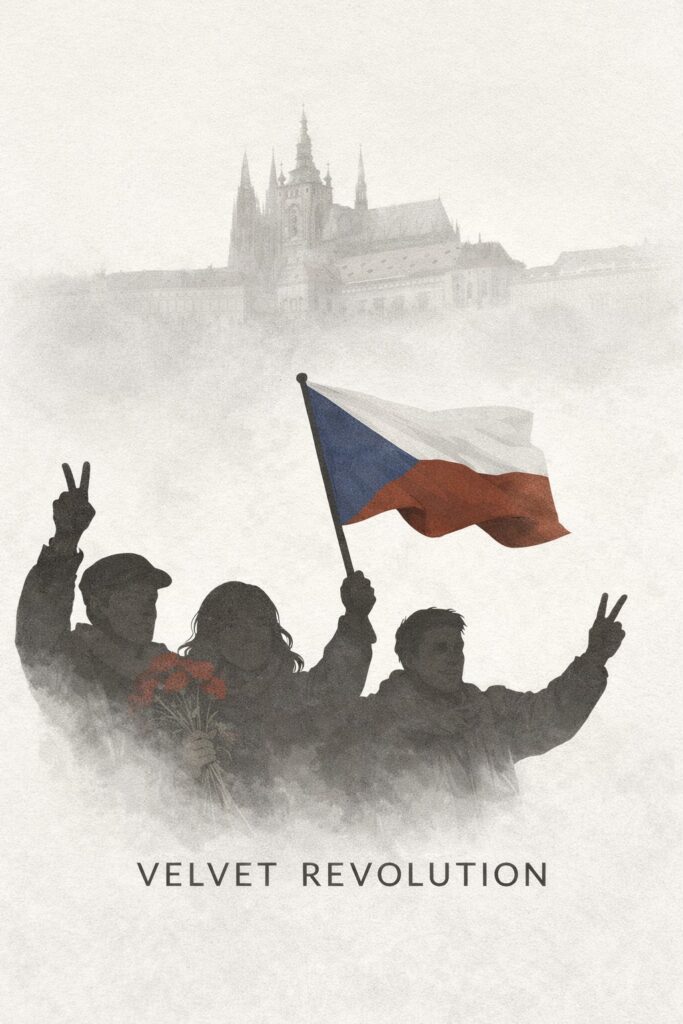
He was a political activist who played a significant role in the gestation of the so-called Velvet Revolution of late 1989.
A revolution without violence, yet one that produced a Copernican shift.
It likely would not have occurred without perestroika and glasnost, since strikes and demonstrations alone rarely overthrow governments.
But a new dawn was already breaking, and the communist government dissolved like salt in water.
The “kingdom of justice” that the dictatorship of the proletariat — which was in fact the dictatorship of the Communist Party, embodied in its general secretary — claimed to build on Earth had come to an end.
Yet among Mejstřík’s statements reported by Radio Prague there is one that may seem surprising, if not for the abundant historical precedents and the insight it offers into the true nature of the system:
“Most Czech billionaires are former communists or collaborators of the secret police.”
After all, salt dissolved in water forms a solution, not a mixture.
Admitting that communism is intrinsically perverse, as described in certain strands of Catholic social thought.
Admitting that countries that ban or restrict it do so from the depth of their own wounds.
Admitting, with Concepción Arenal, that pain is a great teacher.
Even so, one must ask whether a liberal democracy that proscribes a political idea remains fully democratic.
Or does it not proscribe the idea itself, but only its public expression?
“It seems the same,” someone might object.
But that distinction deserves a separate and deeper analysis.
Apoyá la continuidad de Perspectiva Liberal
Perspectiva Liberal es un espacio editorial independiente. Si valorás este trabajo y querés colaborar con su continuidad, podés hacerlo mediante un aporte voluntario a nuestra cuenta Prex.
Cuenta Prex: 13440