
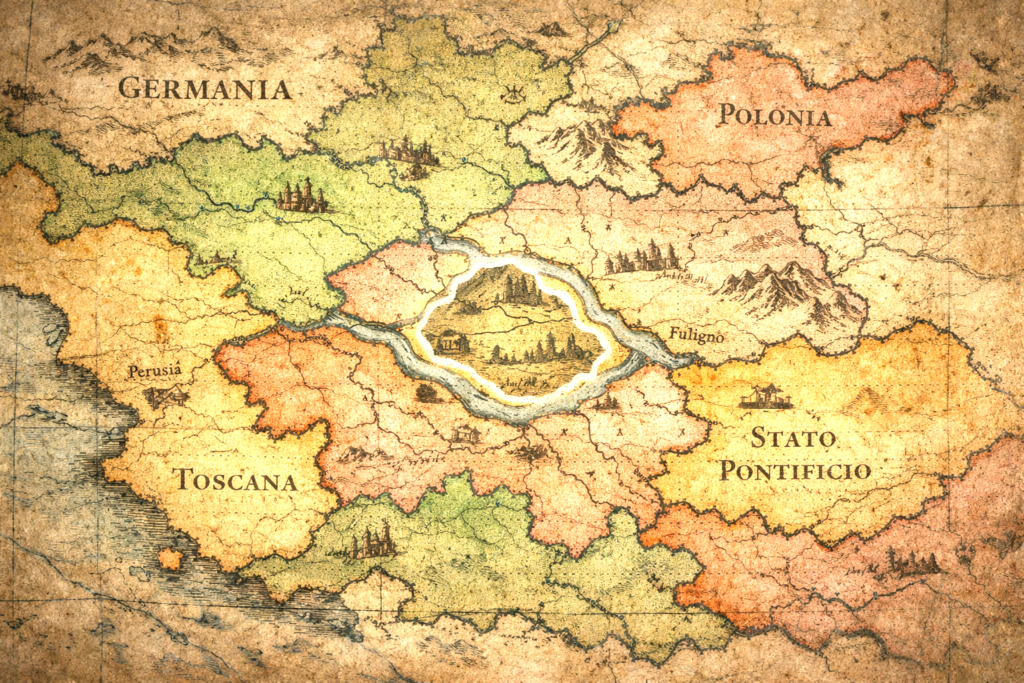
Cospaia, Moresnet and Liberland as examples of spontaneous order versus fiscal monopolies.
Cospaia is one of the most fascinating “accidents” in history.
It was a small strip of land in Italy that became an independent republic for nearly 400 years (1441–1826) simply due to a cartographic mistake.
The fortunate error occurred when Pope Eugene IV ceded part of a territory to the Republic of Florence.
Surveyors failed to include a narrow strip of land located between two parallel rivers (the Rio and the Riascolo).
The Pope believed the border was one river.
Florence believed it was the other.
The result was a 3.3 square kilometer “no man’s land” belonging to neither side.
The inhabitants of Cospaia quickly realized they did not appear in anyone’s tax records.
Instead of asking for correction, they declared independence.
Their motto was simple: Perpetua et firma libertas (Perpetual and firm liberty).
They had no written laws, no army, no prisons and no taxes.
Decisions were made by a council of elders, mainly to resolve local disputes.
When the Papal States banned tobacco in the 16th century, Cospaia became Italy’s production center.
Being technically independent, the prohibition did not apply to them.
Authentic free trade emerged.
It became a vital commercial enclave for merchants seeking to avoid the heavy tariffs imposed by neighboring powers.
By the 19th century, this “smugglers’ paradise” had become too problematic for its neighbors.
In 1826, the Pope and the Grand Duke of Tuscany signed a treaty to divide the territory.
As a consolation, each citizen received a depreciated silver coin and was allowed to retain tobacco cultivation licenses, which explains why the region remains a strong tobacco producer.
Cospaia is often viewed as a historical “holy grail” of anarchic liberalism because it demonstrates that order can emerge without a centralized state or formal government.
There were no state-appointed judges.
Disputes were resolved through customary law based on tradition and personal commitment.
Without police or military to maintain, there was no need to collect taxes, eliminating the primary source of friction between citizens and power.
Cospaia illustrates how deregulation can generate immediate prosperity.
While the Papacy threatened excommunication for tobacco use, Cospaia became the peninsula’s free port.
As the only place where production was legal and untaxed, it attracted capital and agricultural innovation.
Capital tends to move away from oppression and flourish where economic freedom exists.
Cospaia’s end did not come through internal collapse or civil war but through external pressure from state monopolies.
Its annexation in 1826 was essentially a forced absorption to eliminate competition and impose taxation.
Neutral Moresnet was another accidental liberal enclave between Belgium and Prussia.
If Cospaia was the Renaissance accident, Moresnet was the industrial-era counterpart between 1816 and 1920.
It was a 3.5 km² territory created by treaty ambiguity at the Congress of Vienna.
Like Cospaia, it attracted capital through minimal taxation.
Its residents were exempt from military conscription.
Multiple currencies circulated freely.
Disputes were largely resolved through private arbitration.
In the late 19th century, some enthusiasts proposed making it the world’s first Esperanto-speaking state, calling it Amikejo.
The 21st Century Version: Liberland
The closest modern case is Liberland.
It is a 7 km² strip along the Danube between Serbia and Croatia.
Its motto is “Live and let live.”
Taxes are voluntary.
Cryptocurrency plays a central economic role.
Its constitution limits state power.
It includes mechanisms such as voluntary taxation tied to governance participation, prohibition of public debt and absolute protection of private property.
Today Liberland functions as a digital and diplomatic entity with thousands of e-residents operating under private arbitration systems.
Its economy is blockchain-based.
Although physical settlement faces obstacles, its institutional model continues to evolve.
This integration shows that when a state leaves space unclaimed, social order and economic cooperation often emerge rather than chaos.
In many places today, special economic zones attempt to recreate similar dynamics.
The case of ZEDE in Honduras will be explored next.
Apoyá la continuidad de Perspectiva Liberal
Perspectiva Liberal es un espacio editorial independiente. Si valorás este trabajo y querés colaborar con su continuidad, podés hacerlo mediante un aporte voluntario a nuestra cuenta Prex.
Cuenta Prex: 13440