
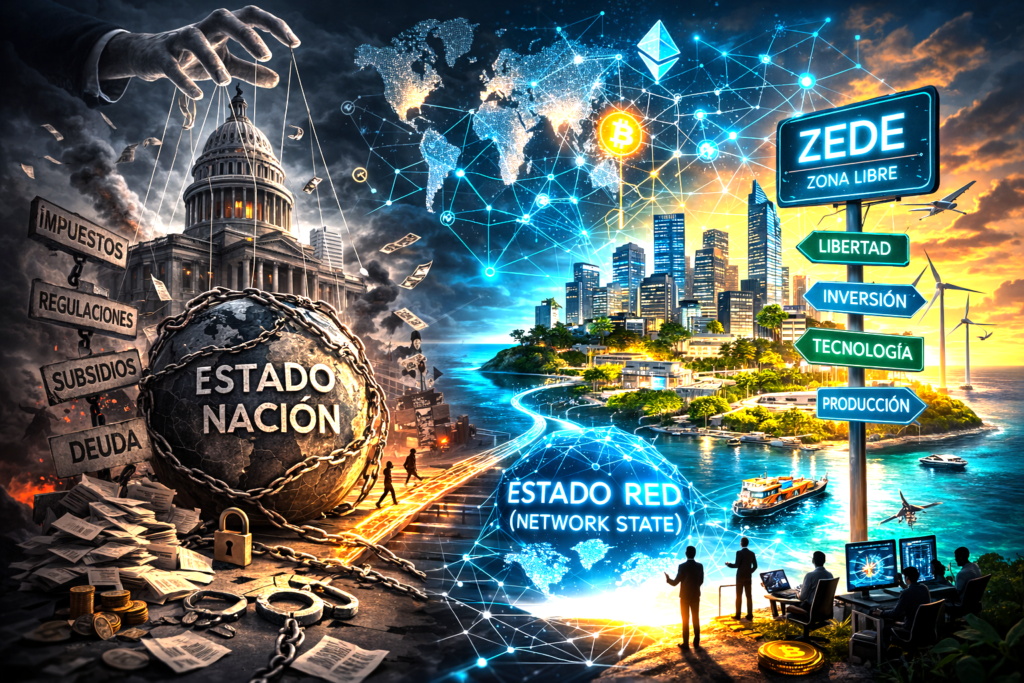
From ZEDE territorial experiments to the digital Network State model, a liberal proposal challenging the state monopoly over land,
Free Spaces from Statist Burdens
These spaces place those who promote and vote for so-called “free trade” agreements in an uncomfortable position.
Within their own countries, they maintain franchised zones free from heavy taxation where investment, technology, production, exports, and intelligent commerce grow. The only condition is the removal of fiscal burdens that sustain subsidies without growth, public spending detached from productive reality, and stagnation in business investment and employment.
Meanwhile, citizens who cannot relocate to those tax-advantaged zones are condemned to a constant erosion of purchasing power or to surviving within the orbit of the political system.
There are varying degrees of freedom within these franchised areas.
ZEDE (Zones for Employment and Economic Development) in Honduras represent the most tangible liberal experiment of the 21st century.
If Cospaia was a geographical accident, ZEDE are “Cospaia by contract.”
They are based on economist Paul Romer’s idea of “Charter Cities.” Imagine a portion of national territory where the central state relinquishes most of its sovereign authority.
These zones have their own police and courts. They do not depend on the national judiciary, often criticized for inefficiency or corruption linked to political power.
They adopt their own commercial laws and may implement foreign legal systems, such as English Common Law, to attract foreign investment.
They enjoy fiscal autonomy, determining their own taxes, which are usually minimal, often through a flat tax system.
Próspera, on the island of Roatán, is the most well-known case.
For a liberal, it is a dream realized; for a statist, a nightmare.
Disputes are resolved through private arbitration rather than public courts. Próspera officially recognized Bitcoin to attract the fintech industry.
Instead of prohibiting activities by default, the model relies on insurance. If you want to start a business, you demonstrate adequate liability coverage and proceed without navigating a labyrinth of state permits.
The Structural Clash: Liberalism vs. Statism
The liberal argument is straightforward: wealth is being created in previously poor territories by importing first-world institutions into a developing country.
Since 2022, however, the Honduran government has sought to eliminate the ZEDE, arguing that they constitute “states within the state” and violate national sovereignty.
As of 2026, Próspera is engaged in a major international legal battle against Honduras, demanding billions of dollars in compensation for alleged breach of contract under investment protection treaties.
The central question remains: is the State merely one system of political organization serving individuals, or do individuals ultimately serve the State?
The Future: The Network State
Popularized by investor Balaji Srinivasan, the Network State suggests that the future lies not in accidental territories like Cospaia but in digitally formed communities that later acquire land.
Step one involves creating an online community bound by shared liberal values.
Step two establishes an internal digital economy, often based on cryptocurrencies.
Step three consists of negotiating with economically fragile governments to acquire territory and declare a ZEDE-like entity or micro-state.
The Statist Version: Tax Expenditures
In Uruguay, so-called “tax expenditures” represent foregone revenue intended to promote investment and development.
However, despite their steady increase in recent years, these measures have not consistently achieved their stated objectives.
In a context where public spending expands almost mechanically from previous budgets without measurable outcomes, fiscal pressure increasingly targets franchised enterprises.
Final Reflection
Cospaia survived because it was small and inconspicuous.
ZEDE and initiatives like Liberland face a different challenge: visibility.
The Leviathan rarely tolerates fiscal and legal self-regulation flourishing near its borders or within its territory without resistance.
Systems collapse when taxpayers can no longer sustain what Octavio Paz described as the “philanthropic ogre,” an authoritarian, bureaucratic, and centralizing state that distributes benefits to preserve control and limit genuine democracy.
The Network State represents the technological evolution of Cospaia.
If Cospaia emerged from a cartographic error, the Network State arises from code.
Unlike traditional countries that begin with land and then seek people, the Network State reverses the process.
An online community forms first.
A digital economy follows, structured through blockchain-based contracts.
Once sufficiently large and capitalized, the community acquires physical nodes across the globe.
With enough economic weight and population, it may negotiate recognition with smaller states, much like the Vatican or the Sovereign Order of Malta.
In the traditional model, dissatisfaction requires physical emigration.
In a Network State, the nation functions as an archipelago of nodes, allowing mobility under a shared legal and fiscal framework.
Rules are encoded as smart contracts.
If the tax rate is set at 2 percent, the system cannot arbitrarily impose 3 percent.
Corruption becomes structurally constrained, as code replaces discretionary bureaucracy.
If one network becomes authoritarian, individuals can exit by transferring their digital assets and joining another community.
Examples include Zuzalu in Montenegro, organized by Ethereum co-founder Vitalik Buterin as a temporary pop-up city, and Cabin, a network of properties for remote workers governed internally.
The fundamental obstacle remains the nation-state.
The Network State may possess cryptographic keys, but the traditional state retains tanks.
States are reluctant to lose their most productive citizens.
The liberal thesis concludes that just as the internet disrupted the monopoly of newspapers over information, the Network State seeks to disrupt the monopoly of governments over geography.
Ultimately, the model that better serves general interests will prevail.
Apoyá la continuidad de Perspectiva Liberal
Perspectiva Liberal es un espacio editorial independiente. Si valorás este trabajo y querés colaborar con su continuidad, podés hacerlo mediante un aporte voluntario a nuestra cuenta Prex.
Cuenta Prex: 13440