
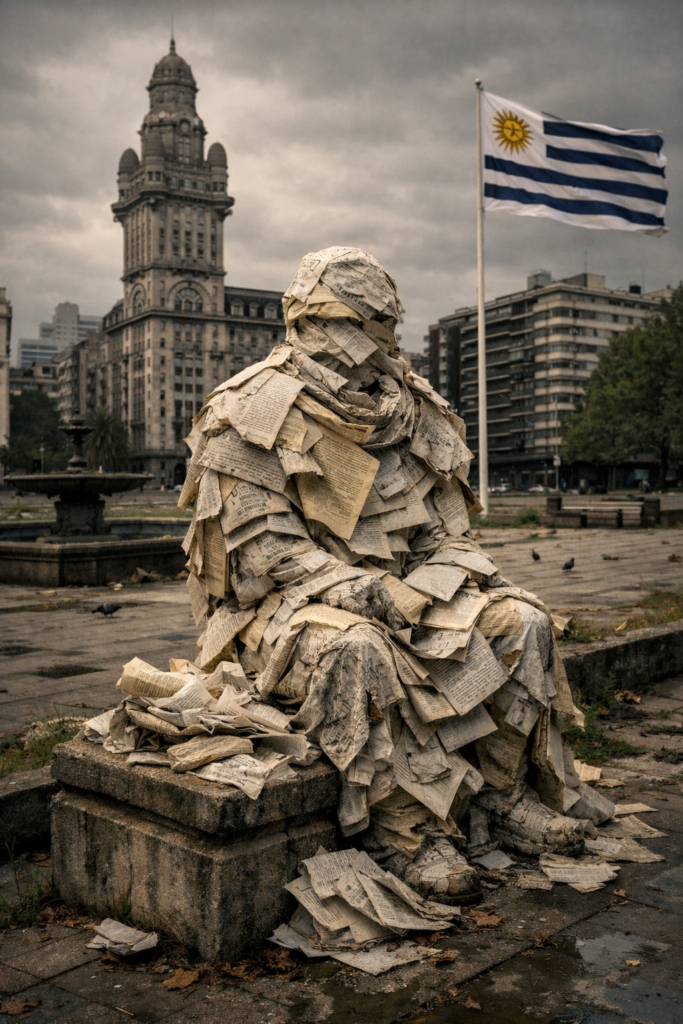
A reflection on the political culture that consolidated Uruguay’s economic and social stagnation.
– Political culture and the construction of stagnation
– The subsidy economy and the reproduction of dependency
– Equality in scarcity and the fear of responsible freedom
Uruguay is a country profoundly dysfunctional when it comes to economic and social growth. It seems almost to cherish its gentle form of underdevelopment as a kind of national identity.
A place where Marx, wherever he might be, would probably celebrate that the left and the opposition together continue advancing toward the miserable egalitarian utopia he once imagined.
And where Gramsci, perhaps in the seventh circle, might lament that the cultural battle has fallen into the hands of the ineffective, the timid, and the converted, who privatized the struggle while statizing capital in what resembles an oligarchic extractive cooperative.
How to advance toward cultural, mental, and economic underdevelopment has become the central task assumed by the members of this political caste. It is divided between those who temporarily pretend to govern and those who pretend to oppose them without actually preventing anything.
To finance the elections of this caste, new sub-castes gradually join the system. They all aspire to some subsidy, a grant, a tax exemption, a non-repayable loan, or some share of the national treasury.
Everyone hopes to save themselves individually while fully aware that they are losing ground along with everyone else.
Abandoning moral restraint and living off impunity openly displayed has become a ritual repeated every five years, while voters angrily punish each other for having elected the very politicians who now live off them.
Since the 1920s, Uruguay has cultivated a peculiar social class that constantly reproduces its own inability to engage in productive activity.
Individuals who, once included in an electoral list, manage to transcend their previous condition of poverty and become permanent dependents on the labor of their fellow citizens.
This culture, patiently worked by Marxist and Gramscian thought, produced a stable electorate that absorbed dialectical language but inverted its meaning.
They received Marx’s thesis almost by reverse osmosis. They remain trapped in the antithesis — a contradiction with reality — and militantly defend their own synthesis — the negation of the negation.
Hegel himself would likely reprimand them for never advancing toward the higher reconciliation that dialectics was meant to achieve.
Always dissatisfied for not being wealthy — and unwilling to work to become so — they demand utopian transformations that promise to eliminate poverty while avoiding the discipline required to overcome it.
Thus they construct “acquired rights” upon the backs of those who still work, slowly pushing society toward something resembling the medieval condition of serfs tied to the land.
By demanding that wealth be taken from those who produce and improve, they secure loyal voters who will continue supporting them even when absurd policies are proposed — such as freezing prices and wages — feeding the illusion of economic justice.
Time, that other name for forgetting, has treated the eastern plains with particular cruelty.
Since the 1920s, Uruguay has done little more than refine the art of scarcity and elevate it to the category of national heritage.
Let us therefore analyze this curious achievement of immobility through a kind of archaeological lens.
The Wealth of Scarcity (according to Smith)
Adam Smith, that Scottish thinker who believed the baker feeds us not out of love but out of enlightened self-interest, would probably observe with astonishment that in this land the Invisible Hand is not busy moving goods but emptying the pockets of others with bureaucratic elegance.
Smith might conclude that Uruguay has discovered a reverse market: while others compete for efficiency, here people compete for subsidies.
The “state of nature” is not the jungle but the public office.
If labor measures the value of effort, then the vote has become the legal currency through which hope is purchased — a hope that by definition must never actually be fulfilled.
The Gentle Despotism (according to Tocqueville)
Alexis de Tocqueville, who feared the mediocrity of the majority more than the sword of tyrants, would probably see in this corner of the Río de la Plata the confirmation of his darkest premonition: a gentle despotism.
The Uruguayan citizen does not seek a statesman but a tutor who reassures him that his poverty is not destiny but someone else’s injustice.
People prefer to be equal in scarcity rather than unequal in abundance.
It becomes a form of national courtesy: no one wishes to offend the neighbor by prospering too much.
The Road to Serfdom toward the Rambla (according to Hayek)
Friedrich Hayek, who saw in every centralized plan the outline of a rope slowly tightening around freedom, would likely recognize in this permanent electorate the evidence that spontaneous order has been replaced by planned chaos.
Marxist and Gramscian cultural engineering functions here less as ideology than as grammar.
Citizens are educated to believe that reducing public spending on other people’s resources is sinful and that fiscal order is a form of cruelty.
The voter resembles the character of a story walking down a circular corridor: always about to reach utopia but stopping along the way to ask for a favor.
Imperial rivalries may be fading, leaving fewer excuses for permanent grievance, yet the habit of complaining remains intact.
In the end, Uruguay is not so much a country as it is a vast library of useless laws accompanied by a very modest reality of facts.
The so-called right proposes order — a rather boring concept.
The left proposes the epic narrative of permanent dissatisfaction.
And the Uruguayan voter, that creature living somewhere between mate and nostalgia, repeatedly chooses the warm certainty of collective shipwreck over the cold uncertainty of responsible freedom.
Apoyá la continuidad de Perspectiva Liberal
Perspectiva Liberal es un espacio editorial independiente. Si valorás este trabajo y querés colaborar con su continuidad, podés hacerlo mediante un aporte voluntario a nuestra cuenta Prex.
Cuenta Prex: 13440