
The structural failure of Marxism and the rise of an AI-driven economic paradigm
– Marxism fails due to economic infeasibility and authoritarian drift.
– Successful cases rely on market pragmatism, not ideological purity.
– Artificial intelligence is reshaping work, inequality, and human purpose.
The failure of Marxist orthodoxy
By Dr. Nelson Jorge Mosco Castellano
Historically, countries that attempted to apply pure Marxist theory (abolition of private property and central planning) encountered two insurmountable barriers:
Economic infeasibility is fundamental: without market prices, the system cannot determine what to produce or the value of effort, generating chronic shortages.
The inevitable totalitarian drift: to impose an economic order against individual will, the State requires absolute control, eliminating civil liberties.
Sweden demonstrated that social welfare is not the product of Marxist socialism, but rather a result of successful capitalism.
When public spending suffocated the economy in the 1970s and 1980s, the country did not deepen socialism; it implemented orthodox market reforms (privatizations, cuts, and freedom of choice for citizens).
Only a free and vibrant market economy can sustain a solid welfare state.
China is a pragmatic hybrid. The only country that has achieved massive economic success under communist leadership, but it did so through a living contradiction:
It adopted aggressive capitalism: a low-cost labor force, subsidized public costs, and dumping practices leveraged by connected business elites to boost productive forces while maintaining Leninist political control.
The current risk lies in increasing state control as artificial momentum slows, revealing that markets require autonomy to continue innovating.
The Tragedy of Transition in the USSR
Unlike China, the Soviet Union attempted to reform politics and economics simultaneously without prior market institutions.
The result was total collapse, demonstrating that transforming a centrally planned system into a functional economy requires containing social explosion to prevent state disintegration.
Final Conclusion
There is no country that has achieved sustainable economic prosperity by strictly following Marxism without falling into authoritarianism.
The successes observed today (Sweden, Vietnam, China) are, in reality, stories of pragmatic orthodoxy applied over failed utopian structures, which dragged societies into deep misery.
Traversing this labyrinth of history, economics, and philosophy allows a useful analysis to understand why the world moves today under that sometimes fragile balance between market freedom and state intervention.
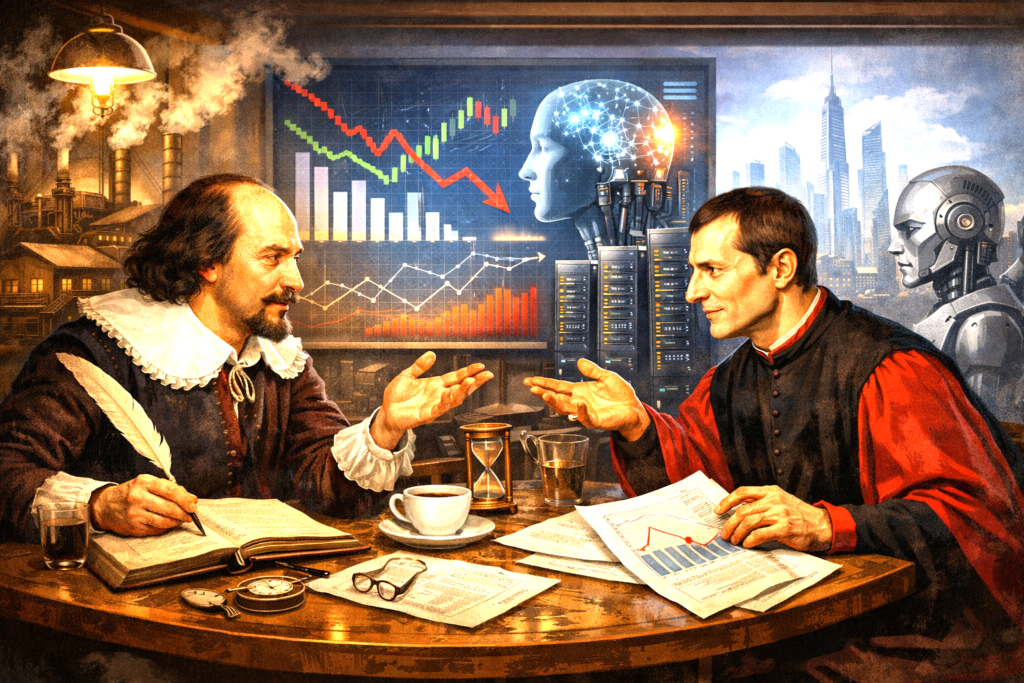
I remain with the image of Shakespeare and Machiavelli discussing the fate of nations in a café while reviewing GDP indices.
Individual freedom to create, save, invest, and engage in open trade significantly reduced global poverty.
Let us awaken curiosity about how artificial intelligence fits into this economic puzzle.
Will it mark the end of work or the beginning of a new era of abundance?
Let us now deepen how new technologies will reshape these economic rules.
We are entering what some sociologists call the “Agentic Era” or the “Post-Labor Era.”
If the 20th century was about labor rights, the 21st century will be about the meaning of being human in a world where work is no longer central to identity.
Let us consider a sketch of society toward 2030:
The decoupling between “Work” and “Income”
Historically, survival required production.
AI is breaking this link as productivity grows exponentially while human labor demand declines.
Universal Basic Income, once a Marxist utopia or libertarian radical idea, is now being tested in places like Manchester or Canada as a technical necessity.
Not out of charity, but because without purchasing power, capitalism collapses.
The end of “entry-level jobs”
Young people are no longer performing repetitive tasks.
This forces a redesign of education: we no longer learn to “do,” but to “direct” AI agents.
The “Cognitive Sovereignty” gap
Society will be divided not only by wealth but by the ability to master technology:
The new operators of this era command armies of AI agents to create value.
A single individual can run a company that previously required fifty employees.
Wars already demonstrate this technological application for power.
Digitally displaced individuals are those unable to adapt to the accelerating pace of knowledge.
The risk is a new “technological feudalism,” where a few AI model owners control reality’s infrastructure.
The crisis (and rebirth) of purpose
Shakespeare would delight in this. If a machine can write poetry, diagnose diseases, and manage cities: what are we for?
A return to the human and the artisanal is projected.
We will see renewed appreciation for what AI cannot replicate: real empathy, physical care, human contact, and craftsmanship.
In an economy of attention within material abundance, the scarcest resource will be human time and attention.
Let us continue analyzing this present that is no longer the future.
Continue exploring this perspective on the contemporary global order at Perspectiva Liberal:
Apoyá la continuidad de Perspectiva Liberal
Perspectiva Liberal es un espacio editorial independiente. Si valorás este trabajo y querés colaborar con su continuidad, podés hacerlo mediante un aporte voluntario a nuestra cuenta Prex.
Cuenta Prex: 13440