
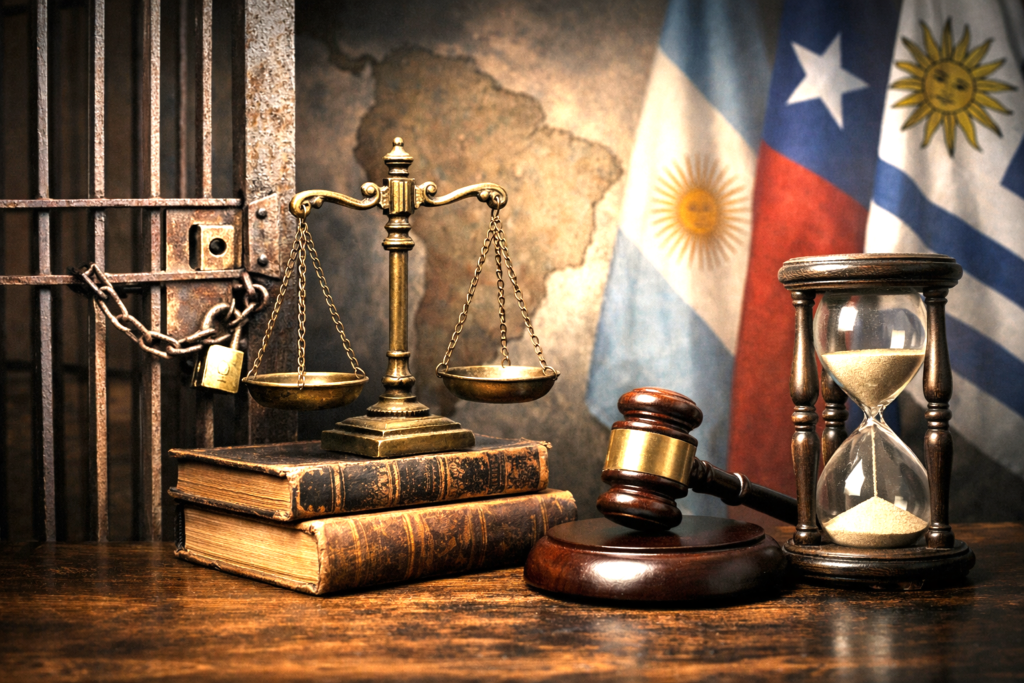
An uncomfortable debate on justice, memory and power in Chile, Argentina and Uruguay
POLITICAL PRISONERS
ARE NOT ONLY IN NORTH KOREA
NOR IN SOME AFRICAN COUNTRY OF QUESTIONABLE LEGALITY
THEY DO EXIST IN THE SOUTHERN CONE
While the world watches with astonishment and concern what is happening in the Middle East and now in Lebanon, with Israel doing as it pleases and involving the United States, and its president Mr. Trump engaging in disputes over this matter with his true allies, the members of NATO, neglecting the more transcendent issues related to Ukraine, Venezuela and Cuba (and this has nothing to do with even minimal support for an archaic and brutal regime such as that of the ayatollahs, let it be clear), in the so-called Southern Cone of America, that is, Chile, Argentina and Uruguay, such prisoners do exist, under a legality heavily disguised as revenge.
Before the first round of elections in Chile, the libertarian candidate Mr. Kaiser had stated that the first thing he would do if elected president would be to go to the far south of the country where the detainees are held in order to release them almost immediately, but victory went to Mr. Kast, quite close in ideas but from whom there is no knowledge of having addressed the issue.
In Argentina, the vice president Mrs. Villarroel was very interested in that same problem, although perhaps her distancing from President Milei has complicated her position.
Nevertheless, there seems to be a rumor across the River Plate suggesting the intention of the current successor of Rivadavia to somehow address the situation of imprisoned military personnel.
And in Uruguay?
A few days ago, it became known that a letter was sent to our government by around thirty members of the European Parliament, reiterating another one sent approximately a month earlier, expressing concern over what they consider a strange situation: the effective imprisonment (house arrest is not so different in terms of restricting freedoms) of dozens of people for events that occurred some fifty years ago, nothing less than half a century (!).
Trying to form a graphic idea, it would be as if in 1954/55 there were proceedings for real or alleged crimes committed in the civil war of 1904. Something unthinkable for a normal human being.
As far as is known, the government has not responded. And frankly, it is doubtful that it will, except for some generic and diluted reference that this is a judicial matter.
Only judicial?
And to whom does the Attorney General’s Office, which is the one that prosecutes, report hierarchically?
To the Executive Branch, which moreover intends to create a Ministry of Justice.
Typical things of South Americans, they might say in Brussels.
Apoyá la continuidad de Perspectiva Liberal
Perspectiva Liberal es un espacio editorial independiente. Si valorás este trabajo y querés colaborar con su continuidad, podés hacerlo mediante un aporte voluntario a nuestra cuenta Prex.
Cuenta Prex: 13440