
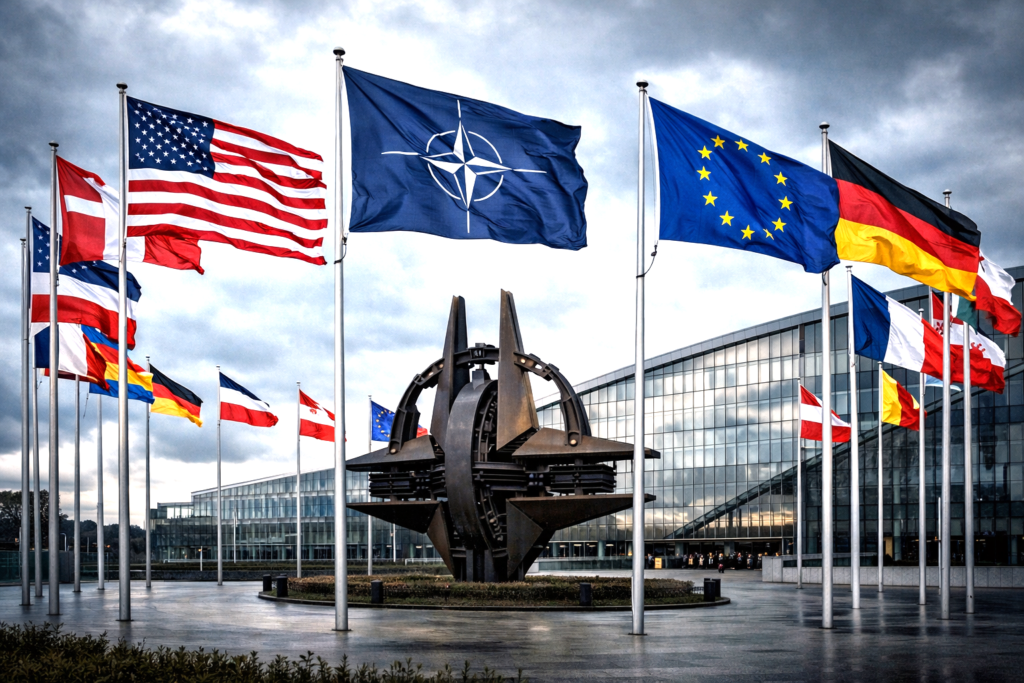
Tensions between Washington and Europe reveal a deeper strategic fracture beyond a temporary disagreement.
TRUMP AND NATO
Anger and mistrust.
Washington and Brussels are not in agreement.
Mr. Trump has become upset with NATO following Europe’s refusal to support the United States in its actions in the Middle East against Iran.
This is not the first disagreement, and it will likely not be the last.
A brief historical review helps to understand the context of these tensions.
NATO was founded in 1949, during the Cold War, after the Soviet blockade of West Berlin and the fall of Czechoslovakia into the Soviet sphere.
The organization, composed of Western European countries along with the United States and Canada, was conceived as a defensive alliance.
Its core principle is Article 5, which states that an attack against one member is an attack against all.
Over time, especially after the collapse of the Soviet Union, more European countries joined.
Following Russia’s invasion of Ukraine in 2022, traditionally neutral countries such as Sweden and Finland also became members.
Ukraine is not part of NATO, but after being attacked, Europe decided to support it with military, logistical and technical assistance.
The United States, under President Joe Biden, did the same.
This support proved essential, as European countries lacked the capacity to sustain such an effort independently.
However, this assistance did not include sending troops, given Ukraine’s non-member status.
With Trump’s arrival, the approach changed.
The U.S. president demanded that European countries, particularly the major ones, increase their contributions to collective defense.
For decades, he argued, Europe had relied on U.S. protection without investing sufficiently in its own security.
On this point, his criticism was valid.
After the collapse of the Soviet Union, Europe significantly reduced its military capabilities.
Germany is a clear example, with a large population but relatively limited and outdated armed forces.
Other countries were in similar situations.
In relative terms, Europe had become weakened in front of Russia.
Trump’s pressure produced results.
Gradually, European countries began to react and reconsider their defense investments.
Paradoxically, Russia’s invasion of Ukraine ended up strengthening NATO.
However, Trump remains unpredictable.
It is often unclear whether his statements reflect a defined strategy or momentary impulses.
The Greenland issue is a revealing example.
It is a territory belonging to Denmark, a NATO member, making any U.S. claim strategically inconsistent.
The current conflict stems from Europe’s refusal to support the United States in its actions against Iran.
In some cases, such as Spain, even the use of airspace for U.S. military operations has been restricted.
From Washington’s perspective, this seems unreasonable.
However, Europe’s position was clearly articulated by German Chancellor Friedrich Merz.
Europe was not consulted before the military action.
Nor was it clearly informed about the strategic objective.
In other words, it was asked to support a decision in which it had no participation.
There is also a key factor.
Israel is not a NATO member.
And the operation in question is offensive, not defensive.
This places it outside the alliance’s original conceptual framework.
In this context, the U.S. complaint loses validity.
NATO was not designed to support unilateral actions, but to ensure collective defense.
What is now visible is not just a temporary disagreement.
It is the emergence of a structural limit.
Europe is beginning to act with greater autonomy.
The United States, meanwhile, still expects automatic alignment.
This divergence defines the present scenario.
And likely the future of the alliance.
Transatlantic relationship under strain
Defense versus offensive strategy
Emerging European autonomy
Continue reading in Global Orden & Geopolitics
Apoyá la continuidad de Perspectiva Liberal
Perspectiva Liberal es un espacio editorial independiente. Si valorás este trabajo y querés colaborar con su continuidad, podés hacerlo mediante un aporte voluntario a nuestra cuenta Prex.
Cuenta Prex: 13440