
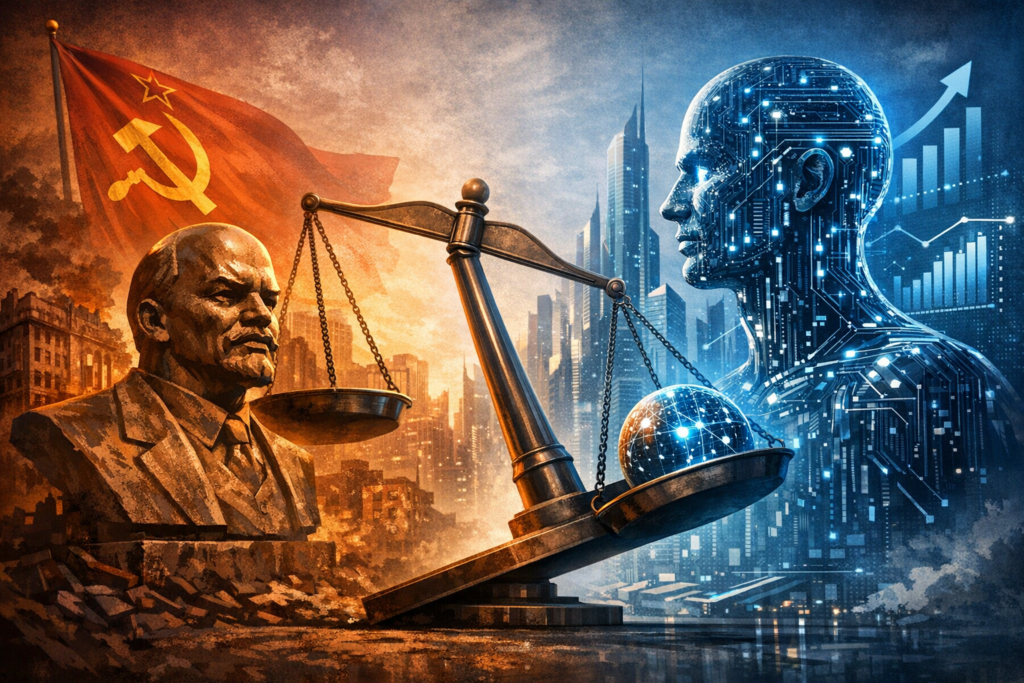
How power accumulation blocks reform and why technology may break the cycle
The Unresolved Dilemma
The ideology that halts critical thinking by accumulating power
By Dr. Nelson Jorge Mosco Castellano
Just seven years ago, on December 14, 2018, with a left-wing party in power, a national representative stated in Parliament:
“I believe that surplus value had no reason to exist, and that human effort should belong to the State. And regarding the means of production, I think they should also belong to the State. Housing should also be owned by the State. Banks and land must also belong to the State.
The industrial and commercial means of production must belong to the State. And within the industrial ones, the graphic and press production means as well.
The problem is that I don’t have enough votes; that’s the problem.
So I have two options: grab a bazooka and a helmet and go to the countryside —which doesn’t exist— or carry out a process of accumulation.”
This argument did not prevent the terrorists of the 1960s from taking that violent path: picking up weapons and developing an urban guerrilla.
During the democratically elected government of Luis Lacalle Pou, those same ideological forces continued accumulating power, blocking reforms or even forcing referendums against laws approved by parliamentary majority.
The accumulation between 2020 and 2025 was not enough. That ideological obstruction persisted even during the COVID-19 pandemic.
The accumulation of reactive forces, which paralyze the transformation of a slow, heavy, inefficient State, ultimately became the stepping stone to return to power and attempt a Cuba-like model.
Here, however, the logic is different: it feeds on society itself. Unable to do so fully, it becomes a permanent blocking machine that prevents real solutions to poverty, the very poverty it cultivates and expands.
That vulnerable population becomes a political argument: to demonstrate that governments that do not align with their program “fail the poorest.”
When the violent path proved ineffective, the strategy shifted —against its own will— to the Gramscian model: the conquest of culture.
That mandate takes many forms: explicit or subliminal, direct or indirect. But the objective remains constant: the accumulation of power.
No space is left unused. Political action becomes permanent. Those who promote it act as secular apostles of an ideological religion whose purpose is to destroy the individual, productive capacity, freedom of thought, and the society that shelters them.
While human intelligence has been able to circle the Moon and return with knowledge for all humanity, these dogmas persist, preventing societies from benefiting from that potential.
The aspiration remains unchanged: to nationalize everything, to control everything, to build enclaves of soviet-style systems in the 21st century.
But to generate a true shift of era, a bureaucratic document is not enough.
What is needed is a piece of precision rhetoric: clear, irrefutable, capable of exposing and shaming structural inefficiency.
Let us imagine, then, that a Child Integrity Agent issues its first public report.
STATE INTEGRITY REPORT: Childhood Sector (April 2026)
Issuer: Autonomous Agent AIN-01 (Non-Human Audit)
Data Status: Full Interoperability (MIDES – INAU – ASSE – MEF)
Friction diagnosis
Assigned budget: $100,000,000
Effective execution: $42,000,000
Loss: 58%
Location of the blockage: 22 days halted in an administrative unit due to a missing digital signature.
Consequence: 450 children received lower-quality nutrition for three weeks.
Data inconsistency
Official narrative: “55% of homeless minors were assisted.”
Reality: 54% had no contact with assistance in the last 60 days.
The system operates with outdated data.
Map of the anomic State
Three zones show substitution of the State by narcotics structures.
Twelve school dropout alerts were not processed.
Automatic resolution
Recorded on public blockchain.
Direct payment orders to suppliers via smart contracts.
The system acts without bureaucratic intermediaries.
The impact of such a report would be immediate.
The politician loses the time needed for manipulation.
The union loses the argument of technological backwardness.
The citizen gains direct evidence.
Truth no longer depends on political will but on system transparency.
That level of administrative exposure would become the turning point for society to demand a profound transformation.
A revolution based not on ideology, but on applied intelligence.
Ideological blockage of the State
Power accumulation and cultural control
Technology as institutional disruption
This analysis is part of the Global Order and Geopolitics cluster
Apoyá la continuidad de Perspectiva Liberal
Perspectiva Liberal es un espacio editorial independiente. Si valorás este trabajo y querés colaborar con su continuidad, podés hacerlo mediante un aporte voluntario a nuestra cuenta Prex.
Cuenta Prex: 13440