
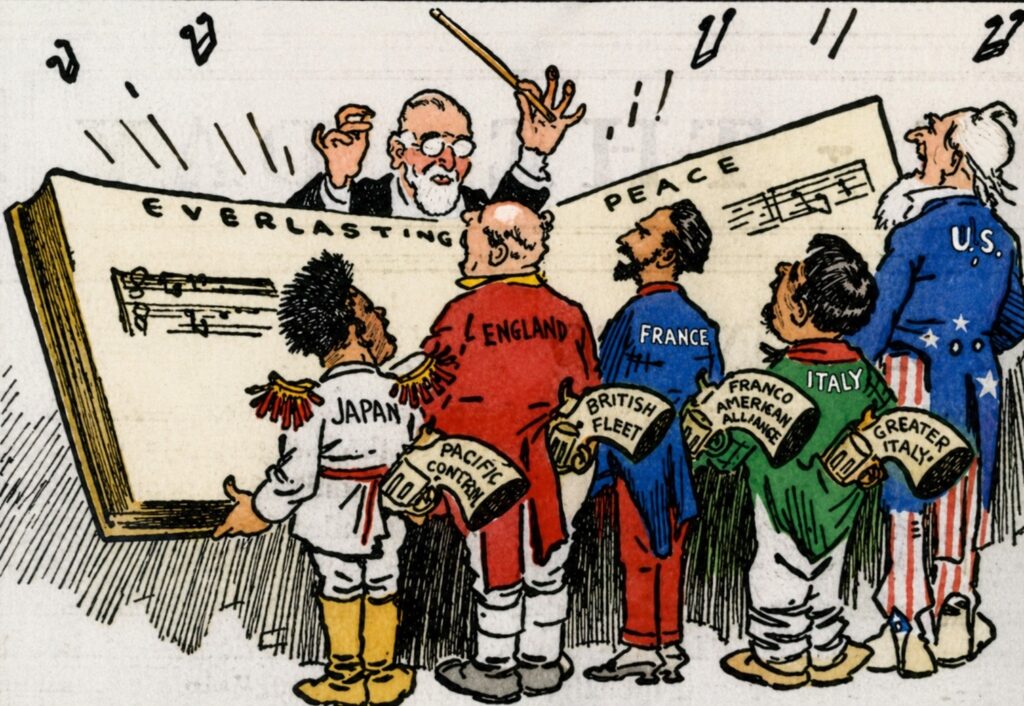
The flawed design of the League of Nations anticipated World War II
After World War I ended with the surrender of the Central Powers, the issue of peace conditions arose.
A key figure, as expected, was U.S. President Woodrow Wilson.
The Swedish historian Ragnar Svanström (who wrote the last two centuries of “Universal History,” originally begun by Carl Grimberg) describes Wilson’s personality and links it to the outcome of his proposal for the League of Nations.
He portrays him as a man full of contrasts.
A Doctor of Philosophy and a graduate of Princeton, he believed he had a providential mission to ensure that justice and democracy prevailed in the world.
At the same time, he was stubborn, unwilling to negotiate or compromise.
In short: “An American little familiar with the map of Europe and its ethnic, national and economic divergences,” says Svanström.
It was his initiative to include the League of Nations in the Treaty of Versailles as a mechanism to ensure world peace.
According to the account, his most important mistake was not inviting Republicans to be part of the negotiating group, thus failing to bind them to his idea.
As a result, the League of Nations became a reality, but the U.S. Senate, now with a Republican majority, did not approve the Treaty of Versailles.
The creator’s country was left outside its own creation.
Among the design flaws identified by Republicans was the composition of the Council, the executive body, which included permanent and temporary members.
Initially, there were only four: the United Kingdom, France, Italy and Japan.
Rotating members served three-year terms.
All members, both permanent and rotating, had the power to block Council decisions.
Uruguay, for example (which did serve on the Council), could, with a negative vote, prevent the approval of a resolution supported by all others.
Regarding Uruguay, it is worth noting that Dr. Alberto Guani, a Uruguayan diplomat first accredited in Switzerland and later in the Austro-Hungarian Empire, the Netherlands and France, later became a delegate to the League, where he presided over both the General Assembly and the Council.
As mentioned, unanimity was required to adopt decisions, which effectively blocked any attempt at enforcement.
Republican Senator George Sutherland, one of the leading voices in the debate over the failed ratification of the Treaty of Versailles, summarized the objection to this veto power:
“If we are going to war, let it be because we decide it in Washington, not because a treaty morally compels us to do so or because a committee in Geneva must give us permission not to go.”
Additionally, the League had no army of its own.
So how could it maintain peace?
It depended on member states providing troops.
They did not.
Then came the withdrawals.
In 1926, Brazil decided to leave the League.
The issue arose when Germany’s admission as a permanent member of the Council was proposed that year.
Brazil claimed a seat, arguing its founding status, large territory and population.
It failed, as France and the United Kingdom opposed expanding South American representation.
Brazil announced its withdrawal, which only took effect in 1928 due to the required two-year notice.
For very different reasons, Hitler’s Germany also left in 1933.
That same year, Japan withdrew before being expelled for its invasion of Manchuria, which had occurred two years earlier.
The system took that long to respond.
Investigations, evidence gathering, travel, negotiations…
When the report was finally produced, Japan had already anticipated the outcome.
This first case demonstrated that when a major power decided to act, there was no way to stop it.
The mechanism created to maintain peace lacked the means to enforce it.
Other leaders understood the message.
They saw that treaties had no power to stop actions.
Thus, Italy invaded Ethiopia between 1935 and 1936, conquering it to the sound of “Faccetta nera.”
A song popular before the military operation, which anticipated:
Faccetta nera, bell’abissina
Aspetta e spera che già l’ora si avvicina
Quando staremo vicino a te
Noi ti daremmo un’altra legge e un altro Re
A song that romanticized young Ethiopian women, whom they would take to Rome to turn into Romans—until racial laws rendered that vision obsolete.
In 1939, the USSR invaded Finland and was expelled.
The departure of several powers further weakened the League.
The weakness shown in the case of Japan proved that the organization had been an illusion.
It was impossible for it to prevent the feared Second World War.
Institutional weakness
Lack of enforcement power
Foundational political error
The illusion of peace without power remains a recurring pattern in international politics.
Apoyá la continuidad de Perspectiva Liberal
Perspectiva Liberal es un espacio editorial independiente. Si valorás este trabajo y querés colaborar con su continuidad, podés hacerlo mediante un aporte voluntario a nuestra cuenta Prex.
Cuenta Prex: 13440