
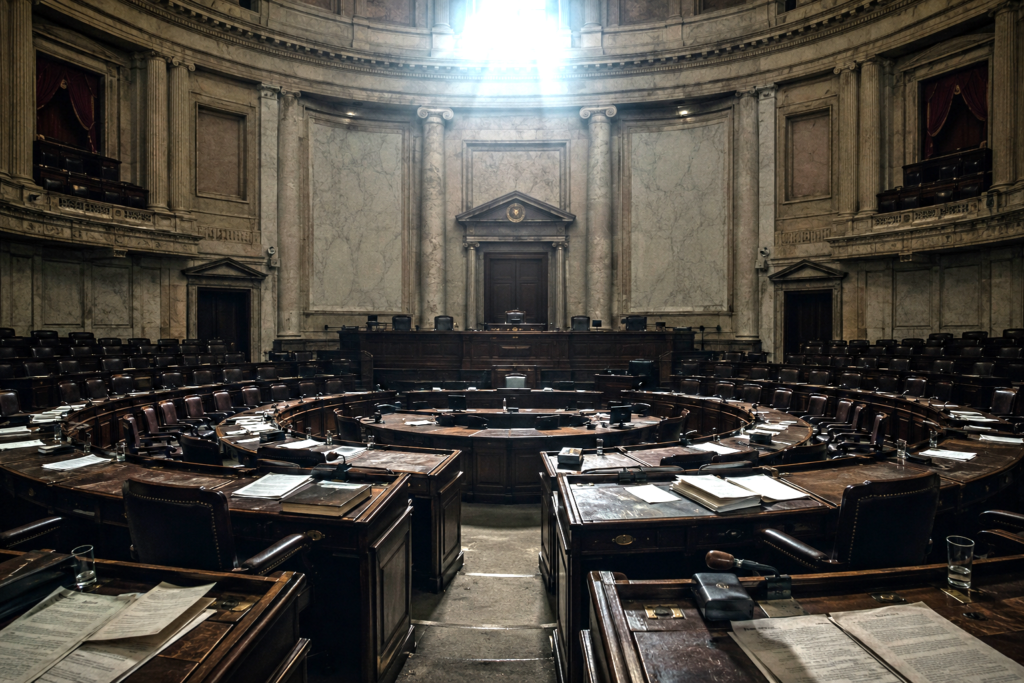
A reflection on the surrender of individual judgment, republican simulation and the hollowing out of the State’s essential functions.
The Triumph of the Collective Imbecile
The Erosion of Institutions and the Renunciation of Judgment
By Dr. Nelson Jorge Mosco Castellano
Olavo de Carvalho was a Brazilian philosopher, journalist and essayist whose influence transformed Brazil’s political and intellectual landscape in the twenty-first century.
Carvalho was one of the main disseminators in Latin America of the theses on cultural Marxism.
Using concepts from Antonio Gramsci, he argued that the left did not seek power only through the economy, but through the occupation of spaces in governance, education, the media and the arts.
His book “O Imbecil Coletivo” is a sharp critique of what he considered the decadence of the intellectual stratum in Brazil.
His work was not limited to politics.
It had a deep metaphysical and educational foundation.
The recovery of consciousness: he held that philosophy should serve to help the individual recover the ability to perceive reality directly, breaking through the “narrative layers” imposed by ideology.
Considered by many to be his masterpiece, “O Jardim das Aflições” is an extensive essay that links the history of philosophy with contemporary politics.
In it, he analyzes how the modern State tends to expand until it attempts to replace the citizen’s spiritual and private life.
The work of Olavo de Carvalho, particularly his analysis of the “occupation of spaces” and the paralysis of individual judgment, offers a rigorous framework for diagnosing the reality of institutions that barely preserve their name, while having entirely emptied their content.
When a society succumbs to what he called the Collective Imbecile, the result is a simulation of democracy in which the vital functions of the State are outsourced or annulled out of fear of social stigma.
A close example of the third type:
The Executive and the Legislature: The Abandoned Function
Within this framework, we find a president who does not preside.
He delegates the function to operators who should be secondary, or to autarchic ministers who only gather as the Executive Branch when they must defend their fatal blunders before public opinion.
Following the logic of “neopseudo-scholasticism”, the ruler ceases to be a manager of reality, from which he desperately flees either to shuffle with the left hand or to be fitted with the right, and becomes instead a manager of narratives.
He does not make decisions based on effectiveness or the common good, but on preserving an ambivalent image that does not break the hegemonic consensus, or place him in the awkward position of having to define himself.
At his side, a Parliament that does not analyze.
Deliberation, the foundation of the republican system, is replaced by administrative procedure.
Technical analysis and the confrontation of ideas disappear under the pressure of “political correctness”.
Legislators, imprisoned by the paralysis of judgment, vote out of fear.
The fear of being branded “insensitive”, “retrograde” or “politically incorrect” acts as a mechanism of internal self-censorship that castrates the legislative function of proposing or controlling.
There is equal fear that the president may “put his foot in it” and that someone will have to soften the impact of his slip, or that he may have to be replaced by an alter ego whose personality and record are terrifying.
The University and the Capture of Critical Thought
The University, which should be the temple of critical spirit and the search for truth, becomes the main engine of bias.
Under the appearance of “critical thinking”, what is encouraged is group obedience, under the violent canopy of facing trained militants.
People are not taught to think, but to identify ideological enemies.
Academia disconnects from real experience in order to live in a world of self-references, where only what reinforces the agenda of cultural hegemony is considered valid.
The Opposition and the Outsourcing of Responsibility
The tragedy is completed by an opposition that aligns itself with the same preconceptions.
By sharing the same cultural ecosystem, the opposition loses its ability to offer a real alternative.
Its vote does not respond to a prospective conviction, but to the panic of being excluded from the “consensus of the good”.
This vacuum of functions generates a bureaucratic anomaly: the creation of parliamentary commissioners for what they themselves should do and do not do: solve what they promised.
It is the definitive admission of failure.
The people end up paying twice: their representatives, who receive the salaries of the rich for obligations postponed for decades, and new officials with the same pharaonic remuneration, created in their own image and likeness, to replace work that will remain in the limbo of yet another subordinate diagnosis that loudly proclaims the responsibility of the chiefs.
While this structure of simulation consolidates itself, material reality offers no respite: we are inevitably heading toward a social and economic iceberg, and what is most alarming is that those who lead us, far from turning to avoid the impact, have decided to accelerate the engines at full power on a collision course.
Paralyzed judgment.
Hollow institutions.
Republican simulation.
You can continue reading in Global Order and Geopolitics.
Apoyá la continuidad de Perspectiva Liberal
Perspectiva Liberal es un espacio editorial independiente. Si valorás este trabajo y querés colaborar con su continuidad, podés hacerlo mediante un aporte voluntario a nuestra cuenta Prex.
Cuenta Prex: 13440