
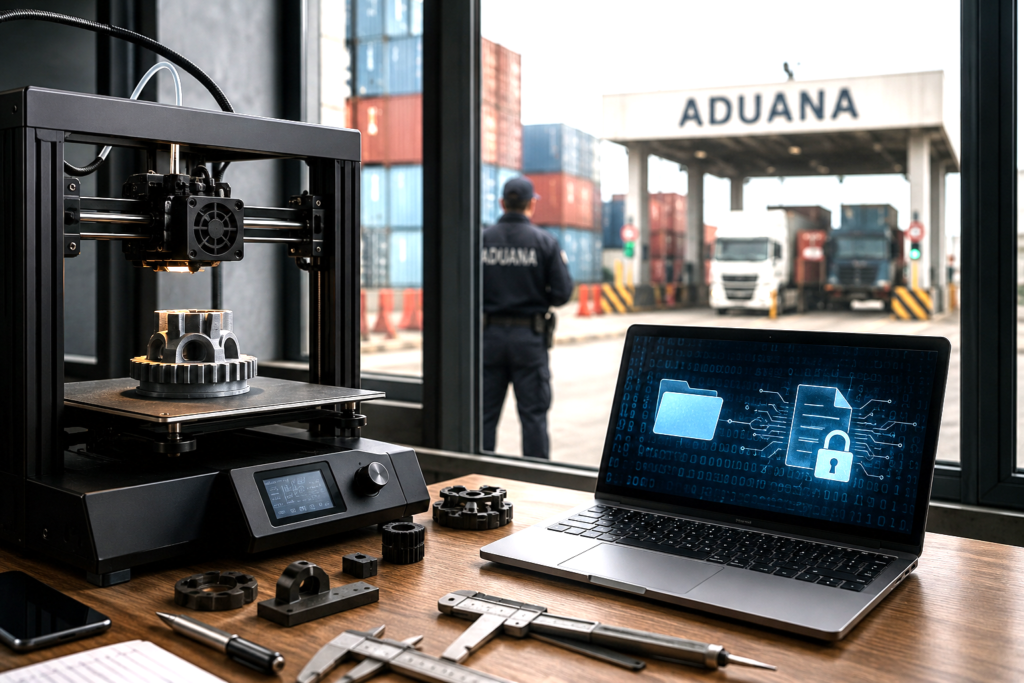
Additive manufacturing moves productive power from the State and large industry to the individual, weakening customs, taxation and regulation.
3D PRINTING AND THE END OF THE FISCAL MONOPOLY
The end of physical customs and the twilight of state mercantilism
By Dr. Nelson Jorge Mosco Castellano
It is an intrinsic characteristic of collectivist regimes —and of those that, without declaring themselves as such, suffocate the citizen with regulations— to be obsessed with controlling borders and the exchange of goods.
Socialism has always needed walls, whether physical or tariff-based, to confine its own inefficiency.
However, we are now facing a revolution that mortally wounds the Leviathan’s capacity for control: additive manufacturing, or 3D printing.
Historically, the State has derived its power from intermediation. By controlling the port, customs and the physical flow of goods, the bureaucrat arrogates to himself the right to decide what enters, what leaves and how much the citizen must pay in taxes for the sin of trading.
But what happens when what travels around the world is not a steel container, but an encrypted digital file?
3D printing shifts the center of gravity of production from the large industrial complex —easily captured by the tax authority and the unions— to the individual’s desk.
This disintermediation is the definitive triumph of the bit over the atom.
Consumer sovereignty in medicine and production
The impact of 3D production of medical solutions is, perhaps, the field where the collision between progress and statism will be most violent.
Medical socialism is based on rationing and standardization. When a patient, in the privacy of his own property, can print a personalized prosthesis or, in the near future, synthesize specific drugs for his condition according to his genetic map, the monopoly of state health funds and the suffocating regulations of health ministries become obsolete.
The argument of “consumer safety” will be the last refuge of the socialist bureaucrat seeking to regulate these technologies.
They will say that it is dangerous for the individual to be autonomous. But the real danger lies in dependence on a state system that punishes innovation with endless waiting lists and lack of funding.
The freedom to produce what one needs for one’s own life is a natural extension of the right of property over one’s own body.
The crisis of the collectivist tax model
Socialism fails because it runs out of other people’s money, as Mrs. Thatcher rightly said.
But in the age of 3D printing and decentralized robotics, other people’s money will become increasingly difficult to confiscate.
The tax model based on taxing physical production and the movement of goods is doomed to fail.
If the individual can produce his own goods and solutions, the concept of “value added” becomes elusive for the tax collector.
Wealth becomes intangible, sheltered in talent, design and creative capacity.
Faced with this, socialism will deepen its voracity over wealth and income, attempting to tax existence itself.
However, the mobility granted by technology —where a designer in Uruguay can sell his plans to a printer in Japan without passing through a single public office— makes human capital the most mobile of all resources.
The State will have to learn, by the force of reality, that it can only survive if it reduces itself to its minimum expression and ceases to be an obstacle to creative genius.
Economic assistance as a transition toward autonomy
In this context of transformation, the aforementioned economic assistance for those who must “reskill” should not be seen as an acquired right to idleness, but as a return of what had previously been confiscated from the citizen.
The welfare system of socialism seeks to perpetuate poverty in order to maintain its clientele; liberalism, by contrast, advocates the elimination of regulations that would allow that citizen, now equipped with a 3D printer and AI, to become an independent micro-entrepreneur.
A population that will live longer cannot be a burden on a bankrupt State; it must be a population of individuals who, freed from physical fatigue by robotics, continue to add value through experience in the liberal arts and critical judgment.
The “change of era” is not a tragedy requiring a protective State, but a golden opportunity for man to finally cast off the chains of state servitude and embrace the freedom to produce his own destiny.
Decentralized production.
Fiscal crisis.
Individual autonomy.
Continue reading in Global Order and Geopolitics
Apoyá la continuidad de Perspectiva Liberal
Perspectiva Liberal es un espacio editorial independiente. Si valorás este trabajo y querés colaborar con su continuidad, podés hacerlo mediante un aporte voluntario a nuestra cuenta Prex.
Cuenta Prex: 13440